
OriginThe forest smells of garlic.
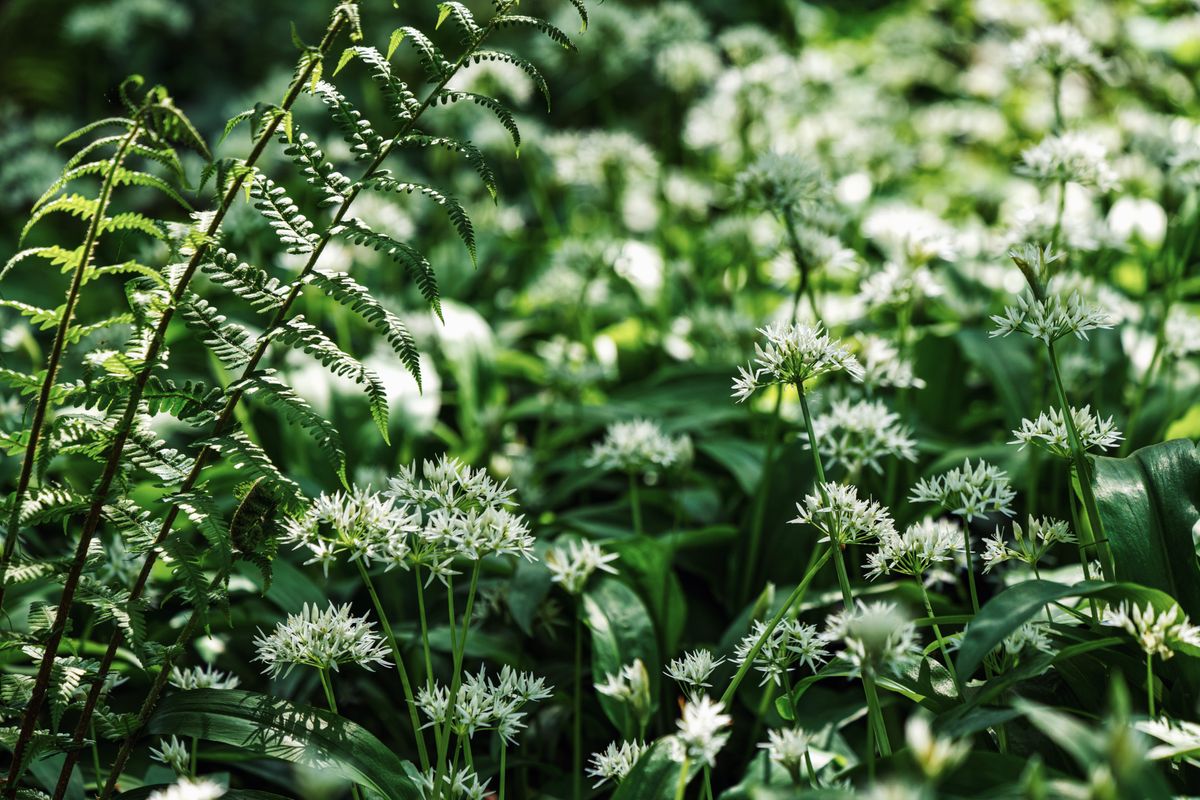
When entire forest floors turn green in March and the air smells of garlic, it's wild garlic season - six to eight weeks, then it's over.
Wild garlic grows in damp, shady deciduous forests on nutrient-rich, calcareous soils – riparian forests, beech forests, stream valleys. It is a Spring geophyteIt sprouts from the bulb before the trees leaf out, utilizes the limited light of just a few weeks, blooms in April and May, and dies back completely by early summer. Anyone searching in July will find nothing – there's no trace of it above ground. In healthy stands, it grows so densely that the forest floor is covered in a blanket of green.
The name comes from the old belief that bears eat wild garlic first thing after hibernation to regain their strength - that's why it's botanically called ramsons. ursinum, "Belonging to the bear." Whether bears actually do this is unclear; nevertheless, it works well as an image for a spring herb after the long winter. In folk medicine, it was considered "blood-purifying" and was part of the classic spring tonic along with nettle and dandelion.
Wild garlic has only become popular in the last three decades. Until the 1990s, it was an almost forgotten wild herb in Germany; today it is the most well-known of all and is even cultivated. This has a downside: popular populations are overexploited, and many people collect it without being able to identify it with certainty. Therefore, the question of potential look-alikes takes precedence over everything else on this page.
To useWhat wild garlic can do for you
Wild garlic is chemically a close relative of garlic and works on the same principle: It stores sulfur-containing compounds, from which, when the cells are damaged, sulfur is released. Allicin and related substances are formed. That's why it smells the way it does, why it tastes the way it does, and why it has similar properties – antimicrobial, mildly anticoagulant, mildly blood pressure-lowering. Commission E has not produced a separate monograph for wild garlic itself; it has never been investigated as systematically for medicinal purposes as garlic. What we know about it is essentially derived from its relationship to other plants – we prefer to state this openly.
Two differences from garlic are practically relevant. First, wild garlic contains significantly more vitamin C and more chlorophyll – nutritionally speaking, it's more of a leafy green than a spice, and a serving of wild garlic pesto contains a good amount of it. Secondly, the famous Garlic breath weakerWild garlic has a slightly different chemical profile, producing fewer volatile compounds that are exhaled through the lungs. Its scent lingers for a shorter time.
The realistic benefit, therefore, is that of a very good wild vegetable: fresh, vitamin-rich, available for free for weeks, and containing the sulfur compounds of a plant family whose overall health benefits for blood vessels and digestion are well-documented. It's not a cure, and those wanting to lower their blood lipids should opt for a standardized garlic supplement. Those who want to eat well should go to the forest.
IngredientsThat's what's in the leaf
As with garlic, the active ingredient exists as an odorless precursor: Alliin and related sulfur compounds. When cells are damaged – by cutting, chopping, or chewing – the enzyme is encountered. Alliinase on it, and it arises Allicin, which rapidly transforms into sulfides and ajoene. These substances are responsible for the smell, taste, and effects. If you put the leaves whole in your mouth, you taste almost nothing; only crushing them releases all the compounds.
In addition, wild garlic is a really good leafy vegetable: lots of Vitamin C, Carotenoids, chlorophyll, iron, magnesium, manganese, and flavonoids. The concentration is highest in young leaves before flowering; once the white, star-shaped flowers open, the plant puts its energy into reproduction, and the leaves become fibrous, bitter, and less aromatic.
For the kitchen, this leads to the most important rule: Wild garlic cannot tolerate heat. Alliinase is destroyed even at moderate temperatures, and the resulting sulfur compounds are volatile. Cooked wild garlic tastes like cooked grass. It belongs at the end of cooking—in finished soup, under warm spaetzle, or in cold pesto. It doesn't dry well; freezing works reasonably well, ideally chopped in oil or as ready-made pesto.
Enhanced combinationsWhat makes wild garlic stronger
Fresh, raw, chopped – and first properly identified. In that order.
Examine and crush each individual leaf. Wild garlic grows singly from the ground, the underside is matte, and it smells of garlic.
The effective breakdown products are fat-soluble - pesto and herb butter remove more than water.
You don't need pine nuts for pesto; local nuts go well with local herbs.
A splash of oil helps maintain the green color and reduces the spiciness - important if the pesto is to stand for a few days.
Bärlauchsuppe: Erdapfel als Basis, Bärlauch erst nach dem Pürieren und nach dem Herd.
Drying doesn't work; chopping it and freezing it in oil in ice cube trays, however, works very well.
What contradicts itselfIt's best to avoid these combinations.
The classic fatal mistake: You grab a bunch and overlook the single lily of the valley leaf in between.
After the first few leaves, your fingers smell of garlic – then the test fails. Wipe your hands occasionally.
Heat destroys enzymes and aroma - wild garlic always comes after the stove.
Once the leaves start to flower, they become fibrous and bland - then it's no longer worth it.
Dried wild garlic tastes like hay; freezing in oil is the only good way to preserve it.
Only take individual leaves per plant, leave the bulb in the ground - do not collect at all in protected areas.
To which courtWhere he belongs
- Wild garlic pestoLeaves, sunflower seeds, olive oil, hard cheese, salt, a squeeze of lemon - cold, never heated.
- Wild garlic soupErdapfel-Zwiebel-Basis, pürieren, vom Herd nehmen, dann erst den Bärlauch.
- Wild garlic butterFinely chopped in soft butter with salt - on bread, with steak, in baked potatoes.
- Wild garlic spaetzlePureed leaves in the dough - heat is unavoidable here, but the color is beautiful.
- cream cheese spreadStirred until smooth with cream cheese and lemon zest.
- Wild garlic saltLeaves mixed with coarse salt in a blender, spread thinly and left to dry - the only dry form that works.
- Green sauceAs a spring variation: wild garlic instead of garlic in herb sauces.
- Wild garlic budsThe closed flower buds pickled in vinegar - mock capers with a garlicky note.
- RisottoStir in at the end, after the pot has been taken off the heat.
- On the breadSimply a few fresh leaves on a buttered slice of bread - the most honest preparation.
As a home remedyThe security check
Safely identify wild garlic
- Growth form: Wild garlic – each leaf emerges individually from the ground with its own stem. Lily of the valley – two (rarely three) leaves emerge from a common stem. Autumn crocus – several thick, fleshy leaves grow together in a rosette without a stem.
- Underside of leaf: Wild garlic is below frosted and lighter than above. Lily of the valley is glossy on both sides and coarser. Autumn crocus is thick, glossy, and stiff.
- Odor: Rub a single leaf between your fingers – wild garlic smells distinctly of garlic, the others of nothing or grass. Afterwards, wipe your hands on a cloth, otherwise everything will smell of garlic from now on.
- When in doubt, leave it as is. This test applies to each leaf individually, not to the bunch in the hand - that's exactly where the poisonings occur.
For every foraging trip, every single time, without exception. Lily of the valley and autumn crocus grow in the same forests, often right next to each other, and both are deadly: Lily of the valley contains cardiotoxic glycosides, while autumn crocus contains colchicine, for which there is no antidote and whose poisoning only begins after several hours. There have been repeated fatalities in Germany due to misidentification – almost always because someone grabbed a bunch and didn't check each leaf.
Only collect as much as you will use fresh, and only individual leaves per plant, to ensure the plant's survival. Do not collect anything in nature reserves. If you suspect a mix-up, call the poison control center immediately. Nausea, vomiting, diarrhea, heart rhythm disturbances, or tingling after eating wild garlic are an emergency and should not be ignored. Regarding fox tapeworm: The risk from wild herbs is now considered very low; however, if you are still unsure, briefly heat the herbs – this will reliably kill the parasite, although it will also eliminate the flavor.
Ayurveda & TCMWhat the old systems say
Ayurveda
Wild garlic is not used in Ayurveda – it doesn't grow in India. Based on its properties, it would be pungent, light, and warming, but less hot than regular garlic. Kapha lowering, Vata in moderation, Pitta It has an increasing effect. As a spring herb after the harsh winter – in Ayurvedic thought, the time when Kapha is reduced – it would be well-suited. This is a classification based on principle, not tradition.
Traditional Chinese Medicine
Wild garlic is also absent from the Chinese Materia Medica; the role of the pungent Allium plant is taken over there by garlic (Da Suan) and the spring onion (Cong BaiAccording to its nature, wild garlic would be a sharp, warming herb that opens the surface, disperses cold and moves the Qi - milder than garlic and therefore more suitable for the transition from winter to spring.
Warning noticesWhen you should be careful
Please note
- Fatal case of mistaken identity: Lily of the valley (cardiac glycosides) and autumn crocus (colchicine, no antidote) grow in the same locations - check each leaf individually.
- The smell test fails: After the first few leaves, your fingers will smell of garlic - wipe your hands occasionally.
- Emergency: If you experience nausea, vomiting, diarrhea, tingling or heart rhythm disturbances after eating wild garlic, call the poison control hotline immediately.
- Blood clotting: Like all Allium species, it has a mild anticoagulant effect - discuss large doses with blood thinners.
- Pets: Toxic to dogs and cats, like onions and garlic - do not feed leftovers.
- Nature conservation: Do not collect in protected areas; otherwise, only take individual leaves from each plant.
This page provides information and does not replace medical advice. If symptoms persist, please consult a doctor.
Related to the topicRead on and cook along!
Shop links lead to our product pages; it is indicated there if a partner is involved.
SourcesWhat is this based on?
- Blaschek W (ed.): Wichtl - Herbal drugs and phytopharmaceuticals. 6th edition 2016, genre Allium.
- Federal Institute for Risk Assessment: Information on confusing wild garlic with lily of the valley and autumn crocus.
- Roth L, Daunderer M, Kormann K: Poisonous plants - plant toxins. 6th edition - Convallaria majalis and Colchicum autumnale.
- Sobolewska D, Podolak I, Makowska-Wąs J. Allium ursinum: botanical, phytochemical and pharmacological overview. Phytochemistry Reviews 2015; 14(1): 81–97.
- Robert Koch Institute: Assessment of the risk of infection from the fox tapeworm when consuming wild herbs and forest fruits.


