
Chicory (Cichorium intybus var. foliosum)
OriginThe white sheet from the cellar
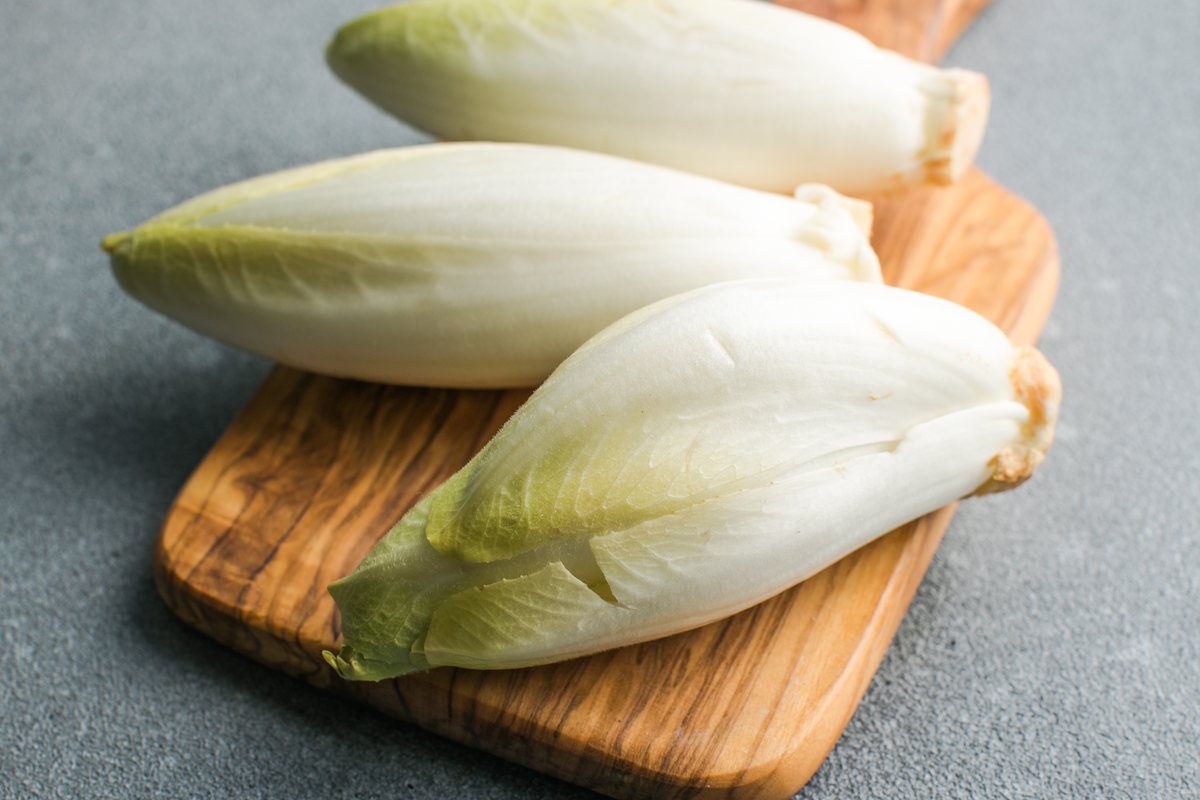
Chicory is a discovery from the shadows: Legend has it that around 1850, forgotten chicory roots sprouted delicate, white shoots in a Brussels cellar.
Chicory is descended from the common chicory, which blooms blue along roadsides in our region. Two cultivated forms have been developed from it: root chicory, whose roasted root long served as a coffee substitute, and salad chicory with leaf forms such as radicchio, sugarloaf chicory, and, of course, chicory.
Cultivation still takes place in two stages: Sowing occurs in spring, and in autumn the fleshy beets are harvested and stored in cool conditions without their leaves – for up to eight months, according to the Federal Centre for Nutrition. As needed, they are moved to dark forcing rooms, usually in hydroponic systems, where they develop firm, white heads with yellow tips in about three weeks. Domestically grown beets are available from October until spring.
To useWhat chicory does for you
Chicory is about 95 percent water and, according to the USDA, provides only about 17 kcal per 100 g. However, it does provide a good 3 g of vitamin D. Dietary fiber, approximately 210 mg potassium and about 37 µg Folate.
He owes his character to the bitter substances: Sesquiterpene lactones such as Lactucin and Lactucopicrin (formerly called intybin), plus chicory and chlorogenic acid. Bitter substances stimulate the flow of saliva and gastric juices via the taste receptors. Commission E has traditionally given a positive assessment to the related chicory for loss of appetite and mild digestive problems – however, there are no clinical studies on chicory as a vegetable for this purpose.
Chicory is one of the plants that Inulin Chicory produces inulin – a soluble fiber that feeds bifidobacteria in the large intestine. However, most inulin is found in the root, from which it is industrially extracted; the EFSA has confirmed that a daily intake of at least 12 g of native chicory inulin leads to more frequent bowel movements. Such amounts cannot be achieved with the leaves.
IngredientsThis is what's in chicory
Chicory contains bitter substances from the group of sesquiterpene lactones (lactucin, 8-deoxylactucin, lactucopicrin), phenolic acids such as chicory acid (dicaffeoyltartaric acid), chlorogenic acid and caffeic acid, flavonoids such as kaempferol and quercetin glycosides, dietary fiber including smaller amounts of inulin, as well as potassium, folate, calcium, provitamin A and some vitamin C.
The bitter compounds are mainly found in the core and the lower, firm part of the leaves. Light causes the heads to turn green and become more bitter – chicory should therefore be wrapped in paper or stored in the dark, in the vegetable drawer of the refrigerator.
Enhanced combinationsWhat makes chicory stronger
Bitter loves sweet, sour and fatty - that's how chicory becomes a well-rounded winter salad.
Reduces bitterness, provides vitamin C.
Fruity and fresh in salads.
Omega-3 and bite.
The classic from Belgium.
It rounds off, carries the carotenoids.
It maintains the balance.
What contradicts itselfIt's best to avoid these combinations.
Turns green and bitter.
It becomes limp and loses nutrients.
The bitter core protrudes in a wedge shape.
Cut edges turn brown.
Cross-reactions are possible.
Inulin is found primarily in the root.
In the kitchenWhere he belongs
- Chicory and orange saladWith walnuts and honey-mustard dressing.
- Baked chicoryBelgian style with ham and cheese sauce.
- Chicory boatsIndividual leaves filled with cream cheese.
- Braised chicoryCaramelized in butter with a little sugar.
- Winter saladMit Vogerlsalat, Apfel und Radicchio.
- Grilled chicoryHalved, with olive oil.
- Chicory gratinMit Erdäpfel.
- Raw food platterLeaves as dipping spoons.
- Chicory with pearAnd blue cheese.
- pastaWith chicory, lemon and Parmesan cheese.
As a home remedyA bitter appetizer to whet the appetite
Chicory and orange appetizer
- Wash 1 head of chicory, cut out only half of the bitter core - a little bitterness is desirable here.
- Cut the leaves into strips and mix with the segments of an orange.
- Add 1 teaspoon of olive oil, a little lemon juice and a pinch of salt.
- Eat slowly and chew thoroughly about 15 minutes before the main course.
Traditionally served as a bitter appetizer for poor appetite and bloating after heavy winter meals. The bitter compounds stimulate the flow of saliva and gastric juices via the tongue. This use is based on anecdotal evidence; there are no clinical studies on chicory.
A small portion before the main meal. If you have gallstones, stomach ulcers, or heartburn, choose milder varieties without the stem and consult a doctor if symptoms persist.
Ayurveda & TCMWhat the old systems say
Ayurveda
Chicory is not described in classical Ayurveda, but the related chicory (Kasni) is: it is considered bitter and cooling. According to current classification, chicory calms Pitta and Kapha; for Vata, it is better steamed or with oil and something sweet.
Traditional Chinese Medicine
Chicory plays no role in classical Traditional Chinese Medicine (TCM). Western TCM dietary theory classifies it as bitter and cooling: it is said to clear heat from the liver and gallbladder and eliminate dampness. For coldness in the stomach, it is best eaten warm, braised, or baked.
Warning noticesWhen you should be careful
Please note
- Allergy: Chicory is a member of the daisy family - cross-reactions are possible in case of allergy to mugwort, chamomile or arnica.
- Bile: Bitter substances stimulate bile flow; if you have gallstones, consume only in normal kitchen quantities and consult a doctor if you experience discomfort.
- Irritable bowel syndrome: Fructans like inulin can cause bloating - start with small amounts.
- Skin contact: People who clean a lot of chicory for work rarely develop contact dermatitis - gloves help.
- Storage: Green, soft, or brown-spotted heads are old and taste significantly more bitter.
This page provides information and does not replace medical advice. If symptoms persist, please consult a doctor.
Related to the topicRead on and cook along!
Shop links lead to our product pages; it is indicated there if a partner is involved.
SourcesWhat is this based on?
- USDA FoodData Central: Chicory, witloof, raw.
- Street RA, Sidana J, Prinsloo G. Cichorium intybus: Traditional Uses, Phytochemistry, Pharmacology, and Toxicology. Evidence-Based Complementary and Alternative Medicine 2013; 2013: 579319.
- Roberto-Flood MB. Inulin-type fructans: functional food ingredients. Journal of Nutrition 2007; 137(11 Suppl): 2493S–2502S.
- EFSA NDA Panel. Scientific Opinion on the substantiation of a health claim related to „native chicory inulin“ and maintenance of normal defecation by increasing stool frequency. EFSA Journal 2015; 13(1): 3951.
- Federal Centre for Nutrition (BZfE): Chicory - healthy nutrients from the darkroom. Press release, 2025.


