OriginThe fruit that hurts - and everyone wants it
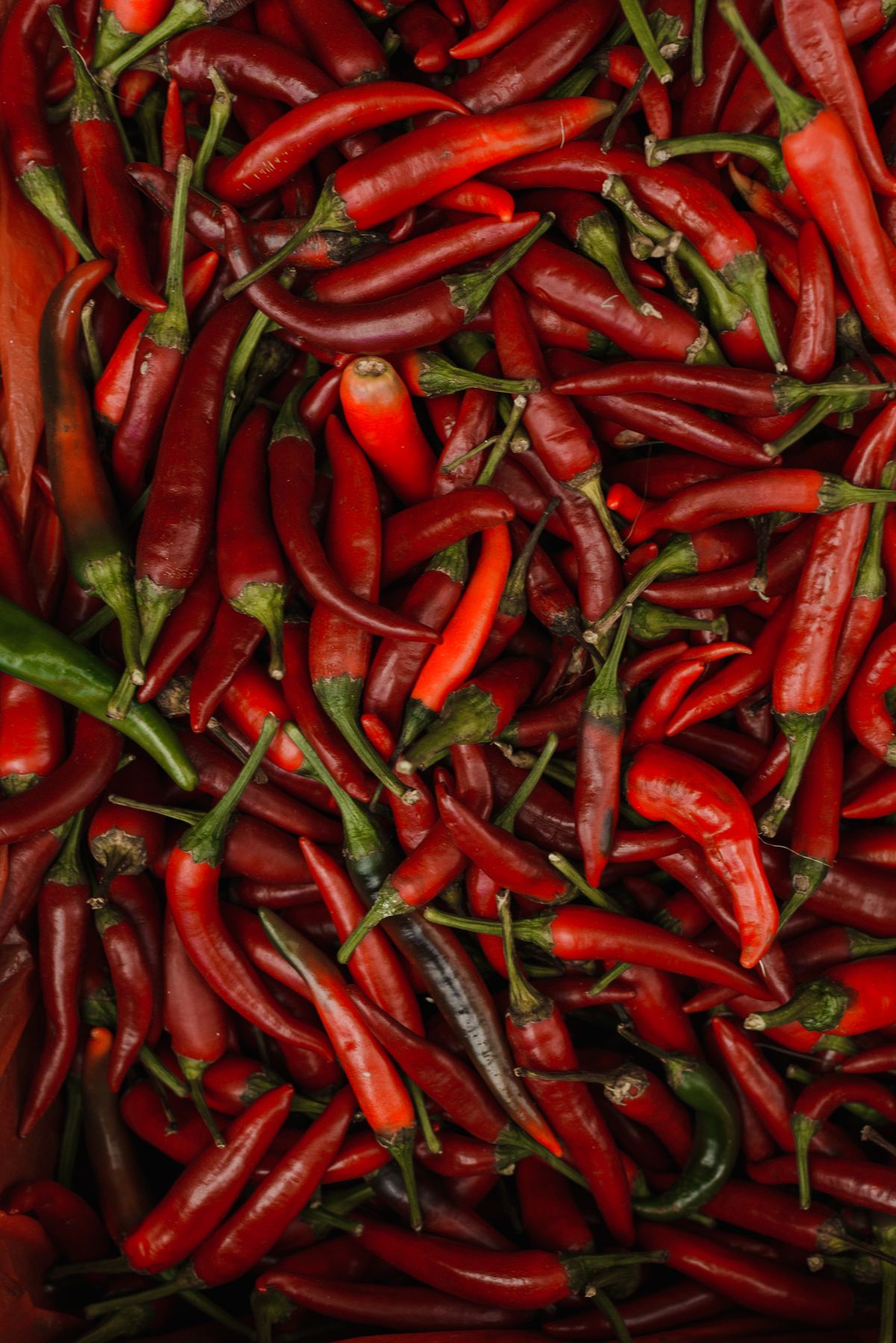
Columbus was looking for pepper and found chili. Within fifty years, the plant had spread to India, China, and Hungary – no spice has ever spread so quickly.
Chili peppers originated in the Amazon region and Mexico, where people have been using them for around 7,000 years – long before corn and beans. The Aztecs knew dozens of varieties and used them to flavor cacao. In 1493, Columbus brought the first chili peppers to Spain; Portuguese traders carried them to Africa and India, from where they spread to Thailand, China, and Korea. Today, it's impossible to imagine Indian, Thai, or Hungarian cuisine without chili peppers – even though they haven't been used in those cuisines for 500 years.
All chili peppers belong to the genus Capsicum: from mild bell peppers to jalapeños, cayenne, and Thai chilies, all the way to habaneros and the varieties exceeding one million Scoville units. The spiciness is a defense mechanism against mammals—birds don't sense it and disperse the seeds. We are the only animal that voluntarily seeks out spiciness.
To useWhat Chili does for you
Chili is a Painkillers that actually cause pain. Capsaicin, the pungent compound, stimulates heat and pain receptors – the body reacts with endorphins, sweating, and improved blood circulation. This is precisely the principle behind external application: capsaicin patches and ointments are approved treatments for nerve pain, rheumatism, and muscle tension because they first stimulate the pain nerves and then exhaust them for hours.
When eaten, chili stimulates saliva, gastric juices, and intestinal motility, and temporarily increases energy expenditure—the effect on weight is measurable, but small. Contrary to long-held beliefs, chili does not harm a healthy stomach; it even protects the mucous membrane by increasing blood flow. Large observational studies found lower mortality rates among regular chili eaters—a correlation, not proof.
And chili peppers are one of the best sources of vitamin C: a fresh red chili contains more than an orange. Frankly, the biggest benefit is the simplest: those who eat spicy food need less salt and fat for it to taste good.
IngredientsThat's what's inside the pod.
Capsaicin Capsaicin and its relatives (capsaicinoids) are located in the placenta – the white membranes to which the seeds are attached. The seeds themselves are barely spicy; removing them and leaving the membranes in place is pointless. Capsaicin is fat-soluble and almost insoluble in water – that's why milk, not water, quenches the flames.
In addition Capsanthin and other carotenoids (the red color, in bell peppers as provitamin A), plenty of vitamin C, vitamin B6, potassium, and flavonoids. During drying, everything except vitamin C becomes concentrated; during smoking (Chipotle) and fermentation (Sriracha, Gochujang), new flavors develop around the spiciness.
Enhanced combinationsWhat makes chili stronger
Chili is an amplifier – it makes everything more intense. The trick is to integrate it in such a way that the spiciness complements the flavor rather than dominating it.
Capsaicin dissolves in fat and distributes evenly. Chili oil, red curry, arrabbiata: the fat makes the spiciness rounded rather than sharp.
Acid enhances the fruitiness of the chili and reduces its spiciness. Salsa, ceviche, sriracha – never without acid.
Sweet chili, mango chutney, chili chocolate: sweetness takes the edge off and lets the fruit aroma shine through.
Chili and pepper act on the same receptors; with turmeric and fat, they form the basis of almost every curry - and piperine improves curcumin absorption.
The Asian base: garlic, ginger, chili in hot oil – sambal, Sichuan, Szechuan. Three complementary spicinesses.
Smoked jalapeños and roasted cumin seeds: the basic Mexican flavor for chili con carne, tacos, and beans.
What contradicts itselfIt's best to avoid these combinations.
Capsaicin is fat-soluble. Water only spreads the spiciness. Milk, yogurt, bread, sugar – these help.
Burnt chili becomes bitter and pungent. Dried chilies should only be fried in hot oil for 20 seconds.
Cream sauces, delicate fish, asparagus – chili subtly overpowers everything. At most, just a hint.
What burns up top, burns down below. Use sparingly for gastritis, reflux, and hemorrhoids – your body will tell you.
Wash hands with oil or dish soap after cutting, not with water. Wait several hours before putting in contact lenses.
Chili-eating contests with super-hot chilies regularly lead to hospitalization: vomiting, cramps, and in isolated cases, vascular spasms in the brain. There is a limit to how much heat there is.
To which courtWhere he belongs
- Chili con CarneSoak dried ancho and chipotle chilies, then puree – use cumin and oregano as the base.
- ArrabbiataKnoblauch und Chiliflocken in Olivenöl, Paradeiser dazu, 20 Minuten - die einfachste scharfe Pasta.
- Chili oilInfuse dried chilies, garlic, and Sichuan peppercorns in warm oil – serve over noodles, eggs, or dumplings.
- SalsaParadeiser, Zwiebel, Koriander, Jalapeño, Limette, Salz - roh, in fünf Minuten.
- Thai curryRed curry paste made from fresh chilies, lemongrass, galangal, garlic - in coconut milk.
- Sambal OelekFresh red chilies crushed with salt and vinegar - the basic Indonesian seasoning.
- HarissaDried chilies, cumin, coriander, garlic, olive oil - for couscous and tagine.
- Chili chocolateA pinch of cayenne pepper in hot chocolate - that's how the Aztecs drank their cocoa.
- GochujangFermented Korean chili paste - for bibimbap and stews.
- Pickled jalapeñosIn vinegar, water, salt and sugar - for tacos, burgers, nachos.
As a home remedyChili peppers applied externally to relieve muscle and joint pain
Warming chili oil
- Stir 2 teaspoons of cayenne powder into 100 ml of olive oil or coconut oil.
- Gently warm in a water bath for 30 minutes, do not boil, then strain through a cloth.
- Massage a small amount onto tense muscles or painful joints - test on a small area first.
- Wash hands thoroughly with dish soap afterwards. Do not apply to mucous membranes, wounds, or face.
Tense muscles, back pain, rheumatic joint pain. The capsaicin warms deeply, increases blood circulation, and, after the initial burning sensation, soothes the pain nerves – the same principle as with approved heat patches.
Apply a thin layer once or twice daily, for no longer than two weeks at a time. A burning sensation is normal, but blisters are not. For nerve pain, standardized capsaicin preparations from the pharmacy are the safer choice.
Ayurveda & TCMWhat the old systems say
Ayurveda
As Marichi (Like pepper) a pungent, hot spice that reduces Kapha and Vata but greatly increases Pitta – therefore, in Ayurveda, it is used with caution: good for cold and lethargy, bad for heat, inflammation, and heartburn. It has only been in India since the Portuguese period.
Traditional Chinese Medicine
La Jiao According to Traditional Chinese Medicine (TCM), it warms the stomach and spleen, dispels cold and dampness, and moves the blood – which is why Sichuan, the wettest province in China, is considered the most pungent. It is not recommended for those with heat patterns (red tongue, inflammation).
Warning noticesWhen you should be careful
Please note
- Stomach and intestines: Use sparingly if you have gastritis, reflux, irritable bowel syndrome and hemorrhoids - chili will worsen the symptoms.
- Skin and eyes: Capsaicin sticks to your hands. Wash with oil or dish soap after cutting; never get it in your eyes.
- Children: Young children don't tolerate spicy food well - introduce chili slowly and gently at first.
- Extreme sharpness: Super-hot chilies (from 500,000 Scoville units) can cause vomiting, circulatory problems and, in rare cases, vascular spasms.
- Medications: Capsaicin can alter the absorption of some active ingredients and has a mild anticoagulant effect - unproblematic in kitchen quantities when used in blood thinners.
- Pregnancy: Chili in food is harmless, but heartburn is more common - listen to your body.
This page provides information and does not replace medical advice. If symptoms persist, please consult a doctor.
Related to the topicRead on and cook along!
Shop links lead to our product pages; it is indicated there if a partner is involved.
SourcesWhat is this based on?
- European Medicines Agency (EMA), HMPC: Community herbal monograph on Capsicum annuum L. var. minimum and small fruited varieties, fructus, 2015 - externally for muscle pain.
- Commission E: Monograph Capsicum fruit (bell pepper/cayenne pepper), Federal Gazette 1990.
- Lv J et al. Consumption of spicy foods and total and cause specific mortality: population based cohort study. BMJ 2015; 351: h3942.
- USDA FoodData Central: Peppers, hot chili, red, raw - Vitamin C.
- Bosland PW, Votava EJ: Peppers: Vegetable and Spice Capsicums. 2nd edition, CABI 2012.