
Pistachio (Pistacia vera)
OriginThe laughing nut from the Orient
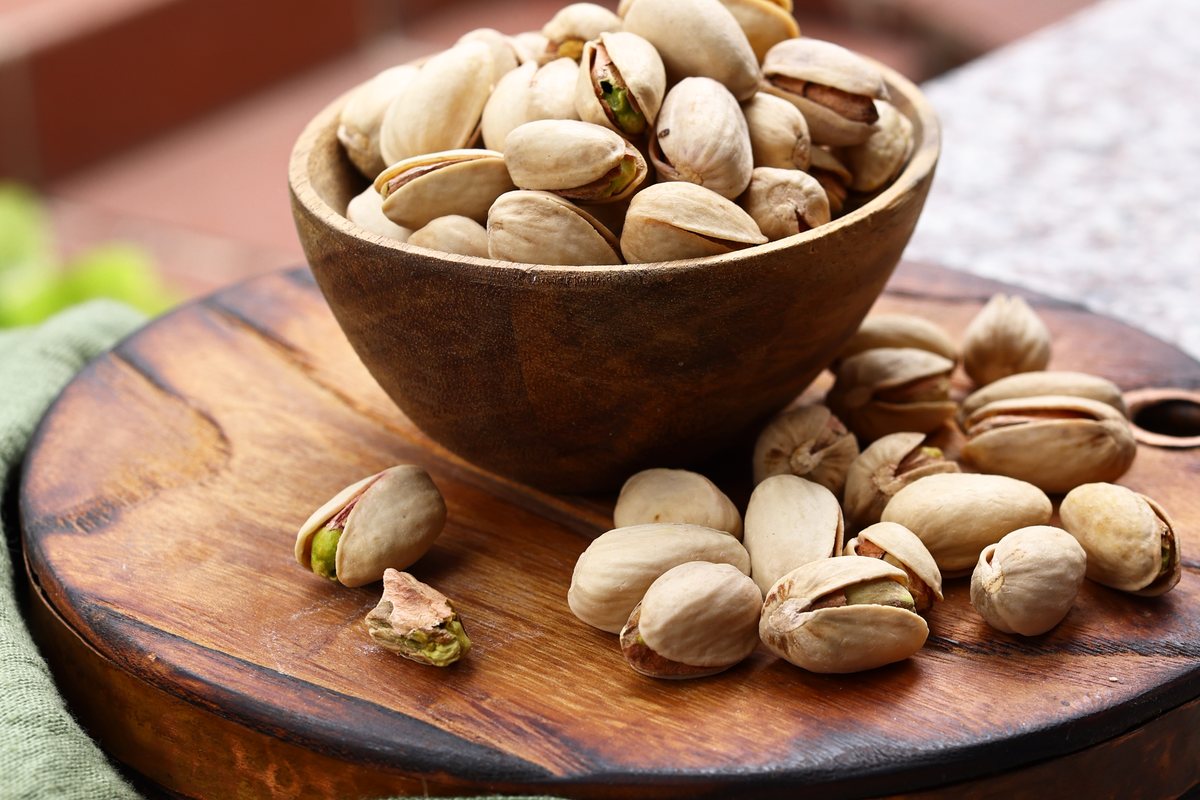
In Iran, the pistachio is called pesteh khandan, in China „happy nut“ - because the ripe shell pops open by itself, as if it were laughing.
Wild pistachio trees grow in the dry mountain regions from Central Asia to Iran. The seeds were gathered there thousands of years ago and later cultivated. The pistachio spread to the Mediterranean world via Persia and Syria; the Romans brought it to Italy.
Pistachio trees are dioecious: there are male and female trees, and pollination is carried out by the wind. Today, most pistachios come from California, Iran, and Turkey. The bright green pistachios from Bronte on Mount Etna in Sicily are famous. In Germany, the tree does not grow to maturity – pistachios are always imported here.
To useWhat pistachios can do for you
100 g of raw pistachios provide around 20 g of protein, 45 g of fat - predominantly monounsaturated and polyunsaturated - and a good 10 g Dietary fiber. Approximately 1,000 mg is outstanding. potassium, 1.7 mg Vitamin B6 and 1.3 mg of copper. A 30 g handful thus provides around 300 mg of potassium and about a third of the daily requirement of vitamin B6. With around 560 kcal per 100 g, pistachios are among the lighter nuts.
Pistachios are the only common nut with significant nutritional value. Lutein and zeaxanthin Depending on the analysis, pistachios contain approximately 1 to 3 mg per 100 g. These carotenoids are deposited in the retina. In a controlled study with people with elevated cholesterol, lutein levels in the blood increased and oxidized LDL cholesterol decreased with a diet rich in pistachios. However, this does not prove whether this provides long-term protection for the heart or eyes.
Large observational studies link a handful of nuts a day to fewer cardiovascular diseases; pistachios are included in this list. Cracking them has another benefit: those who shell pistachios themselves eat more slowly, and the empty shells show how much has already been eaten. But the real advantage lies in the unsalted Salted kernels quickly contain a gram or more of salt per 100g.
IngredientsThis is what's in pistachios
Pistachios contain fat with high levels of oleic and linoleic acid, protein, fiber, phytosterols, carotenoids (lutein, zeaxanthin), chlorophyll, gamma-tocopherol (vitamin E), polyphenols such as anthocyanins in the purple seed coat, flavonoids and proanthocyanidins, as well as potassium, phosphorus, magnesium, copper, iron and vitamins B1 and B6.
The greener the kernel, the more chlorophyll and lutein it contains – pistachios harvested early are therefore the most intensely colored. Roasting reduces some of the delicate pigments and vitamins.
Enhanced combinationsWhat makes pistachios stronger
Pistachios are a flavorful ingredient: they go well with both sweet and savory dishes - preferably unsalted.
Lutein is better absorbed when combined with fat.
Color, freshness, and help with iron.
Chopped over fruit.
Stuffed as a snack.
As pesto.
Oriental salad.
What contradicts itselfIt's best to avoid these combinations.
High sodium levels raise blood pressure.
Frequent cross-reaction.
Suspected aflatoxins - discard.
Approximately 560 kcal per 100 g.
Danger of suffocation.
They become rancid and mold more easily.
In the kitchenWhere they belong
- Pistachio pestoWith basil and lemon.
- Pistachio creamOn bread or in pastries.
- BaklavaWith filo pastry and syrup.
- Pistachio ice creamMade with real pistachio butter.
- Bulgur saladWith pomegranate and mint.
- crustFor salmon or tofu.
- Yogurt toppingChopped with honey.
- Green saladWith pear and goat cheese.
- Mortadella-styleItalian sausage with pistachios.
- KulfiIndian milk ice cream with cardamom.
As a home remedyPistachio butter without additives
Pistachio butter
- Lightly toast 200g of unsalted, peeled pistachio kernels in a pan without fat for 3 to 4 minutes and let cool.
- First, grind finely in a high-performance blender or food processor.
- Continue mixing, occasionally scraping the mixture from the sides of the bowl, until a creamy puree is formed after 8 to 12 minutes.
- If desired, stir in a pinch of salt or some lemon zest and pour into a clean glass.
As a spread without sugar or palm oil, as a base for dressings, or to enhance yogurt and porridge. A spoonful brings potassium, vitamin B6, and lutein into your daily routine. A kitchen helper, not a cure.
1 to 2 teaspoons per serving. Stored in a cool, dark place, it will keep for about 4 weeks. Not suitable for those with nut or cashew allergies.
Ayurveda & TCMWhat the old systems say
Ayurveda
In Ayurveda, the pistachio is called Pista. It is considered sweet, heavy, oily and warming - nourishing and strengthening for Vata, but burdensome for Pitta and Kapha in large quantities.
Traditional Chinese Medicine
In Chinese dietary theory, the pistachio is classified as sweet and warming. It is said to strengthen the digestive system and moisten the intestines; classical sources hardly mention it.
Warning noticesWhen you should be careful
Please note
- Allergy: Pistachios are nuts and major allergens. People allergic to cashews very often also react to pistachios (and vice versa) – both should only be eaten after medical consultation.
- Aflatoxins: Pistachios are repeatedly reported to the EU rapid alert system due to mold toxins. Musty-smelling, discolored, or moldy kernels should be discarded, not just sorted out.
- Salt: Salted pistachios contain 1g of salt or more per 100g, depending on the product - choose unsalted pistachios if you have high blood pressure.
- Toddlers: No whole nuts for children under 4 years old due to choking hazard.
- Energy: Approximately 560 kcal per 100 g - a handful is a sensible portion.
This page provides information and does not replace medical advice. If symptoms persist, please consult a doctor.
Related to the topicRead on and cook along!
Shop links lead to our product pages; it is indicated there if a partner is involved.
SourcesWhat is this based on?
- USDA FoodData Central: Nuts, pistachio nuts, raw.
- Kay CD, Gebauer SK, West SG, Kris-Etherton PM. Pistachios increase serum antioxidants and lower serum oxidized-LDL in hypercholesterolemic adults. Journal of Nutrition 2010; 140(6): 1093–1098.
- Aune D et al. Nut consumption and risk of cardiovascular disease, total cancer, all-cause and cause-specific mortality: a systematic review and dose-response meta-analysis of prospective studies. BMC Medicine 2016; 14: 207.
- Willison LN et al. Pistachio vicilin, Pis v 3, is immunoglobulin E-reactive and cross-reacts with the homologous cashew allergen, Ana o 1. Clinical & Experimental Allergy 2008.
- Commission Regulation (EU) 2023/915 on maximum levels of certain contaminants in foodstuffs (aflatoxins in nuts).


