OriginThe fungus that hunts nematodes
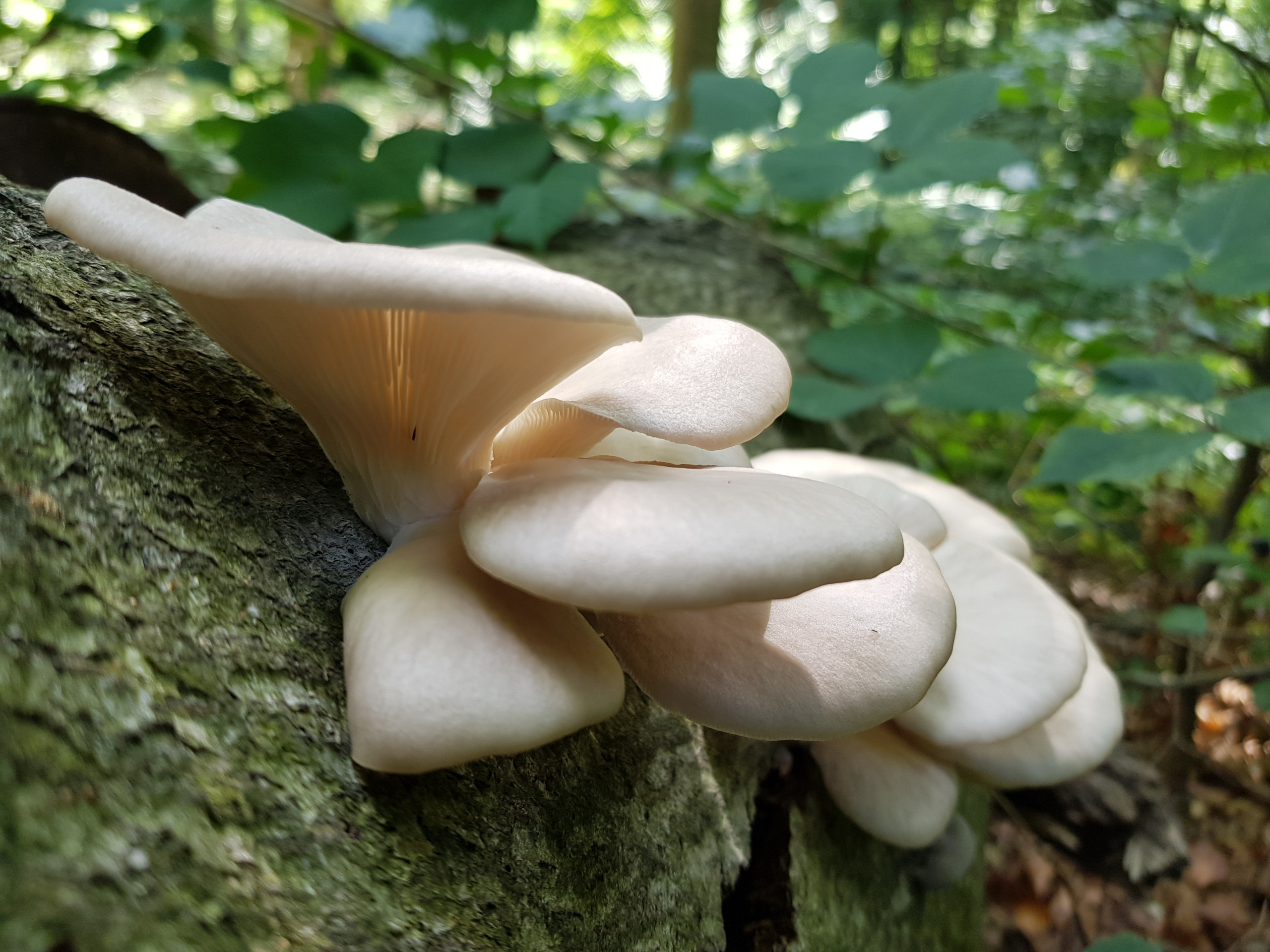
Wood contains very little nitrogen - and the oyster mushroom has found an unusual solution to this problem.
Pleurotus ostreatus It grows in overlapping, roof-tile-like clusters on dead or weakened deciduous wood, especially beech and poplar. Its caps are shell- to oyster-shaped – hence the name – grey to greyish-brown, with white gills extending far down the side of the stem. In Central Europe, it typically appears from October onwards and continues to grow into winter; it even requires a period of cold to fruit. This makes it one of the few edible mushrooms that can be found fresh in December.
Biologically, it's a unique case. Wood is a nitrogen-poor substrate, and fungi need nitrogen for their proteins. The oyster mushroom solves this problem in an unexpected way: its mycelium produces tiny droplets containing a neurotoxin that paralyzes nematodes within minutes. The hyphae then penetrate the paralyzed worm and digest it. This makes it a true carnivorous fungus—one of several nematophagous species, but the best known and most thoroughly studied.
Economically, it is the third most produced cultivated mushroom in the world after button mushrooms and shiitake, and it is by far the easiest to grow. It thrives on pasteurized straw, coffee grounds, sawdust, and even paper and cardboard. This undemanding nature makes it the standard mushroom for hobby cultivation and for development cooperation projects – and it has opened up a second field of application: In mycoremediation, it is used to rid soils of oil residues and other organic pollutants that its enzymes can break down.
To useAn edible mushroom containing a statin
There is no drug monograph for the oyster mushroom; it is a foodstuff. From a nutritional standpoint, it is a good, but not exceptional, mushroom: high in protein for a vegetable, high in fiber, low in calories, with B vitamins and ergosterol as a precursor to vitamin D.
One peculiarity, however, is well documented: oyster mushrooms contain lovastatin, and in measurable quantities. Lovastatin is the same active ingredient used as a prescription cholesterol-lowering drug; it was originally isolated from a mold. It occurs naturally in oyster mushrooms, with levels that vary considerably depending on the strain and growing conditions – measurements range from trace amounts to several milligrams per hundred grams of dry weight.
Before this becomes a recommendation: The amounts in a normal serving are far below the therapeutic dose of a statin, which ranges from ten to eighty milligrams daily. There are small studies in which regular consumption of oyster mushrooms slightly improved blood lipid levels, but these are small and methodologically limited. Those with elevated cholesterol levels should not treat them with mushrooms.
More interesting is the reverse idea: There are dietary supplements based on red rice mold that also contain natural lovastatin—in quantities that can actually trigger statin-like effects and side effects, which is why the EU severely restricted them in 2022. This isn't an issue with oyster mushrooms as a foodstuff. But it shows that the line between food and medicine is sometimes a matter of quantity.
IngredientsWhat's inside - and what breeders need to pay attention to
In addition to the aforementioned lovastatin, the oyster mushroom contains beta-glucans, ergothioneine – a sulfur-containing amino acid that is particularly abundant in mushrooms and is being studied as an antioxidant – potassium, B vitamins, and ergosterol. The latter is converted into vitamin D2 under UV light, which is why, here too, a few hours of sun exposure on the gills significantly increases the vitamin D content.
The protein content is high, at around 20 to 30 percent of the dry mass, and the amino acid profile is favorable for a non-animal source. However, like all mushrooms, it consists of over 90 percent water when fresh; the absolute amounts in a serving are correspondingly modest.
One practical point concerns the spores. Oyster mushrooms produce very large quantities of white spores – if you're growing them indoors, you'll see a white, dusty coating on all surfaces below after just a few days. With intensive exposure, this can lead to allergic alveolitis, an inflammation of the alveoli in the lungs, which is known as an occupational disease among mushroom growers. For occasional hobby cultivation, the risk is low, but you shouldn't keep the growing bag in your bedroom and you shouldn't harvest the mushrooms before the caps are fully mature.
For collectors: In Central Europe, confusion is not a problem. The similar ear-shaped oyster mushroom is also edible. The poisonous olive tree mushroom Omphalotus olearius, The species that grows on olive and oak stumps in southern Europe and is bright orange is rarely found in our region and is easily distinguished by its color. More importantly, it's essential to collect only from deciduous wood and to identify the mushroom definitively.
Enhanced combinationsA mushroom that can handle anything
The oyster mushroom is uncomplicated, aromatic and has a strong structure - and is one of the few mushrooms that you can grow yourself without investing much.
It needs intense heat and patience: first water is released, then the browning begins. If you turn it over or add salt too soon, you'll end up with a gray, limp mass.
When pulled into strips, breaded and fried, it makes a surprisingly convincing plant-based substitute for chicken or veal cutlets.
The simplest mushroom growing project ever: collect coffee grounds, mix them with mushroom spawn, put it in a bag, and wait. After a few weeks, it will grow.
It needs a period of cold to fruit. Therefore, it can be found in the forest from October onwards, often after the first frost.
The classic partner. Its own flavor is mild and anise-like, and it pairs well with strong herbs.
Leaving the device in the sun for a few hours with the slats facing upwards significantly increases the vitamin D2 content.
What contradicts itselfIt's best to avoid these combinations.
The spore count is significant, and intensive exposure can trigger allergic alveolitis. Keep breeding bags well-ventilated and away from sleeping areas.
The lovastatin content is far below therapeutic doses. Elevated cholesterol levels require different treatment.
If cooked gently, it becomes limp and watery. It needs a hot pan and plenty of space.
Salt attracts water. Only add salt once the liquid has evaporated and browning has begun.
They become tough and produce many spores. Harvest young, when the cap edges are still rolled inwards.
Like all mushrooms, it should be cooked thoroughly.
In the kitchenWhat's going on with him?
- FriedTorn into pieces, fried vigorously in a hot pan with garlic and thyme.
- breadedLarge hats or pulled strips, breaded and fried - the best plant-based schnitzel substitute.
- PulledShredded into fibers, seared and served with BBQ sauce - as a burger filling.
- Creamy mushroomsServe in cream sauce with bread dumplings or spaetzle.
- wokWith soy sauce, ginger and spring onions.
- SoupAs an ingredient in clear broths and noodle soups.
- InsertedMarinated in vinegar and oil as an antipasto.
- DriedIt dries well and can be used as mushroom powder for seasoning.
- Grow your ownOn coffee grounds, straw or cardboard - the simplest breeding project.
- sunsPlace in the sun before use to obtain vitamin D2.
As a home remedyThe simplest mushroom growing project
Oyster mushrooms on coffee grounds
- Collect about one kilogram of fresh coffee grounds – ideally over a few days, in a sealed container in the refrigerator to prevent mold. Fresh coffee grounds are practically germ-free due to the brewing process.
- Obtain oyster mushroom grain spawn; it is available in specialist shops. Approximately one hundred grams of spawn per kilogram of coffee grounds.
- Thoroughly mix the coffee grounds and spawn with clean hands and fill into a freezer bag with a few small air holes. Fill loosely, do not press down.
- Place the bag in a dark place at around 20 degrees Celsius. After two to three weeks, the substrate will be permeated with white growth – this is the mycelium.
- Then place the bag in a brighter, cooler location and cut a cross into the film. Spray the cut surface with water daily.
- The first caps appear after about a week. Harvest when the cap edges are still slightly rolled in – this is when they are most tender and not yet producing spores. A substrate usually supports two to three spores.
An excellent edible mushroom from our own cultivation – available year-round, from a by-product. The oyster mushroom is a foodstuff; its lovastatin content is far below therapeutic levels.
Use as food if desired, but cook thoroughly. Keep the breeding bag well-ventilated and away from sleeping areas – the number of spores is considerable.
Ayurveda & TCMWhat the old systems say
Ayurveda
The oyster mushroom is not included in Ayurveda. Mushrooms in general are viewed with reservation there; however, in modern Indian dietary practice, the oyster mushroom is established as a protein-rich, inexpensive foodstuff, and its cultivation is promoted in rural development programs.
Traditional Chinese Medicine
In China, the oyster mushroom is considered Ping Gu - "Flat mushroom" - primarily a foodstuff and less of a medicinal drug. In dietetics, it is described as sweet and warming, with a connection to the spleen and stomach, and is considered to strengthen Qi and "dispel wind" in cases of muscle and joint problems. It is one of the most widely cultivated mushrooms in China and is more commonly found in everyday cooking than in pharmacies.
Warning noticesWhen you should be careful
Please note
- Spore exposure during breeding: Large quantities of spores can trigger allergic alveolitis upon intensive exposure. Place the breeding bags in a well-ventilated area, not in the sleeping area, and harvest while young.
- Not a cholesterol-lowering medication: The lovastatin level is far below therapeutic doses. Elevated levels require different treatment.
- Always cook thoroughly: Like all mushrooms, it should be cooked thoroughly.
- Collect only from deciduous trees: And only if clearly identified. In Southern Europe, there is a poisonous, bright orange lookalike called the olive tree mushroom.
- Harvest young: Fully ripe hats become tough and produce strong spores.
- Mushroom allergy: Allergic reactions to edible mushrooms are possible.
This page provides information and does not replace medical advice. If symptoms persist, please consult a doctor.
Related to the topicRead on and cook along!
Shop links lead to our product pages; it is indicated there if a partner is involved.
SourcesWhat is this based on?
- Gunde-Cimerman N., Cimerman A.: Pleurotus fruiting bodies contain the inhibitor of HMG-CoA reductase - lovastatin. Experimental Mycology 1995.
- Barron GL, Thorn RG: Destruction of nematodes by species of Pleurotus. Canadian Journal of Botany 1987.
- Stamets P.: Growing Gourmet and Medicinal Mushrooms - Cultivation Basics.
- Cardwell G. et al.: A review of mushrooms as a potential source of dietary vitamin D. Nutrients 2018.
- German Statutory Accident Insurance: Exogenous allergic alveolitis in mushroom growers - occupational disease documentation.