
OriginThe shrub that they tried to eradicate
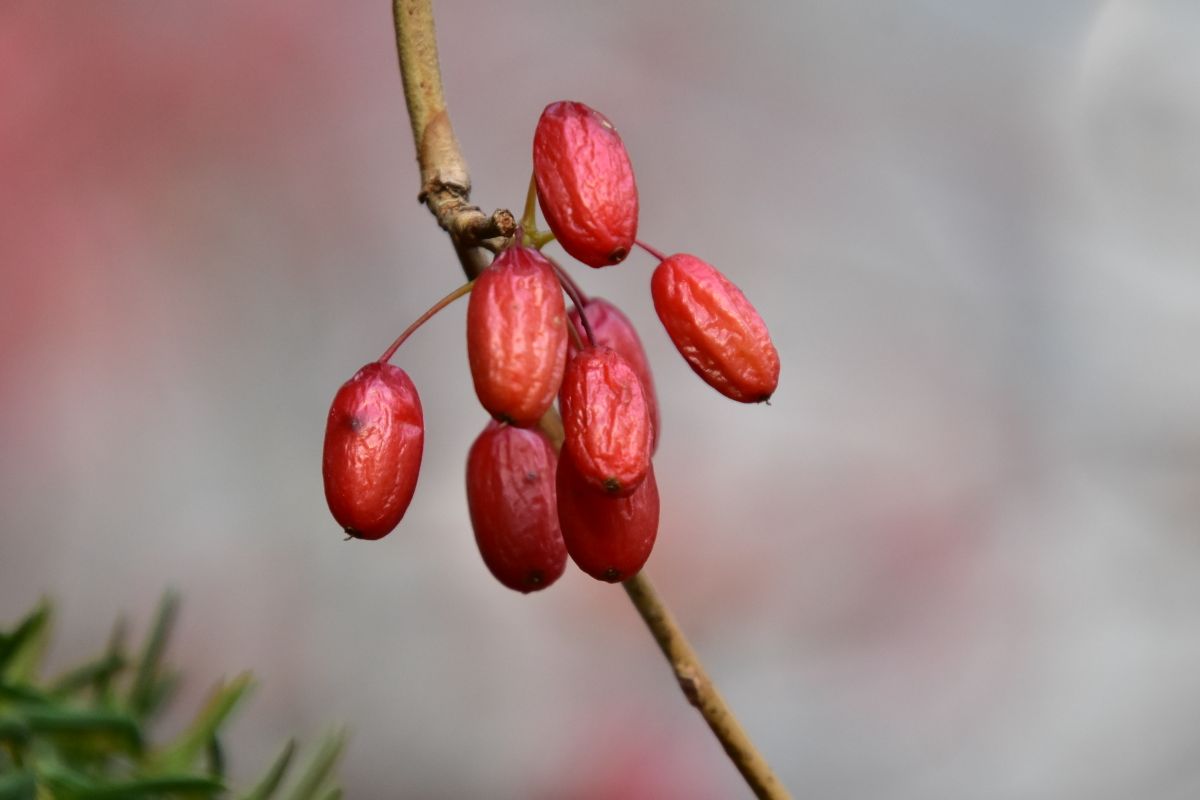
In the USA, millions of barberry bushes were destroyed over a period of forty years - because of a fungus that overwinters on them.
Berberis vulgaris Berberis is a thorny shrub that grows up to three meters tall and is native to Europe, North Africa, and West Asia. It thrives on forest edges, in hedgerows, and on dry slopes, bearing yellow, drooping flower clusters in May and elongated, bright red berries from August onward. Its thorns are modified leaves; the bright yellow color of the wood and root bark is also striking – this is due to berberine, and it does indeed stain.
The flowers have a mechanism that's worth seeing: the stamens are irritable. If an insect touches the base of a stamen, it snaps inwards within a tenth of a second, releasing pollen onto the visitor. This can easily be triggered with a blade of grass – one of the most beautiful little natural phenomena you can observe in May.
The story that almost cost the shrub its life has to do with grain. The barberry is an alternate host of stem rust. Puccinia graminis, a fungus that causes devastating crop failures in wheat. The fungus needs both hosts: it reproduces asexually on the grain, while sexual reproduction takes place on the barberry bush – leading to the development of new, more aggressive strains. As early as 1660, Rouen passed a law to eradicate the bushes; in the USA, a government-organized campaign ran from 1918 into the 1970s, resulting in the destruction of over 500 million bushes. In Germany, planting restrictions were in place until the 1970s. This is why barberry remains rare in many regions to this day.
To useBerber woman - much research, little European recognition
For Berberis vulgaris There is no EMA monograph and no Commission E assessment. In the EU, the fruit is classified as a foodstuff; preparations of the root bark are not established medicinally. This is the starting point – and it stands in remarkable contrast to the amount of research that exists on the main alkaloid, berberine.
Berberine is one of the most studied plant alkaloids, especially in China, where it is derived from Coptis chinensis It has been developed and used for a long time. Meta-analyses indicate reductions in fasting blood glucose, HbA1c, and LDL cholesterol, sometimes to a degree comparable to that achieved with standard medications. However, these meta-analyses have a recurring problem: the included studies are predominantly from China, small, methodologically heterogeneous, and often inadequately described. The authors themselves regularly rate the quality of the evidence as low to moderate.
Important for context: These studies were conducted with isolated berberine in doses of mostly 500 to 1500 milligrams daily. Barberry tea made from the fruit contains practically none of it – berberine is found in the root bark, not in the berry. Applying the findings on berberine to barberry fruit is a mistake, one that is sometimes deliberately made in advertising.
And then there are contraindications that you need to be aware of. Berberine displaces bilirubin from its binding to albumin. In newborns, this can worsen neonatal jaundice and, in extreme cases, lead to kernicterus, a serious brain injury. Therefore, berberine is contraindicated during pregnancy and breastfeeding, as well as in newborns. Additionally, berberine inhibits CYP3A4 and the transport protein P-glycoprotein, and can thus affect the levels of numerous medications. None of this applies to the fruit consumed in typical kitchen quantities – but it certainly does to berberine preparations.
IngredientsYellow root, red berry - two separate worlds.
The most striking component of barberry is berberine, an isoquinoline alkaloid with an intense yellow color. It is found in the root, root bark, and wood, in smaller quantities in the stem bark – and practically not in the berries. Anyone who cuts a barberry root will see this immediately: the cut surface is bright yellow. Historically, the root was therefore also used as a dye for leather and wool.
Besides berberine, the root bark contains other alkaloids such as palmatine, jatrorrhizine, and berbamine. This mixture of alkaloids is the reason why preparations made from the root bark require significantly more caution than those made from the fruit. The traditional European use—as a bitter tonic for liver and gallbladder ailments—is no longer common and has not been evaluated.
The fruit is a completely different matter. It contains five to seven percent organic acids, predominantly malic acid, along with about 50 to 80 milligrams of vitamin C per 100 grams, anthocyanins, pectin, and sugar. Its acidity is so pronounced that it is hardly edible raw—in Persian cuisine, it is therefore dried and used in small quantities, where it contributes a very characteristic, clear acidity.
To avoid confusion: The barberry is easily recognizable by its three-part thorns, its yellow, drooping flower clusters, and its oblong red berries on thorny branches. The red berries are edible. It can be confused with poisonous berry bushes like the daphne if one only looks at the color – however, the daphne has no thorns and bears its berries directly on the branch. The ornamental form Berberis thunbergii The garden also has edible, but smaller and mealy fruits.
Enhanced combinationsThe berries in the kitchen, the root with care
The most important distinction in barberry is that between the two parts of the plant - they have nothing to do with each other.
Zereshk PoloDried barberries briefly sautéed in butter and served over saffron rice. One of the most famous Persian dishes and the best way to get to know the fruit.
The clear acid cuts through fatty meat, similar to pomegranate seeds or sumac.
They can be used like cranberries, but are significantly more acidic and contain less sugar. An interesting alternative in muesli and baked goods.
The fruits are rich in pectin and gel well; mixed with apple, this makes a clear, very acidic jelly to serve with game and cheese.
Thorny, dense, with food in winter - excellent as a hedge plant for birds, provided there is no grain cultivation nearby.
In May, touch the base of the stamens with a blade of grass – they will spring inwards. A clear identifying characteristic and a beautiful observation.
What contradicts itselfIt's best to avoid these combinations.
Berberine displaces bilirubin from its binding to albumin; in newborns, this can lead to kernicterus. Berberine preparations are contraindicated during this period.
For the same reason: Berberine is dangerous for newborns with jaundice.
Berberine inhibits both and can increase the levels of numerous medications – from statins and immunosuppressants to anticoagulants. Do not use without consulting a doctor if you are taking these medications long-term.
The blood sugar-lowering effect is the main reason many people take it – and precisely for this reason, alongside metformin or insulin, it carries a risk of hypoglycemia. This should be discussed in practice.
There are many red berries on bushes, including poisonous ones. The barberry has three-part thorns and drooping clusters – do not collect berries without these characteristics.
It is an intermediate host of cereal stem rust. In regions where wheat is grown, replanting is not a good idea – in some countries, it is still regulated.
To which courtWhat red berries can do
- Zereshk PoloDried barberries tossed in butter over saffron rice - the standard Persian dish.
- Chicken stuffingAdd onions and spices to the stuffing for roast chicken.
- Wild game jellyCooked with apple; very tart, ideal with game and strong cheese.
- MuesliLike cranberries, but significantly more sour and without added sugar.
- pastriesIn yeast dough and cookies - they give clear acidity points.
- syrupMade from fresh fruit with sugar; a very clear, tart-sour syrup.
- ChutneyAdd onion, ginger and sugar to cheese and meat.
- lettuceDried berries over leafy salads with feta and nuts.
- Winter teaDried fruits with rosehips - tart and rich in vitamins.
- No root teaThe root bark is not a culinary product; its alkaloids should not be used for self-medication.
As a home remedyThe barberry jelly
Barberry and apple jelly
- Harvest ripe barberries in September or October – ideally wearing gloves, as the thorns are quite sharp. Alternatively, cut off entire clusters of fruit and strip them off later.
- Sort, wash and place in a pot with the same amount of finely chopped, low-acid apples (with peel and core).
- Barely cover with water and cook until soft, about twenty minutes, until the berries have burst.
- Drain through a cloth – do not squeeze, otherwise the jelly will become cloudy. Hanging overnight will yield the clearest juice.
- Measure the juice and boil it with the gelling sugar according to the package instructions. The barberries contain a lot of acid, which is why the mixture gels reliably.
- Pour hot into clean jars, seal and briefly turn upside down. Label and store in a dark place.
As a tangy jelly to accompany game, strong cheese and pâtés - where one would otherwise use cranberry or currant jelly, only clearer and more acidic.
As desired – that's a foodstuff. This explicitly does not apply to the root bark and berberine preparations: no monograph, no tested dosage, relevant interactions, and clear contraindications during pregnancy and breastfeeding.
Ayurveda & TCMWhat the old systems say
Ayurveda
The genus Berberis is in Ayurveda with Daruharidra (Berberis aristata) prominently represented - the name is "wood turmeric" and refers to the yellow color of the wood, i.e., to the berberine. It is considered bitter, astringent, and warming and is used for skin diseases, eye inflammations, and liver diseases. A thickened extract called Rushing This is a classic preparation. The European barberry is botanically closely related to the Indian species and contains the same key alkaloid.
Traditional Chinese Medicine
In Chinese medicine, berberine is central via another plant: Huang Lian, the root of Coptis chinensis, Barberry is one of the most important drugs in the entire materia medica and the main source of pharmaceutically used berberine. It is considered bitter and cold, with a connection to the heart, stomach, liver, and large intestine, and clears "damp-heat" conditions—used for diarrhea, infections, and inflammations. The fact that the European barberry contains the same alkaloid is the reason why Western berberine research relies so heavily on Chinese studies.
Warning noticesWhen you should be careful
Please note
- Berberine should not be used during pregnancy or breastfeeding: It displaces bilirubin from its albumin binding; in extreme cases, this can lead to kernicterus in newborns. This does not apply to the fruit as food.
- Not for newborns and infants: For the same reason - berberine preparations are contraindicated here.
- Interactions via CYP3A4 and P-glycoprotein: Berberine can increase the levels of many medications. Do not take without consulting a doctor if you are taking these medications long-term.
- Diabetes medication: The blood sugar-lowering effect can lead to hypoglycemia when used alongside metformin or insulin.
- Root bark is not a home remedy: There is no monograph and no tested dosage for root bark preparations. They should not be used for self-medication.
- Grain stem rust: The barberry is an intermediate host of a serious cereal fungus. Replanting is problematic in regions where wheat is grown.
This page provides information and does not replace medical advice. If symptoms persist, please consult a doctor.
Related to the topicRead on and cook along!
Shop links lead to our product pages; it is indicated there if a partner is involved.
SourcesWhat is this based on?
- Imenshahidi M., Hosseinzadeh H.: Berberis vulgaris and berberine: an update review. Phytotherapy Research 2016.
- Lan J. et al.: Meta-analysis of the effect and safety of berberine in the treatment of type 2 diabetes mellitus, hyperlipidemia and hypertension. Journal of Ethnopharmacology 2015.
- Chan E.: Displacement of bilirubin from albumin by berberine. Biology of the Neonate 1993.
- Peterson GL: The relationship between barberry and stem rust - a historical overview of the US eradication campaign. Plant Disease 2018.
- Federal Institute for Risk Assessment: Information on food supplements containing berberine.


