OriginA native species and two very successful immigrants
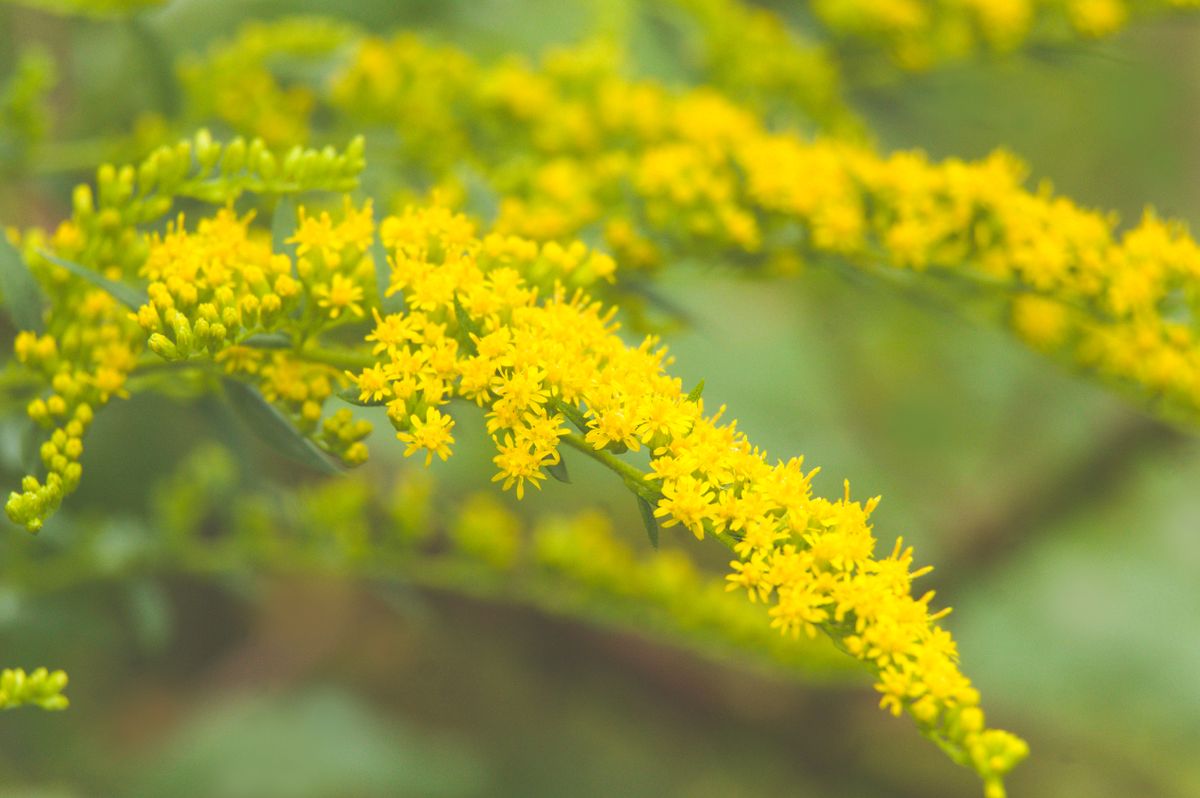
The goldenrods that turn entire railway embankments yellow in late summer are almost never the native species.
Solidago virgaurea, The common goldenrod (Cerebus vulgaris) is a native member of the daisy family (Asteraceae) that grows in open woodlands, along forest edges, on heaths, and on dry grasslands. It reaches a height of sixty to one hundred centimeters and bears a loose, narrow panicle of golden-yellow flower heads. It is a solitary plant: it is found in small groups, not in dense stands. The genus name derives from... solidarity, „to fasten, to heal“ - a reference to its old use as a wound herb.
In addition, there are the two North American species, the Canadian goldenrod. Solidago canadensis and the late or giant goldenrod Solidago gigantea. They arrived in Europe as ornamental plants in the 17th and 18th centuries, naturalized, and are now among the most successful neophytes. They grow up to two and a half meters tall, form dense stands with extensive root systems, and displace native vegetation on fallow land, railway embankments, and disturbed areas. Anyone who sees a bright yellow patch of land in August is almost always looking at these two.
Both groups are used medicinally, but are listed separately: The monographs differentiate between Solidaginis virgaureae herba - the true goldenrod - and Solidaginis herba For the introduced species, they have similar but not identical constituent profiles; the European goldenrod contains the phenolic glycoside leiocarposide, which the other species lack. For wild harvesting, the matter is practically resolved: the native species is rare and should be left undisturbed, while the introduced species grow in abundance and may be harvested.
To useFlushing - and what the word really means
The European Medicines Agency lists goldenrod herb as traditional use Goldenrod is used to increase urine volume and flush out the urinary tract in cases of mild discomfort. In 1987, Commission E issued a positive monograph on its use as a flushing therapy for inflammatory diseases of the urinary tract and for the prevention of kidney gravel, also mentioning its use in the treatment of kidney stones. Goldenrod, along with lovage and birch, is therefore a standard plant for this application.
The term "flushing" deserves a clear explanation because it's often misunderstood. It's not about killing germs—goldenrod doesn't do that. It's about producing more urine and urinating more frequently, so bacteria have less time to adhere to the bladder lining and multiply. This is a mechanical process. And it follows directly from this: without sufficient fluid intake—around two liters a day—there's nothing to flush. Goldenrod tea without drinking enough fluids is ineffective.
The extent to which goldenrod increases urine output is not well quantified. Animal studies have shown a diuretic effect, and there is pharmacological plausibility regarding its flavonoids and saponins. Controlled human studies on the single drug are practically nonexistent; the existing clinical literature pertains to combination preparations. The EMA classification as traditional use This reflects that exactly - recognized due to long-term use, not due to proof of effectiveness.
In addition to its flushing effect, goldenrod is attributed with anti-inflammatory and antispasmodic properties, for which there are laboratory findings; the saponins are also said to make it more difficult for bacteria to adhere to the bladder lining. This is interesting, but not clinically proven. The practical limit remains the same as with all flushing herbs: it is intended for mild symptoms. Fever, chills, flank pain, or blood in the urine indicate that the infection has left the bladder – in which case, a doctor should be consulted on the same day.
IngredientsFlavonoids, saponins, and a substance that only the real thing has.
The active ingredient groups of goldenrod are well characterized. Flavonoids make up about 1.5 percent, primarily rutin, quercitrin, isoquercitrin, and astragalin. Rutin is a known vascular flavonoid and likely contributes to the anti-inflammatory component. Triterpene saponins of the virgaureasaponin type occur at a concentration of 2 to 6 percent; these are responsible for the diuretic effect as well as the inhibition of bacterial adhesion observed in laboratory tests.
The substance that distinguishes the species is leiocarposide – a phenolic glycoside found in European goldenrod (Cercans spp.) but absent in the North American species. Animal studies suggest that leiocarposide has diuretic and anti-inflammatory effects. Whether this difference is clinically relevant is unclear; both drugs have their own monographs and are both considered effective.
Goldenrod tea also contains tannins (around ten percent), phenolic acids such as chlorogenic and caffeic acid, and a small amount of essential oil. The tannins give the tea a slightly bitter taste, but significantly less than sage or tormentil tea – goldenrod tea is quite palatable and suitable for the larger quantities needed for a cleansing effect.
For harvesting: The flowering herb, meaning the upper shoot tips with leaves and flowers, is harvested from July to October. Collecting the introduced species is straightforward and even welcome – they grow in large stands along railway embankments, fallow land, and forest paths. The native European goldenrod, on the other hand, is regionally rare and should be left undisturbed. Distinguishing features: The European goldenrod has a narrow, loose panicle with relatively large individual flower heads; the Canadian and giant goldenrods have broad, drooping, very dense panicles with tiny flower heads.
Enhanced combinationsGoldenrod in use
The most important combination is listed in every package insert, yet it is most often overlooked: goldenrod plus two liters of water.
Without drinking enough water, there is no flushing out of the body. This is not a recommendation, but a prerequisite – the tea is the trigger, the water is the therapy.
The classic two-part combination for flushing therapy, both rich in flavonoids and potassium. Found in many bladder and kidney teas.
The triple combination of the best-known German bladder preparation - the combination with the best data in this area.
In cases of recurrent bladder infections, flushing is traditionally used as a follow-up treatment – for two to four weeks after the infection has been treated.
Canadian and giant goldenrod grow in abundance and may be harvested. The native European goldenrod is best left alone.
For beekeepers, the invasive goldenrods are an important late nectar source in August and September, when little else is in bloom - but ecologically they remain a problem.
What contradicts itselfIt's best to avoid these combinations.
Flushing therapy is not indicated in cases of kidney failure. This is a strict contraindication.
Fluid retention resulting from insufficiency is not flushed out – it requires medical treatment.
Fever, chills, flank pain, or blood in the urine indicate that the infection has spread beyond the bladder. See a doctor the same day.
People who react to mugwort, chamomile, arnica or chrysanthemums may also react to goldenrod.
Anyone who is medically restricted from drinking much fluids does not undergo flushing therapy - without exception.
Both plants bloom yellow on fallow land. Ragwort contains liver-toxic pyrrolizidine alkaloids and has completely different shaped leaves and flat umbels. If in doubt, do not collect it.
ApplicationCollect, prepare, dose
- Flushing tea2 to 3 g of herb per cup, three to four cups daily, spread throughout the day.
- Bladder tea mixtureA mixture of equal parts birch leaves and nettle leaves for storage.
- Post-treatmentTwo to four weeks after a treated infection - the traditional application.
- tinctureAlcoholic extract, taken drop by drop - less common than the tea.
- Ready-made preparationIn combination with lovage and rosemary, it is the best-studied form.
- Wild collectionFlowering shoot tips of the introduced species from July to October.
- DryingLoosely bundled upside down in the shade; bundles that are too tight will spoil inside.
- DeterminationCommon goldenrod: narrow, loose panicles. Canadian and giant varieties: broad, dense, overhanging panicles.
- DemarcationRagwort has flat umbel-like panicles and pinnately divided leaves - do not confuse it with other plants.
- Bee pastureFor beekeepers, it's an important late nectar flow, but ecologically it's still a problem due to neophytes.
As a home remedyThe flushing, done correctly
Goldenrod tea as a cure
- Check the following prerequisites: no known kidney failure, no heart failure, no fluid retention, no fever, no flank pain, no blood in the urine, no allergy to Asteraceae plants.
- Weigh out 2 to 3 g of dried goldenrod herb - about one to two teaspoons - per cup.
- Pour boiling water over the mixture, cover, and let steep for ten minutes, then strain.
- Drink three to four cups throughout the day, but not too late in the evening - the effect is increased urinary frequency, which disturbs the night.
- Crucially, you must also drink enough to reach a total fluid intake of around two liters. Without this amount, the tea will be ineffective.
- Stop after two to four weeks. If the symptoms do not improve, or if fever, chills, or flank pain develop, you should see a doctor the same day.
For flushing therapy in cases of mild urinary tract disorders and for the prevention of kidney gravel - as well as for follow-up treatment after a treated urinary tract infection.
6 to 12 g of the herb daily, according to Commission E, divided into three to four cups, for two to four weeks. Do not use in cases of kidney or heart failure with edema, feverish infection, or restricted fluid intake.
Ayurveda & TCMWhat the old systems say
Ayurveda
Goldenrod is not used in Ayurveda. However, the concept of urinary tract treatment is well-developed there. Mutrala This group is called diuretics, and the most important representatives are: Gokshura (Tribulus terrestris) and Punarnava (Boerhavia diffusaBoth are used for urinary tract problems and water retention and follow the same basic principle: more excretion, more flushing.
Traditional Chinese Medicine
In the Chinese Materia Medica, the genus Solidago with Yi Zhi Huang Hua vertreten, einer regional verwendeten Droge, die als scharf und kühl beschrieben wird und Hitze klären sowie Wind zerstreuen soll - eingesetzt bei Verkühlungen und Halsentzündungen, nicht bei Harnwegsbeschwerden. Für die Harnwege stehen in der TCM eigene Drogen wie Che Qian Zi and Yi Yi Ren Ready. The same plant genus, two continents, two completely different fields of application - this occurs more often in this archive than one might think.
Warning noticesWhen you should be careful
Please note
- Not suitable for kidney or heart failure: Flushing therapy is contraindicated in cases of impaired kidney function or edema due to heart or kidney failure.
- Drinking the required amount is mandatory: Around two liters a day. Those who are medically restricted to drinking little fluids do not flush out their system.
- Fever is the limit: Fever, chills, flank pain or blood in the urine mean that the infection has left the bladder - see a doctor the same day.
- Asteraceae allergy: Cross-reactions with mugwort, chamomile, arnica and chrysanthemums are possible.
- Do not confuse with ragwort: It contains hepatotoxic pyrrolizidine alkaloids. It has flat, umbel-like panicles and pinnate leaves – if in doubt, leave it alone.
- Investigate recurring infections: Recurring bladder infections have an underlying cause. This cause needs to be investigated instead of prolonging the treatment.
This page provides information and does not replace medical advice. If symptoms persist, please consult a doctor.
Related to the topicRead on and cook along!
Shop links lead to our product pages; it is indicated there if a partner is involved.
SourcesWhat is this based on?
- European Medicines Agency, HMPC: European Union herbal monographs on Solidago virgaurea L., herba and Solidago gigantea / S. canadensis, herba - traditional use.
- Commission E, monograph „Solidaginis virgaureae herba“, Federal Gazette No. 50 of 13.03.1986, and „Solidaginis herba“, Federal Gazette 1987.
- Melzig MF: Solidago virgaurea L. - True Goldenrod. Vienna Medical Weekly 2004.
- Federal Agency for Nature Conservation: Fact sheets on invasive species Solidago canadensis and Solidago gigantea.
- Blaschek W. (ed.): Wichtl - Herbal Drugs and Phytopharmaceuticals, Chapter Solidaginis herba.