Carrot (Daucus carota subsp. sativus)
OriginViolet before it turned orange
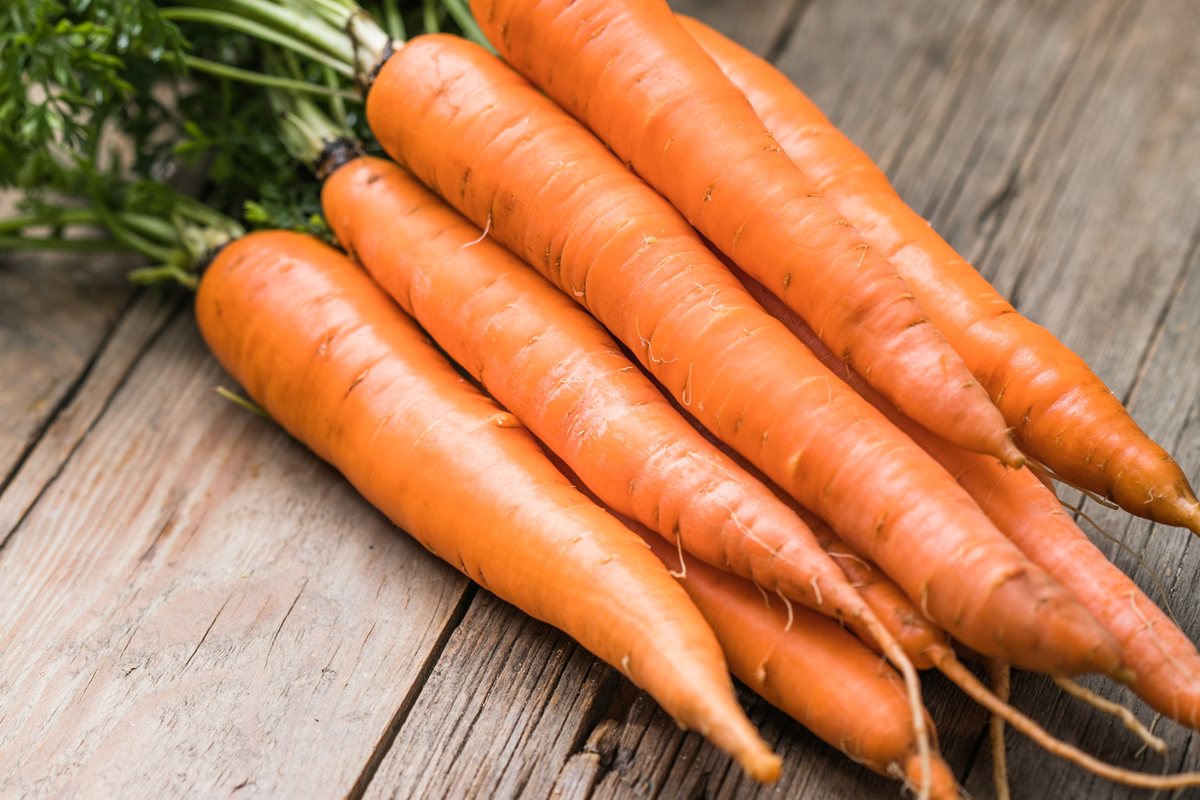
The first cultivated carrots were purple and yellow - the orange carrot is a Dutch variety from the 17th century.
Wild carrots grow along roadsides throughout Europe; their roots are thin, white, and woody. Cultivated carrots originated in Afghanistan and Persia about a thousand years ago; these early forms were purple due to anthocyanins or yellow. They spread to Spain via the Arabs and reached Central Europe in the late Middle Ages.
The orange carrot, as we know it, became established in the Netherlands in the 17th century. The charming story that it was bred in honor of the House of Orange, however, is unsubstantiated. Today, the carrot is one of the most important vegetables in Germany; heirloom varieties in purple, yellow, and white are making a comeback through farmers' markets and vegetable boxes.
To useWhat the carrot does for you
Carrots are the most important Beta-carotene source In the Central European diet, the body converts beta-carotene into vitamin A as needed – important for the eyes, skin, mucous membranes, and immune system. A medium-sized carrot theoretically covers more than the daily requirement of vitamin A. It also contains fiber, potassium, and vitamin K.
The preparation is crucial: Beta-carotene is fat-soluble and is firmly embedded in the cell walls. Cooked, pureed and with a little fat The body absorbs many times more nutrients from carrots cooked with butter than from raw, coarsely grated carrots. Therefore, carrot soup with butter is nutritionally superior to a raw salad without oil.
The story that carrots improve night vision dates back to World War II: The Royal Air Force attributed the accuracy of its night fighters to carrots – to keep the new radar secret. The only truth is that a genuine vitamin A deficiency causes night blindness. Those with sufficient vitamin A intake will not see better by eating more carrots.
IngredientsThis is what's in the carrot
Carrots contain water, sugar (mainly sucrose), soluble and insoluble fiber – including a lot of pectin –, Beta and alpha carotene, Potassium, vitamin K and B vitamins. Purple varieties also contain anthocyanins, yellow varieties lutein, red varieties lycopene.
Polyacetylenes, such as falcarinol, are responsible for the slightly bitter taste of some carrots and are being researched as plant defense compounds. During prolonged cooking, the pectins break down into short-chain oligosaccharides – this is precisely the principle behind Moro's carrot soup.
Enhanced combinationsWhat makes the carrot stronger
Carrots need fat so that their carotene can be absorbed - and acid or spice so that they don't just taste sweet.
Beta-carotene is fat-soluble: always eat carrots with some fat, in raw salads with oil, in vegetables with butter.
Cooking breaks down the cell walls - carrot soup and puree provide more carotene than raw sticks.
Carrot and ginger soup with orange zest: sweet, spicy, fresh.
Roasted carrots with cumin, yogurt and coriander - oriental and simple.
Carrot and apple salad with lemon and linseed oil - a classic for children.
Carrots, lentils, onions - stews and soups that fill you up.
What contradicts itselfIt's best to avoid these combinations.
The carrot allergen is similar to the birch pollen allergen. It is usually tolerated when cooked.
Carotene is hardly absorbed without fat - a few drops of oil are enough.
Large amounts turn the skin yellow-orange (carotenemia). Harmless, but noticeable – especially in infants.
As with all vegetables containing nitrates: prepare baby food fresh, do not keep warm for long.
The ethylene from apples makes carrots bitter.
The foliage draws water from the beet - cut it off before storage; the greens can be used as pesto.
In the kitchenWhere she belongs
- Carrot and ginger soupPureed with coconut milk or cream.
- Glazed carrotsIn butter with a little honey and thyme.
- Oven-baked carrotsRoasted whole with cumin and olive oil, with yogurt.
- Carrot and apple raw vegetablesFinely grated lemon, linseed oil.
- Carrot stewMit Erdäpfel, Petersilie und Mettwurst oder Linsen.
- Carrot cakeWith walnuts and cream cheese.
- Carrot top pestoWith nuts, Parmesan cheese, and olive oil.
- Carrot hummusRoasted carrots pureed with chickpeas.
- SoffrittoCarrot, onion, celery - the basis of the Italian sauce.
- baby foodThe classic first complementary food, with a teaspoon of oil.
As a home remedyMoro's Carrot Soup
Moro's Carrot Soup
- Cook 500g of peeled carrots in one liter of water for at least 90 minutes - the long cooking time is crucial.
- Puree and top up to one liter with boiled water.
- Stir in 3 g of salt (one level teaspoon).
- Drink or spoon it in small portions throughout the day, lukewarm.
Diarrhea in children and adults. The Heidelberg pediatrician Ernst Moro used the soup in 1908 to treat infants with diarrhea; mortality in his clinic dropped significantly. Later, an explanation was found: Prolonged cooking produces oligosaccharides that inhibit certain intestinal bacteria from attaching to the intestinal wall. Additionally, the soup replaces water and salt.
As needed throughout the day. The soup supplements, but does not replace, an electrolyte solution or a doctor: In the case of infants, fever, blood in the stool, lethargy, or if the child is hardly drinking, consult a pediatrician immediately.
Ayurveda & TCMWhat the old systems say
Ayurveda
The carrot (GarjaraIn Ayurveda, it is considered sweet, slightly bitter, and warming. It pacifies Vata and Kapha and is recommended for indigestion and eye health; it is a well-known dessert. Gajar ka Halwa made from carrots, milk, ghee and cardamom.
Traditional Chinese Medicine
In Traditional Chinese Medicine (TCM), the carrot (Hu Luo Bo) sweet and neutral. It is said to strengthen the spleen, resolve food stagnation, nourish the liver and clear the eyes - traditionally used for indigestion and dry eyes.
Warning noticesWhen you should be careful
Please note
- Allergy: For those with birch pollen allergy, raw birch pollen is often not well tolerated, while cooked birch pollen is usually fine.
- Carotenemia: Very large amounts will turn the skin yellowish - harmless and reversible.
- Infants: Prepare carrot puree fresh and do not reheat it multiple times (nitrate).
- Blood sugar: Cooked carrots have a higher glycemic index than raw ones - harmless in normal quantities.
- Diarrhea: Carrot soup does not replace medical evaluation in infants and in severe cases.
This page provides information and does not replace medical advice. If symptoms persist, please consult a doctor.
Related to the topicRead on and cook along!
Shop links lead to our product pages; it is indicated there if a partner is involved.
SourcesWhat is this based on?
- Moro E. Carrot soup for feeding disorders in infants. Munich Medical Weekly 1908; 55: 1637–1640.
- Guggenbichler JP et al. Acidic oligosaccharides from natural sources block adherence of Escherichia coli on uroepithelial cells. Pharmaceutical and Pharmacological Letters 1997; 7:35–38.
- van het Hof KH et al. Dietary factors that affect the bioavailability of carotenoids. Journal of Nutrition 2000; 130(3): 503–506.
- Banga O. Origin of the European cultivated carrot. Euphytica 1957; 6: 54–63.
- USDA FoodData Central: Carrots, raw.