
Pomelo (Citrus maxima)
OriginThe mother of the grapefruit
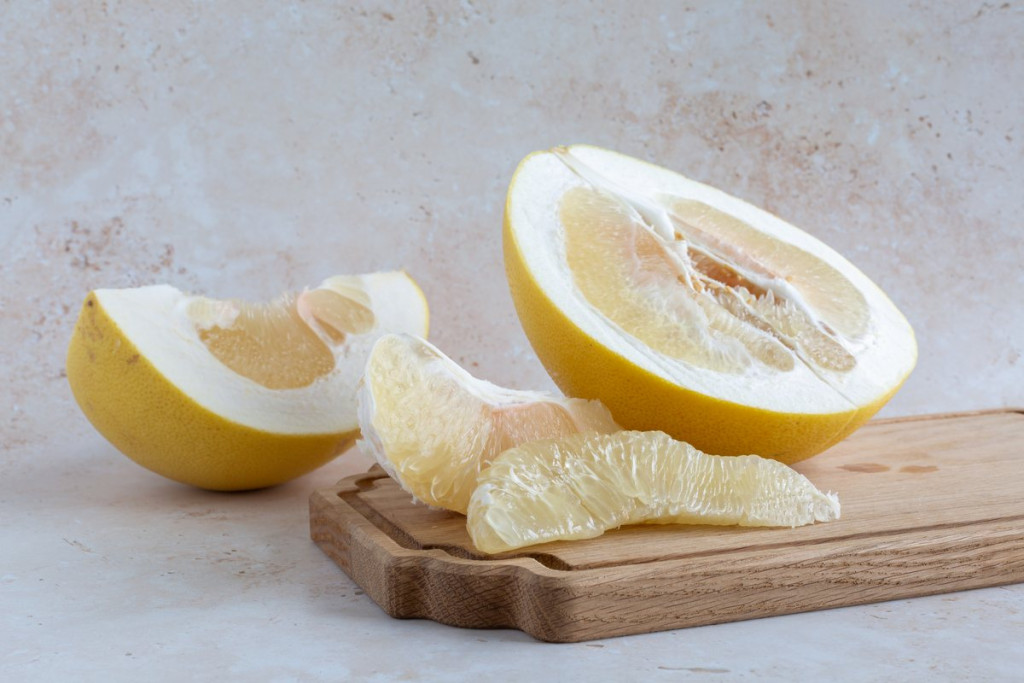
Genetic analyses show that the pomelo is one of the few true ancestral species from which almost all of today's citrus fruits originated.
The pomelo originates from Southeast Asia and southern China, where it has been cultivated for millennia. Along with the mandarin orange and the citron, it is one of the ancestors of our citrus fruits: the orange evolved from the pomelo and mandarin orange, and later the grapefruit from the pomelo and orange. Seafarers brought it to Europe; an English captain named Shaddock is said to have introduced it to the Caribbean in the 17th century – hence its English name. shaddock.
The fruits grow to be 15 to 30 cm long and often weigh 1 to 2 kg. Beneath the soft peel, which can be several centimeters thick, lie large segments whose membranes are bitter. Pomelos are primarily imported to Germany from China, Israel, and South Africa. Hybrids such as Sweetie or Oroblanco (pomelo × grapefruit) are also available commercially. In China, the pomelo is considered a lucky fruit during the Mid-Autumn Festival.
To useWhat Pomelo does for you
According to the USDA, 100 g of pomelo pulp provides approximately 61 mg of vitamin D. Vitamin C, 216 mg potassium, approximately 1 g of fiber and only around 38 kcal. A 150 g serving thus already covers the daily requirement of vitamin C. It also contains folate, flavonoids such as naringin and hesperidin, and, in pink varieties, some lycopene and beta-carotene.
Because it contains a lot of water and little acid, the pomelo is refreshing and easier for many people to digest than grapefruit. The large segments are filling and go well in savory salads. There are no reliable studies on any special health benefits – the pomelo is a good source of vitamin C, nothing more.
Another important characteristic is that pomelos contain, like grapefruits, Furanocoumarins, for example bergamottin. They inhibit the enzyme in the intestine. CYP3A4, which breaks down many drugs. The Canadian researchers who discovered the grapefruit interaction explicitly mention pomelos as being affected as well. A case has been described from Japan in which the blood level of the transplant drug tacrolimus rose significantly after the consumption of pomelo.
IngredientsThat's what's inside the pomelo
Pomelos consist of approximately 89% water and contain fructose, citric acid, vitamin C, potassium, folate, pectin, the flavonoids naringin, naringenin, and hesperidin, as well as limonoids. Pink varieties provide lycopene and beta-carotene. The peel and membranes contain essential oil, bitter substances, and particularly high concentrations of furanocoumarins such as bergamottin and 6′,7′-dihydroxybergamottin.
The furanocoumarin content varies greatly between varieties and growing regions. Because it cannot be detected when buying pomelo, people taking relevant medications should treat it like grapefruit.
Enhanced combinationsWhat makes pomelo stronger
The mild pomelo can tolerate strong partners - and needs distance from some tablets.
The Thai classic Yam Som-O.
Carotenoids from the pink varieties are absorbed better.
Vitamin C helps with the absorption of plant-based iron.
Awakens the mild aroma.
A refreshing contrast to Omega-3 fat.
Adding protein makes it more filling.
What contradicts itselfIt's best to avoid these combinations.
More active ingredient in the blood.
Dangerously high mirrors are possible.
Blood pressure can drop too low.
The inhibition lasts up to three days.
Bitter and rich in furanocoumarins.
Use only untreated peel.
In the kitchenWhere she belongs
- Pure for breakfastDetach segments from the skin.
- Yam Som-OThai pomelo salad with peanuts.
- Vietnamese saladGoi bưởi with shrimp and herbs.
- Winter saladMit Fenchel und Vogerlsalat.
- Avocado bowlWith pomelo, rice and sesame seeds.
- fruit saladWith kiwi and pomegranate.
- Candied peelMade from untreated fruit.
- jamWith a little ginger.
- Yogurt dessertWith mint and honey.
- Chinese dessertMango Pomelo Sago.
As a home remedyPomelo and herb salad as a vitamin C plate
Pomelo and herb salad
- Peel half a pomelo, remove the segments from the membranes and tear them into bite-sized pieces.
- Mix with a handful of coriander and mint, half a chili and a tablespoon of chopped peanuts.
- Season with the juice of half a lime and a teaspoon of oil.
- Eat immediately - Vitamin C is sensitive to prolonged standing.
A fresh, low-calorie side dish in winter when local fruit is scarce. Combined with lentils, tofu, or fish, the vitamin C helps with the absorption of plant-based iron.
A serving of approximately 150g of fruit pulp covers the daily requirement of vitamin C. This applies only if no relevant medications are being taken – if in doubt, consult a doctor or pharmacist.
Ayurveda & TCMWhat the old systems say
Ayurveda
The pomelo is used in Ayurveda as Madhukarkati It is well-known and considered sweet and sour, cooling, and heart-strengthening. According to current classification, it calms Pitta and is beneficial for Vata in moderation; the peel is described as aiding digestion.
Traditional Chinese Medicine
In Traditional Chinese Medicine (TCM), the pomelo is called You Zi: cold, sweet-sour, and associated with the stomach and lungs. It is said to relieve food stagnation and quench thirst. The peel (Hua Ju Hong) is considered warming and is used for coughs with a lot of phlegm.
Warning noticesWhen you should be careful
Please note
- Medications: Like grapefruit, pomelo contains furanocoumarins and can enhance the effects of many medications—for example, some statins, calcium channel blockers, immunosuppressants, and cancer drugs. Read the package insert or ask at the pharmacy.
- No distance: Enzyme inhibition can last up to three days - a time interval between taking the tablet and the medication does not provide reliable protection.
- Intersections: Sweetie, Oroblanco and Grapefruit are also affected.
- Potassium: Those with impaired kidney function who need to avoid potassium should only eat large pomelos in small portions.
- Peel: Use only untreated fruit for candying; imported fruit is often waxed and treated with preservatives.
This page provides information and does not replace medical advice. If symptoms persist, please consult a doctor.
Related to the topicRead on and cook along!
Shop links lead to our product pages; it is indicated there if a partner is involved.
SourcesWhat is this based on?
- Wu GA et al. Genomics of the origin and evolution of Citrus. Nature 2018; 554: 311–316.
- Bailey DG, Dresser G, Arnold JMO. Grapefruit–medication interactions: forbidden fruit or avoidable consequences? CMAJ 2013; 185(4): 309–316.
- Egashira K et al. Pomelo-induced increase in the blood level of tacrolimus in a renal transplant patient. Transplantation 2003; 75(7).
- Cancer Information Service, German Cancer Research Center: Citrus fruits and interactions with cancer medications.
- USDA FoodData Central: Pummelo, raw.


