OriginThe herb of the solstice
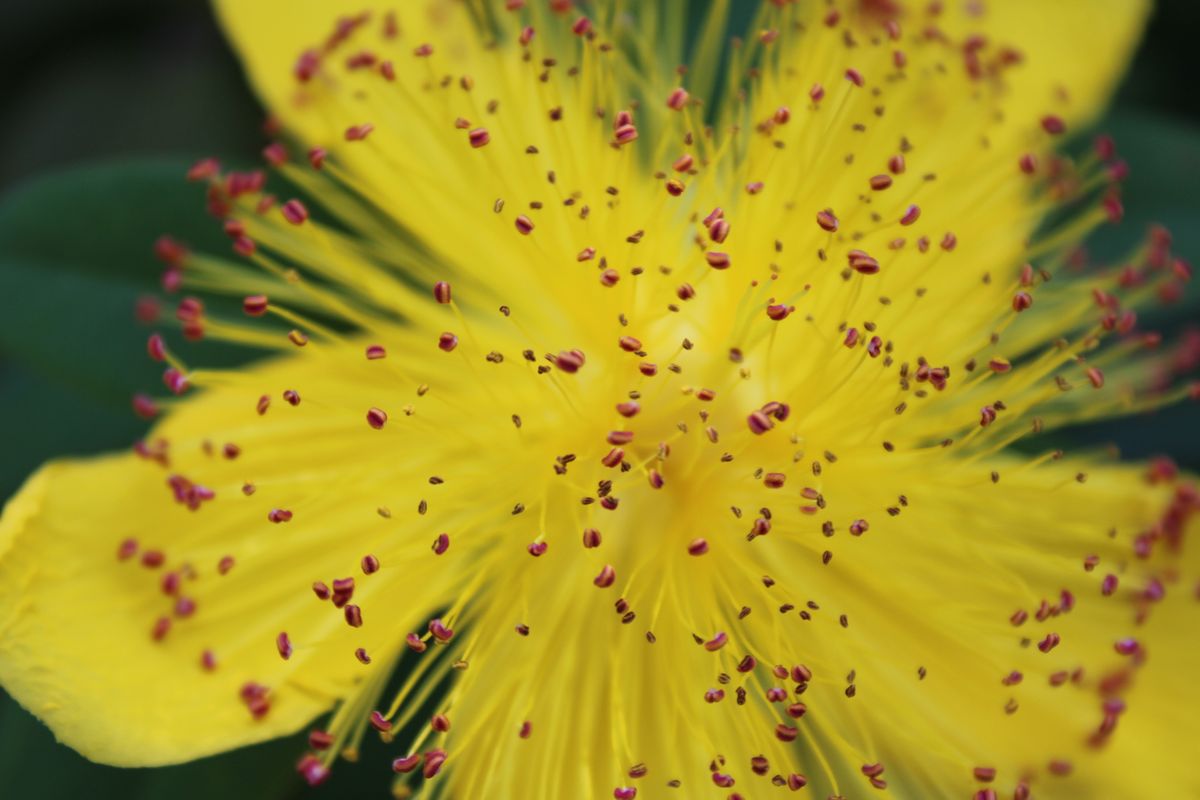
Hold a leaf up to the light: The apparent holes are oil glands, and the black dots on the leaf edge are hypericin, which turns oil and fingers deep red.
St. John's wort grows throughout Europe and Western Asia along roadsides, railway embankments, slopes, and in dry meadows – an undemanding, sun-loving perennial with bright yellow flowers. It gets its name from St. John's Day on June 24th: around the summer solstice, it is in full bloom, and it is precisely then that its active ingredient content is at its highest. The harvest time is therefore not folklore, but pharmacology.
Cultural history is closely intertwined with light and protection. It was hung above doors to ward off misfortune, woven into solstice wreaths, and called "devil's flight" and "witch's herb." The genus name Hypericum It is usually interpreted as "over the image"—branches that were placed over religious images. Two distinguishing features make it unmistakable: when held up to the light, the leaves appear perforated—these are light-colored oil glands, hence the specific epithet. perforatum. And if you rub a flower bud between your fingers, they change color. blood red; that is hypericin, and in common parlance the juice was called "St. John's blood".
Over the last four decades, St. John's wort has evolved medicinally from a folk remedy to one of the most thoroughly researched herbal medicines. In Germany, standardized St. John's wort extracts are among the most frequently prescribed medications for mild to moderate depressive episodes. Alongside this, its traditional external application continues to be used: Red oil, an oil extract from the fresh blossoms, traditionally used for burns, bruises and nerve pain.
To useWhat St. John's wort can do for you
St. John's wort is the The best-documented medicinal plant for mood, And that's no exaggeration. The European Medicines Agency lists standardized extracts in the category well-established use For mild to moderate depressive episodes. Large review studies, including a comprehensive Cochrane review, conclude that St. John's wort extracts are more effective than placebo in treating mild to moderate depression and are comparable in efficacy to standard antidepressants – with significantly fewer side effects and therefore fewer treatment discontinuations. This is an exceptional body of evidence for a plant.
Two limitations must be included immediately. First: This applies to standardized extracts in sufficient doses - usually 600 to 900 milligrams of dry extract daily - and not for St. John's wort tea or low-dose supplements. Secondly: This applies to light to moderate Episodes. St. John's wort is not the right answer for severe depression, and suicidal thoughts require immediate professional help, not a herbal remedy. And as with all antidepressants, it takes two to four weeks to assess whether it is effective.
However, the most important paragraph on this page is a different one, and it is deliberately placed at the top: St. John's wort has massive interactions. Its active ingredient, hyperforin, activates enzymes in the liver and transport systems in the intestines, which break down and eliminate medications more quickly. As a result, other drugs in the blood can drop significantly and lose their effectiveness – this affects, among others... hormonal contraceptives (Pregnancies caused by St. John's wort while taking the pill have been documented), blood thinners like warfarin (Marcumar), medications taken after organ transplants, HIV medications, some cancer medications, heart medications, and cholesterol-lowering drugs. Anyone regularly taking any medication should consult their doctor or pharmacist before using St. John's wort. This isn't fine print; it's the bottom line.
IngredientsThat's what's in the weed
Here too, it is not a single substance that is at work, but a combination of them. Hypericin and pseudohypericin are the red pigments from the black glands on the leaf and flower margins; they are traditionally used for standardization and are responsible for photosensitivity. Hyperforin Today it is considered the most important carrier of the mood-enhancing effect: It inhibits the reuptake of serotonin, noradrenaline and dopamine - similar to synthetic antidepressants, only broader and weaker at each individual point.
Hyperforin is also the substance behind these interactions. It activates a receptor in the liver that stimulates the production of the enzyme. CYP3A4 boosts, and additionally increases the transport protein P-glycoprotein in the intestine. Both of these factors combined mean that other drugs are broken down more quickly and absorbed less effectively. That's why there are also preparations with low hyperforin content – they have fewer interactions, but the strong body of research primarily concerns extracts with high hyperforin content.
In addition, the herb contains flavonoids such as hyperoside, rutin and quercetin, tannins, xanthones and essential oil. For the Red oil Fresh flower buds are steeped in good quality vegetable oil and left in the sun for several weeks; the oil turns deep red as hypericin and related substances are extracted. Applied externally, it is a traditional remedy for burns, blunt injuries, and nerve pain—with one caveat: after application, the skin should not be exposed to direct sunlight.
Enhanced combinationsWhat makes St. John's wort stronger
With this plant, the most important part is not what makes it stronger, but what you should have clarified beforehand.
600 to 900 mg of dry extract daily – that's the amount the studies refer to. Tea doesn't reach that level.
As with all antidepressants, the effect builds up slowly; nothing can be assessed beforehand.
The one step that really matters with St. John's wort: going through the medication list.
Daylight in the morning, exercise and a regular rhythm have been proven to help with mild episodes.
If tension and sleep problems are part of the package, then these are the unproblematic companions.
Oil extract from fresh blossoms for bruises, minor burns and nerve pain - a very unique application.
What contradicts itselfIt's best to avoid these combinations.
St. John's wort can render hormonal contraceptives ineffective – there are documented cases of pregnancies. Use additional protection or another herbal remedy.
These and many other active ingredients lose their effectiveness – this can be life-threatening for transplant recipients.
This combination can trigger serotonin syndrome - never combine or change them on your own.
Hypericin causes photosensitivity; sunburns have been reported in fair-skinned people and at high doses.
In cases of severe episodes, lack of motivation lasting for weeks, or suicidal thoughts, professional help is needed immediately.
It does not have an immediate effect and is not a calming or energizing remedy for a single bad day.
ApplicationHow it is used
- Standardized dry extract600 to 900 mg daily as a tablet - the form to which the studies refer.
- St. John's wort teaTwo teaspoons in 250 ml, covered for ten minutes - significantly weaker than the extract, more of a supportive measure.
- Red oil homemadeFresh flower buds in olive or sunflower oil, leave in the sun for three weeks, then strain.
- Red oil externallyMassage into the skin to relieve bruises, muscle tension, minor burns, and nerve pain.
- tinctureAlcoholic extract, taken drop by drop - dosage is more difficult to estimate than with a finished product.
- Combined with valerianWhen restlessness and sleep disturbances are part of the picture.
- As an accompanimentIn addition to talk therapy, exercise and light therapy, but not as a replacement for them.
- WintertimeTraditionally used during the dark season - together with daylight in the morning.
- Harvest timeAround St. John's Day at the end of June, when the active ingredient content is at its highest.
- Not for medicationsBefore starting any of this: Go through the medication list with your doctor or pharmacist.
As a home remedyMake your own red oil
St. John's wort red oil for the skin
- Around St. John's Day at the end of June, collect freshly opened blossoms and buds on a dry, sunny morning - when rubbed between the fingers, they must turn red.
- Loosely fill the blossoms into a clean screw-top jar and completely cover with good olive or sunflower oil.
- Place the sealed jar in a bright, sunny spot for three to four weeks, shaking it once a day. The oil will gradually turn a deep red.
- Strain through a cloth, pour into a dark bottle and store in a cool place - it will keep for about a year.
Externally, it's used for bruises, tension, sore muscles, minor burns, and sunburn, as well as traditionally for nerve pain. This is an old, well-established home remedy; the research is limited, but the oil is mild, pleasant, and demonstrably harmless. Red oil is not intended for internal use—its mood-enhancing effect comes from standardized extracts, not from the oil itself.
Massage a thin layer onto the affected area as needed. Important: After application, avoid exposing the skin to direct sunlight. Hypericin makes you sensitive to light. Do not apply to open, weeping wounds or to large or deep burns; these require medical attention.
Ayurveda & TCMWhat the old systems say
Ayurveda
St. John's wort is not a classic Ayurvedic plant and is not mentioned in the traditional texts. Based on its properties, it would be described as bitter, astringent, and slightly warming: reducing Kapha, calming Vata, and rather unfavorable for Pitta in therapeutic doses. It would thus be suitable for the dark, heavy, sluggish mood of winter—a Kapha state in Ayurvedic thought. This is a classification based on principle, not on tradition.
Traditional Chinese Medicine
In the Chinese Materia Medica Hypericum perforatum not classically classified; related species are used in Chinese folk medicine as Guan Ye Lian Qiao It is used primarily externally for wounds and swelling. Based on its nature, it is a bitter, cooling herb that clears heat and moves stagnant liver Qi – liver stagnation in TCM is the image that most closely corresponds to low mood and irritability.
Warning noticesWhen you should be careful
Please note
- Interactions: St. John's wort weakens the effects of numerous medications – birth control pills, warfarin, cyclosporine, HIV medications, some cancer drugs, digoxin, statins. Always consult your doctor or pharmacist beforehand.
- Prevention: Hormonal contraceptives can become ineffective; pregnancies have been documented.
- Antidepressants: Do not take additional doses on your own – the combination can trigger serotonin syndrome.
- Light sensitivity: Hypericin increases sensitivity to the sun and tanning beds, especially in fair skin and at high doses.
- Severe depression: In cases of severe episodes, persistent lack of motivation, or suicidal thoughts, immediate professional help is necessary – this is not a case for self-treatment.
- Discontinue: Never replace or discontinue prescribed medications on your own with St. John's wort.
This page provides information and does not replace medical advice. If symptoms persist, please consult a doctor.
Related to the topicRead on and cook along!
Shop links lead to our product pages; it is indicated there if a partner is involved.
SourcesWhat is this based on?
- EMA/HMPC: European Union herbal monograph on Hypericum perforatum L., herba - well-established use in mild to moderate depressive episodes.
- Linde K, Berner MM, Kriston L. St John's wort for major depression. Cochrane Database of Systematic Reviews 2008; CD000448.
- Commission E: Monograph Hyperici herba (St. John's wort), Federal Gazette 1984.
- Federal Institute for Drugs and Medical Devices: Information on interactions of St. John's wort-containing drugs, including with hormonal contraceptives, ciclosporin and HIV protease inhibitors.
- Blaschek W (ed.): Wichtl - Herbal drugs and phytopharmaceuticals. 6th edition 2016, monograph Hyperici herba.