
Rambutan (Nephelium lappaceum)
OriginThe fruit that bears its hair in its name
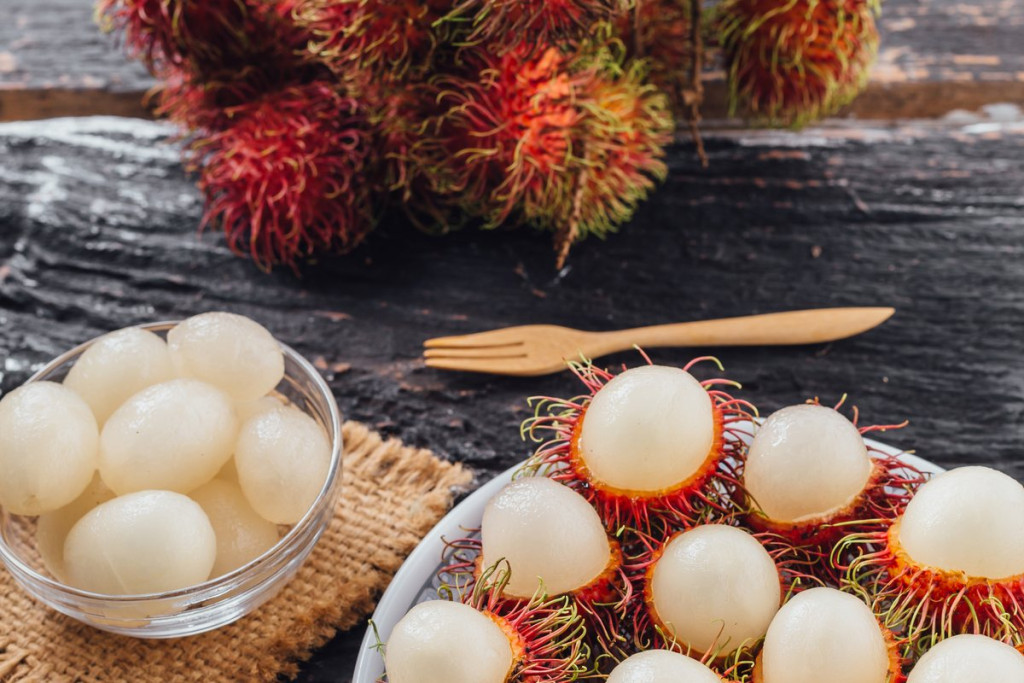
The name comes from Malay: rambut It simply means "hair".
The rambutan tree originates from the rainforests of the Malay Archipelago and has been cultivated there for centuries. From there, traders brought it to Sri Lanka, India, and the Philippines, and later to Central America. Today, the largest producers are Thailand, Indonesia, Malaysia, and Vietnam. Botanically, it belongs to the soapberry family – like lychee and longan.
Rambutan rarely arrives in Europe fresh. It's a problem child when it comes to transport: just a few days after harvesting, the hairs and peel turn brown, even though the flesh underneath is still good. That's why it's usually found on our shelves canned in syrup, and occasionally as an expensive, air-freighted fruit from Thailand or Vietnam in Asian markets.
To useWhat the rambutan does for you
According to the Federal Centre for Nutrition, fresh rambutan fruit pulp provides approximately 50 to 70 mg Vitamin C Per 100g – that means just a handful would exceed an adult's daily requirement. It also contains carbohydrates, some fiber, potassium, calcium, and traces of iron. Fat and protein are practically non-existent.
However, this only applies to fresh fruit. The canned fruit in syrup commonly found in Germany is listed in the US nutritional database with approximately 82 kcal and only around 4.9 mg Vitamin C Per 100g - heat and storage destroy most of the vitamin C. Therefore, anyone planning to use rambutan as a source of vitamin C needs fresh fruit; from a can, it's a sweet dessert, not a nutrient provider.
Everything else you read in advertising claims about rambutan comes from laboratory work on the Peel. It is rich in tannins such as geraniin, corilagin, and ellagic acid, and these substances have shown antioxidant and antimicrobial effects in test tubes. However, nobody eats the peel. Reliable studies on humans are still lacking. Rambutan is a good, water-rich fruit – and it doesn't need to be anything more.
IngredientsThis is what's in the rambutan
The pulp consists of roughly four-fifths water. It also contains fructose, glucose, and some sucrose, a small amount of fiber, vitamin C, potassium, calcium, magnesium, traces of iron and copper, as well as fruit acids that provide the delicate acidity.
The red peel and the kernel contain entirely different substances. The peel contains ellagitannins such as geraniin and corilagin, while the kernel contains fat – the so-called rambutanthali – as well as… Saponins and tannins. Studies of eleven varieties found saponins and tannins in all kernels. Both taste bitter and irritate the stomach; therefore, the kernel should not be eaten raw. In Southeast Asia, it is occasionally roasted and further processed, but this is industrial, not home cooking.
Enhanced combinationsWhat makes the rambutan stronger
The rambutan is sweet and mild - it thrives on acidity, spiciness and cool partners.
Enhances sweetness and protects vitamin C.
Refreshing on hot days.
The Thai classic.
Turn fruit into a dessert.
Sweet addition to the spicy pot.
Three family members in one bowl.
What contradicts itselfIt's best to avoid these combinations.
In its raw state, it contains saponins and tannins.
Inedible and often treated after harvesting.
It's almost entirely sugar water.
Otherwise, fruit becomes a candy.
They are corrupt.
Almost everything is lost during the canning process.
In the kitchenWhere she belongs
- Pure freshnessScore the peel all around and twist it open.
- fruit saladWith pineapple, mango and lime.
- Stuffed RambutanWith cream cheese or a piece of pineapple.
- Thai saladChili, lime, fish sauce, fried onions.
- SorbetPureed and frozen.
- SmoothieWith mango and coconut water.
- Red CurryAs a sweet treat at the end.
- ChutneyWith ginger, lime and chili.
- SalsaWith grilled fish.
- Long drinkInstead of lychee in a glass.
As a home remedyRambutan-Lime Refreshment
Rambutan-Lime Refreshment
- Peel 8 to 10 fresh rambutans and remove the seeds.
- Puree the pulp with the juice of half a lime and 300 ml of cold water.
- Pour through a coarse sieve, serve with a few mint leaves and ice cubes.
Not a cure, but the most sensible way to use ripe rambutan: plenty of water, some vitamin C, and no added sugar. On hot days and after exercise, a good alternative to store-bought fruit juice drinks.
One to two glasses a day. Best drunk fresh, as vitamin C degrades quickly when exposed to air.
Ayurveda & TCMWhat the old systems say
Ayurveda
Rambutan is not described in classical Ayurveda because it grows outside of India's heartland. According to modern understanding, the juicy, sweet fruit is considered cooling and moistening – balancing Pitta, but should be consumed sparingly by those with a strong Kapha constitution.
Traditional Chinese Medicine
Rambutan plays no role in classical Chinese texts either. In popular Southeast Asian tradition, it is considered – like its relative the lychee – a sweet, warming fruit, and one should not eat too many of it at once.
Warning noticesWhen you should be careful
Please note
- Core: Do not eat raw - it contains saponins and tannins, tastes bitter and irritates the stomach.
- Toddlers: Always remove the pit; it's best to cut the smooth fruit into pieces - otherwise there's a risk of choking.
- Allergy: Cross-reactions with lychee and longan are possible; avoid if tingling occurs in the mouth.
- Sugar: Canned goods are packed in sweetened syrup - for diabetics, treat them like a dessert.
- Peel: Do not eat; it is sometimes treated after harvesting and is inedible.
This page provides information and does not replace medical advice. If symptoms persist, please consult a doctor.
Related to the topicRead on and cook along!
Shop links lead to our product pages; it is indicated there if a partner is involved.
SourcesWhat is this based on?
- Federal Centre for Nutrition (BZfE): Exotic fruits: Rambutan - sweet and sour, and refreshingly fruity. Press release, 2018.
- USDA FoodData Central: Rambutan, canned, syrup pack.
- Zhang T et al. A review: extraction, phytochemicals, and biological activities of rambutan (Nephelium lappaceum L) peel extract. Heliyon 2022; 8(11): e11314.
- Chai KF et al. Characteristics of fat, and saponin and tannin contents of 11 varieties of rambutan (Nephelium lappaceum L.) seed. International Journal of Food Properties 2018; 21: 1091 ff.
- Isenberg SL et al. Quantification of toxins in soapberry (Sapindaceae) arils: hypoglycin A and methylenecyclopropylglycine. Journal of Agricultural and Food Chemistry 2016; 64(27): 5607–5613.


