
Blackthorn (Prunus spinosa)
OriginThe blackthorn of the hedges
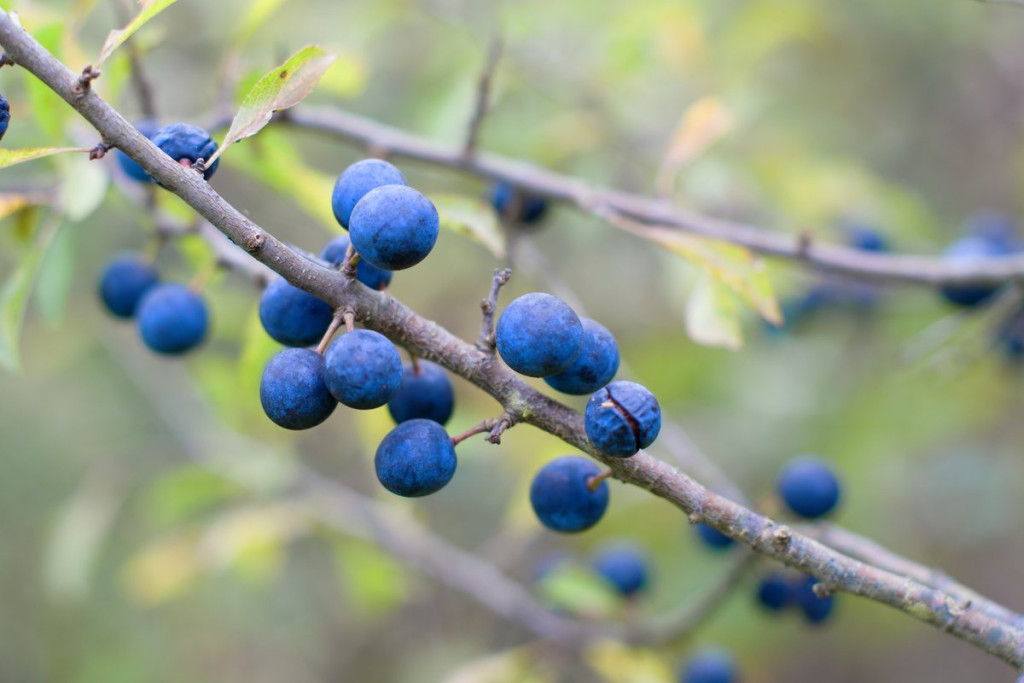
The shrub is called blackthorn because of its dark bark and long, sharp thorns.
Blackthorn grows wild throughout Europe along roadsides, forest edges, and in hedgerows. Seeds found in pile-dwelling settlements show that even Neolithic people gathered the fruit. The shrub blooms snow-white in March and April, even before the leaves appear – often the first blossom in the landscape. It provides an early food source for insects and a safe nesting site for birds in its tangle of thorns.
Sloes used to be a winter food supply for poor people: dried, cooked into a puree, or pickled unripe in brine. The sloe berry originated in England. Sloe Gin, We make sloe liqueur and sloe brandy from it. The sloe is an ancestor of the cultivated plum – it is considered, along with the cherry plum, a parent of the damson plum.
To useWhat sloe berries can do for you
Sloe berries are small, but densely packed with tannins and PolyphenolsSloe berries contain anthocyanins in their dark skin, flavonoids, phenolic acids, and proanthocyanidins. They also contain fruit acids, some vitamin C, potassium, and fiber. Precise nutritional information is scarce because sloe berries are not listed in major food databases and their composition varies considerably depending on location.
The tannins have an effect contracting. Therefore, Commission E gave a positive assessment to sloe berries – as a mouthwash or gargle for mild inflammation of the oral and pharyngeal mucosa. Laboratory studies show antioxidant and anti-inflammatory effects of sloe extracts; however, there are practically no clinical studies in humans to date.
The flowers sind ein altes Hausmittel: Als Tee galten sie als mild abführend, harntreibend und „blutreinigend“ und wurden bei Verkühlungen getrunken. Die Kommission E sah die Wirksamkeit dafür nicht belegt, aber auch keine Risiken. Schlehen sind also vor allem eine aromatische, herbe Wildfrucht mit viel Tradition - keine Heilpflanze mit gesicherter Wirkung.
IngredientsThis is what's in sloe berries
The fruits contain tannins (proanthocyanidins), anthocyanins, flavonoids such as quercetin and kaempferol glycosides, phenolic acids such as chlorogenic and neochlorogenic acid, fruit acids, sugars, pectin, vitamin C, and potassium. The flowers contain primarily flavonoids, as well as triterpenes and sterols.
In den Kernen steckt - wie bei Marille, Kirsche und Bittermandel - das cyanogene Glykosid Amygdalin, from which hydrocyanic acid is released when chewed or ground. The pulp itself is harmless.
Enhanced combinationsWhat makes sloe berries stronger
Sloe berries need cold, time, and sweet partners to show their aroma.
Cell walls break, bitterness diminishes.
Reduces the acidity in the puree.
For wild berry jelly.
For sloe juice in winter.
Dark winter juice.
As a bitter snack.
What contradicts itselfIt's best to avoid these combinations.
Amygdalin releases hydrogen cyanide.
Cook the fruit whole and then pass it through a sieve.
Very bitter, hard on the stomach.
Exhaust fumes and dog urine.
Alcohol is alcohol.
Similar blue berries are poisonous.
In the kitchenWhere they belong
- Sloe juiceHot-pressed, with honey.
- sloe jamCooked with apple.
- Sloe jellyWith rosehip.
- sloe liqueurFruits preserved entirely in grain.
- Sloe GinThe English classic.
- Wild game sauceWith venison or mushroom roast.
- Sloe chutneyWith onion and ginger.
- Sloe syrupFor sparkling water and tea.
- Pickled sloesUnripe in brine, like olives.
- Blackthorn blossom teaCollected in spring.
As a home remedyBlackthorn blossom tea according to folk medicine
Blackthorn blossom tea
- Collect freshly opened blackthorn blossoms away from roads in March or April and dry them in the shade.
- Pour 250 ml of hot, but not boiling, water over 1 to 2 teaspoons of dried flowers.
- Cover and let steep for 5 to 10 minutes, then strain.
- Drink warm and in small sips, with a little honey if desired.
In der Volksmedizin als milder Frühjahrstee zur Anregung der Verdauung, bei leichter Verstopfung und bei Verkühlungen. Die Wirksamkeit ist nicht belegt; die Kommission E sah für diese Anwendungen keine ausreichenden Nachweise, aber auch keine Risiken.
1 to 2 cups a day, for a maximum of a few weeks. Consult a doctor if digestive problems persist.
Ayurveda & TCMWhat the old systems say
Ayurveda
The sloe is a European wild plant and not described in classical Ayurveda. According to current understanding, the tart fruit is considered astringent and cooling – balancing Pitta and Kapha, while for Vata it is better cooked and sweetened.
Traditional Chinese Medicine
Sloe berries play no role in Traditional Chinese Medicine (TCM). Based on their taste, they would be classified as sour and astringent, and thus "constricting," remedies traditionally used for diarrhea and excessive sweating.
Warning noticesWhen you should be careful
Please note
- Cores: Do not bite, grind or puree - amygdalin releases hydrocyanic acid.
- Liqueur: Use only whole, undamaged fruits and strain after a few weeks.
- Stomach: Raw, unripe sloes can cause stomach upset due to their tannin content.
- Confusion: Only harvest bushes with thorns and stone fruits that you have identified with certainty.
- Pregnancy: Avoid sloe blossom tea due to a lack of data, and liqueur in general.
- Children: Guide children while collecting so they don't chew the kernels.
This page provides information and does not replace medical advice. If symptoms persist, please consult a doctor.
Related to the topicRead on and cook along!
Shop links lead to our product pages; it is indicated there if a partner is involved.
SourcesWhat is this based on?
- In MF et al. An Overview of the Phytochemical Composition of Different Organs of Prunus spinosa L., Their Health Benefits and Application in Food Industry. Horticulturae 2024; 10(1): 29.
- Magiera A, Czerwińska ME, Owczarek A, Marchelak A, Granica S, Olszewska MA. Polyphenol-Enriched Extracts of Prunus spinosa Fruits: Anti-Inflammatory and Antioxidant Effects in Human Immune Cells Ex Vivo in Relation to Phytochemical Profile. Molecules 2022; 27(5): 1691.
- Commission E (BGA/BfArM): Monographs Pruni spinosae fructus (blackthorn fruits) and Pruni spinosae flos (blackthorn flowers).
- EFSA Panel on Contaminants in the Food Chain (CONTAM). Acute health risks related to the presence of cyanogenic glycosides in raw apricot kernels and products derived from raw apricot kernels. EFSA Journal 2016; 14(4): 4424.
- Consumer Advice Center: Hydrocyanic acid from flaxseeds, almonds, and other foods: A problem with dietary supplements?


