OriginThe fungus that needs a tree
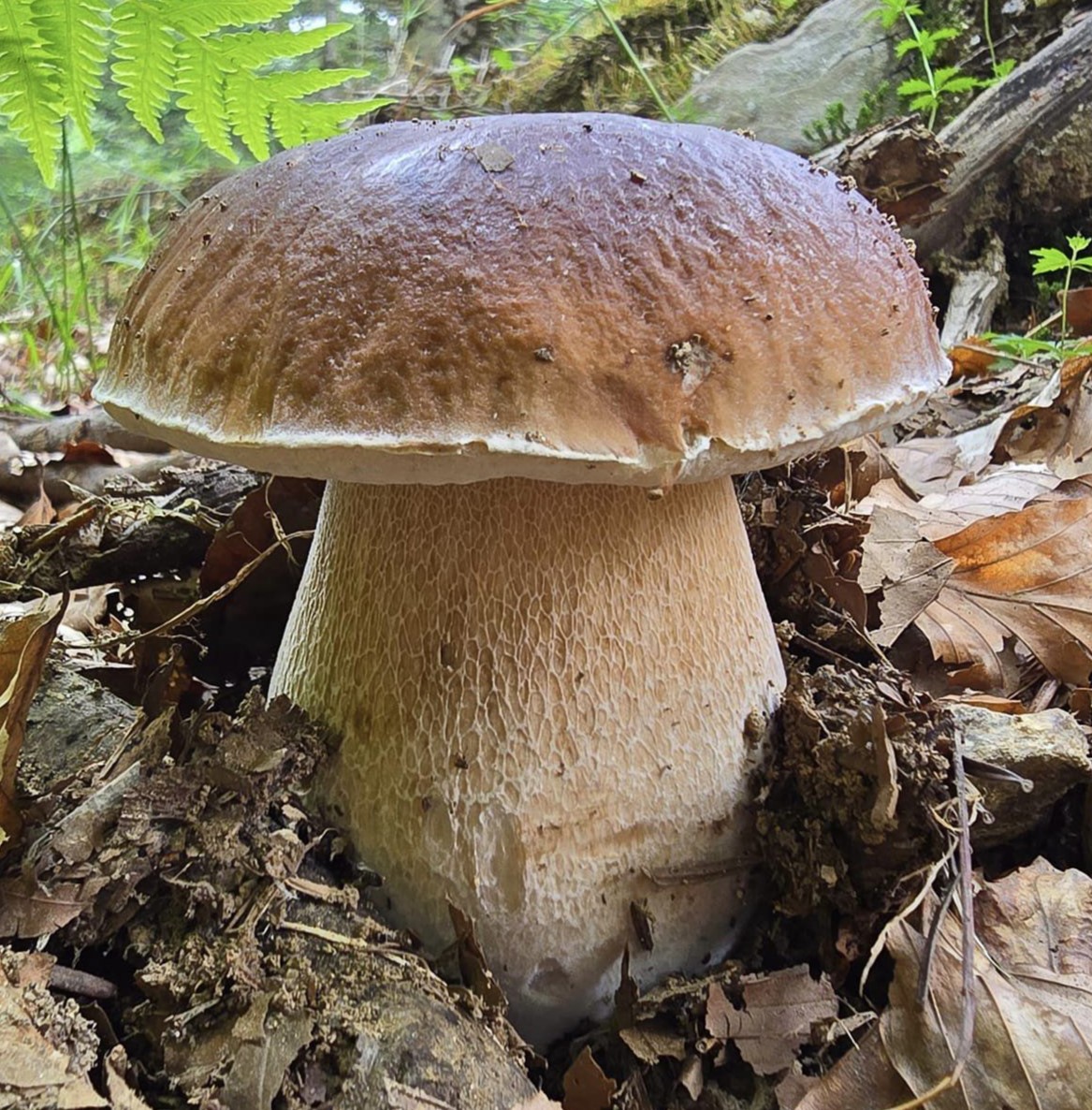
Why there is no such thing as porcini mushroom cultivation: It cannot exist without living tree roots.
Boletus edulis It forms a thick, bulbous stem with a fine white network in the upper part and a brown, wheat-colored to chestnut-brown cap. The underside has a layer of tubes instead of gills; these are white when young and turn yellowish-green with age. The flesh is white and does not discolor when cut – an important identifying characteristic.
It lives in mycorrhiza, a symbiotic relationship with tree roots: The fungal mycelium envelops the fine roots, supplying the tree with water and minerals, and in return receiving sugars from photosynthesis. Its partners are primarily spruce, pine, beech, and oak. This very dependence is the reason why there is no such thing as cultivating porcini mushrooms – unlike button mushrooms or oyster mushrooms, it cannot be grown on a dead substrate. All porcini mushrooms sold commercially are wild-harvested, predominantly from Eastern Europe.
Its occurrence is therefore dependent on the forests and the weather. Good years for porcini mushrooms follow warm, humid late summers; in dry years, there is no harvest. The main season is between August and October, with a smaller peak in early summer. Collectors know their spots, and the fact that they don't reveal them is part of the folklore of mushroom picking – and rightly so, because the mycelia remain in the same place for decades.
To useOne food item – and two practical questions
The porcini mushroom is an edible mushroom with no medicinal properties. Nutritionally, it provides protein, fiber, B vitamins, potassium, and selenium, with a low energy density – like most mushrooms. Its true value lies in its flavor: it has an exceptionally high content of glutamate and other flavor-active compounds, which explains its intense umami character.
It's remarkable that dried porcini mushrooms have a more intense flavor than fresh ones. During the drying process, enzymatic processes create additional flavor compounds, and the flavor-active substances become more concentrated. A few grams of dried porcini mushrooms add more depth to a sauce than an entire pan of fresh ones. The soaking liquid is therefore very valuable and should always be used.
Now to a topic that many people don't consider: radioactivity. After the Chernobyl reactor disaster in 1986, parts of southern Germany—especially the Bavarian Forest, the Alpine foothills, and parts of Baden-Württemberg—were contaminated with cesium-137. Fungi absorb cesium particularly well because they mistake it for potassium, and mycorrhizal fungi like the porcini mushroom accumulate it more than decomposer fungi. The Federal Office for Radiation Protection continues to measure the contamination and publishes annual figures.
How serious is this? For occasional consumption, it's not a problem. The Federal Office for Radiation Protection points out that consuming 250 grams of highly contaminated wild mushrooms per week leads to additional radiation exposure that is significantly lower than the natural annual exposure. Anyone who regularly collects large quantities of mushrooms in the affected regions should be aware of the current BfS (Federal Office for Radiation Protection) measurements for their area. For mushrooms from northern Germany and those purchased commercially, the issue is practically settled.
IngredientsHow to recognize him - and how to recognize his doppelganger
The porcini mushroom can be easily identified by four characteristics: a brown, dull to slightly slimy cap; a tube layer that is white when young and later yellowish-green; a bulbous, light-colored stem with a fine, white network in the upper third; and white flesh that does not discolor when cut.
The most important lookalike is the bitter bolete. Tylopilus felleus. It's not poisonous, but so extremely bitter that a single specimen can render a pan full of porcini mushrooms inedible. Distinguishing it is easy once you know how: its tubes are white when young, but turn pink to a dirty pink, not yellowish-green. Its stem reticulation is coarse and dark – brown to blackish – instead of fine and white. And if you want to be absolutely sure, just lick the pore surface: the bitter bolete tastes immediately and unmistakably bitter.
The Satan's Bolete Rubroboletus satanas Its poisonous relative is easily recognizable: it has red pore mouths, a red stem network, and bruises noticeably blue when cut. It also only grows on calcareous soils and mostly under oak and beech trees. The rule of thumb for boletes is: steer clear of anything with red pores, and be careful with mushrooms that bruise strongly blue.
One more practical tip regarding maggots. Porcini mushrooms are frequently infested by fungus gnat larvae; the stem is usually affected first. This isn't a health risk, but it's unappetizing. The trick: When picking, cut the stem at the bottom and inspect the cut surface – if it shows tunnels, leave the mushroom or at least cut away the infested part. And don't transport porcini mushrooms in a plastic bag, but in a well-ventilated basket, otherwise they will spoil within hours.
Enhanced combinationsCollect and process
When it comes to porcini mushrooms, two things matter: identifying them with certainty and not wasting their aroma.
Dried, it's more intense than fresh. The best preservation method and the best way to keep the aroma going through the winter.
The soaking water from dried porcini mushrooms is an excellent base for sauces and risotto - never throw it away, just leave the sediment.
Slice fresh, firm porcini mushrooms into thick slices and fry in butter. Less is more: garlic and parsley are sufficient.
The porcini mushroom is one of the few mushrooms that are eaten raw - very young, firm specimens in paper-thin slices with oil, lemon and Parmesan cheese.
Never put them in plastic bags. Mushrooms will spoil within hours in them.
White-yellow-green tubes and a fine white network on the stem. Pink tubes plus a coarse dark network indicate bitter bolete.
What contradicts itselfIt's best to avoid these combinations.
Not poisonous, but extremely bitter – one specimen can ruin the whole pan. Check the color of the tubes and the network of membranes on the stem; if in doubt, lick the tubes.
Red pore mouths and strong blue coloration indicate caution. A rule of thumb for beginners: leave boletes with red pores where they are.
Cesium-137 is still detectable in parts of Bavaria and Baden-Württemberg. Anyone regularly collecting large quantities there should be aware of the BfS (Federal Office for Radiation Protection) measurement values.
Mushrooms spoil very quickly in plastic bags. Use a basket or paper bag.
They soak up water and then can no longer be fried. Brush them off or wipe them with a damp cloth.
No health risk, but unappetizing. Check the cut surface of the stem; cut away any affected parts.
In the kitchenWhat you make of him
- FriedCut into thick slices, cooked in butter with garlic and parsley.
- RisottoDried porcini mushrooms made with soaking water as stock - one of the best mushroom dishes ever.
- cream sauceWith bread dumplings, spaetzle or game.
- CarpaccioVery young, firm specimens, sliced paper-thin with oil, lemon and Parmesan cheese.
- SoupMade from dried porcini mushrooms - more intense than from fresh ones.
- Porcini mushroom powderDried and ground into a seasoning powder; a teaspoon enhances any sauce.
- pastaServe with cream and parsley over tagliatelle.
- FrozenFreeze them pre-fried - if frozen raw they will become mushy.
- InsertedSmall, firm specimens marinated in vinegar and oil.
- DryCut into thin slices and dry at 40 to 50 degrees.
As a home remedyHow to properly dry porcini mushrooms
The winter supply
- Use only firm, maggot-free specimens. Cut the stem at the bottom: If the cut surface shows feeding tunnels, cut away the infested part.
- Do not wash. Clean with a brush or cloth; cut off any dried soil from the stem.
- Cut into even slices of about three to five millimeters. Uniformity is more important than thickness to ensure everything dries at the same rate.
- Spread the slices out on wire racks, a dehydrator, or parchment paper – they must not touch each other. Dry in a dehydrator or oven at 40 to 50 degrees Celsius with the door slightly ajar.
- They are finished when they break instead of bending when bent. This takes four to ten hours, depending on the thickness.
- Allow to cool completely and fill into airtight jars. Stored in a dark place, they will keep for at least a year. Check them after one to two weeks: If the glass is fogged up, they were not completely dry and need to be dried further.
For winter storage – and because dried porcini mushrooms are more aromatic than fresh ones. The soaking water makes one of the best mushroom broths ever.
It can be consumed as food at will. For wild harvesting, the rule of personal use applies – usually defined as about one kilogram per person per day. In cesium-contaminated regions of southern Germany, observe the current measurement values of the Federal Office for Radiation Protection.
Ayurveda & TCMWhat the old systems say
Ayurveda
The porcini mushroom is not represented in Ayurveda - it is a European-North Asian forest mushroom, and mushrooms play a minor role in classical Ayurvedic dietetics anyway.
Traditional Chinese Medicine
In China Boletus edulis as Mei Wei Niu Gan Jun A well-known and highly prized edible mushroom in Yunnan, it is also exported. In dietetics, it is described as sweet and neutral, with a connection to the spleen and stomach, strengthening Qi and promoting digestion. It does not have a medicinal role in the strict sense – as in Europe, it is primarily a delicacy, and in Yunnan, the mushroom season is one of the culinary highlights of the year.
Warning noticesWhen you should be careful
Please note
- Bitter bolete: Not poisonous, but extremely bitter – one specimen can ruin an entire dish. Pinkish tubes and a coarse, dark reticulated stem are its distinguishing features.
- Satan's bolete and red pores: Leave boletes with red pore mouths alone. That's the safest rule of thumb for beginners when looking at this group of mushrooms.
- Cesium-137 in southern Germany: Still measurable in parts of Bavaria and Baden-Württemberg. When regularly collecting large quantities, observe the measurement guidelines of the Federal Office for Radiation Protection.
- Do not transport in plastic bags: Mushrooms will spoil within hours in it. Airy basket.
- Always cook thoroughly: The exception is the carpaccio made from very young, firm specimens - and that is a conscious decision.
- If in doubt, consult a mushroom advisor: Free consultations are available in many cities. If you are unsure, don't put a mushroom in the pan.
This page provides information and does not replace medical advice. If symptoms persist, please consult a doctor.
Related to the topicRead on and cook along!
Shop links lead to our product pages; it is indicated there if a partner is involved.
SourcesWhat is this based on?
- Federal Office for Radiation Protection: Radioactivity in wild mushrooms - annual measurement reports.
- German Society for Mycology: Identifying characteristics and risks of confusion in boletes.
- Gerhardt E.: The large BLV mushroom guide for on the go - standard work for identification.
- Federal Nature Conservation Act § 39 and Federal Species Protection Ordinance - regulations on removal for personal use.
- Peintner U. et al.: Mycorrhizal fungi and their role - why porcini mushrooms cannot be cultivated.