
Watermelon (Citrullus lanatus)
OriginThe desert water bottle
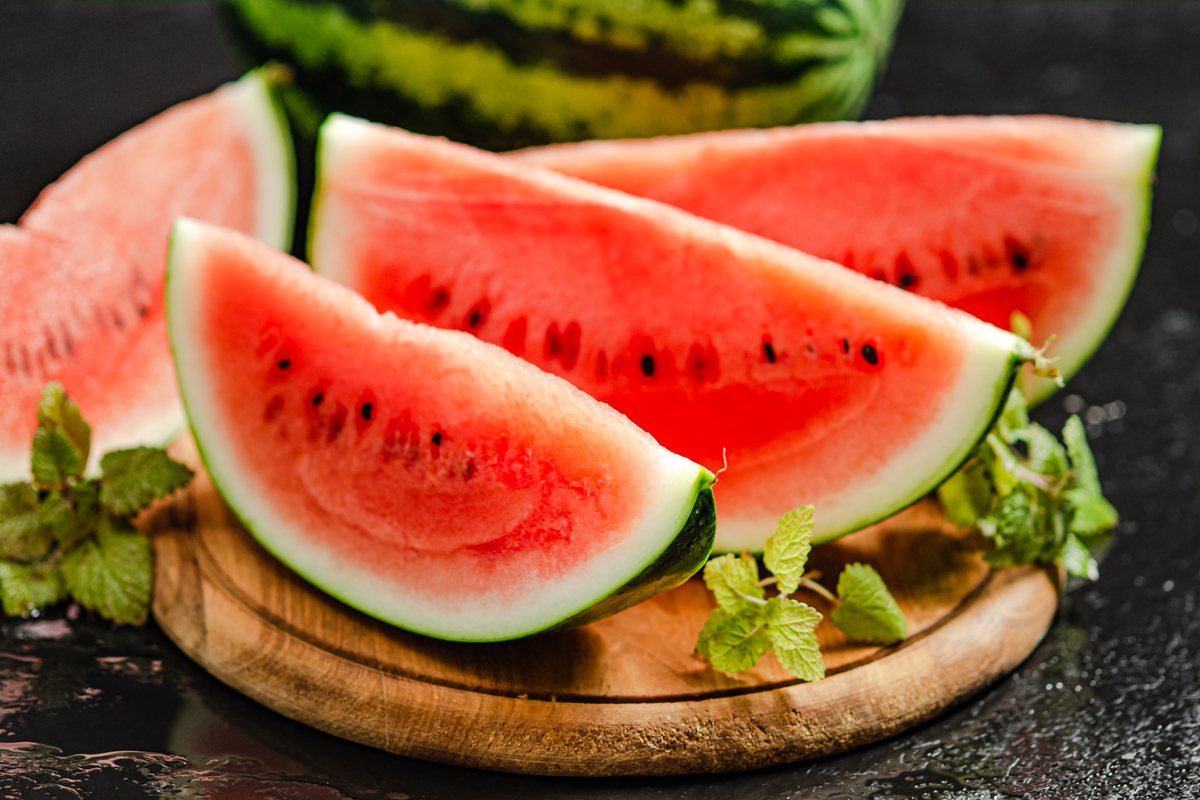
Even in ancient Egypt, watermelons were placed next to the pharaohs as grave goods.
The watermelon originated in Northeast Africa, where wild relatives still grow in Sudan and the Kalahari. Originally, the fruits were rather bitter and were valued primarily as a water reservoir for dry periods and for their seeds. Egyptian wall paintings depict melons more than 4,000 years ago. Via the Mediterranean, Persia, and India, it reached China – today by far the world's largest producer.
Watermelons arrived in Central Europe via Spain with the Moors. Our watermelons mostly come from Spain, Italy, Greece, or Turkey, and from overseas in winter. For some years now, with warmer summers, they have also been cultivated in southern Germany, especially in Baden and the Palatinate. Besides the large, striped varieties, there are small, seedless mini-melons and yellow-fleshed varieties that contain primarily other carotenoids instead of lycopene.
To useWhat watermelon can do for you
100g of watermelon consists of approximately 92g of... Water and provide only about 30 kcal, a good 6 g of sugar, some vitamin C, potassium and magnesium. Their outstanding ingredient is Lycopene: Mit rund 4,5 mg pro 100 g enthält sie ähnlich viel wie eine frische Paradeiser. In einer kleinen Studie stiegen die Lycopin- und Beta-Carotin-Werte im Blut nach drei Wochen Wassermelonensaft ähnlich an wie nach Paradeisersaft.
The second special feature is Citrulline, Arginine is an amino acid that the body converts into arginine—a building block for nitric oxide, which dilates blood vessels. In one study, arginine levels in the blood increased after several weeks of drinking watermelon juice. Small pilot studies with watermelon extract found slightly reduced blood pressure; however, such an effect has not been proven for the whole fruit in normal quantities.
Blood sugar levels warrant a second look: glycemic index Watermelon has a high INR of around 72 because its sugar is quickly absorbed into the bloodstream. However, because it contains so little sugar, the glycemic load A 120g portion contains about 4 calories. A slice for dessert is therefore usually fine even for people with diabetes – half a melon at once, however, is not recommended.
IngredientsThis is what's in the watermelon
Watermelon contains water, sugar (primarily fructose, glucose, and sucrose), carotenoids such as lycopene and beta-carotene, the amino acids citrulline and arginine, vitamin C, vitamin A (as provitamin), potassium, magnesium, and small amounts of polyphenols. Citrulline is also abundant in the light-colored rind.
The black kernels They are edible and have a completely different composition: Dried, they provide plenty of protein, fat, magnesium, iron, and zinc. Swallowed whole, they usually pass through the intestines undigested; roasted or sprouted, they become a nutty snack.
Enhanced combinationsWhat makes watermelon stronger
Watermelon likes salt, acidity and a little fat - and lots of cold.
Salty and sweet, the quintessential summer salad.
Freshness without sugar.
It enhances sweetness and provides vitamin C.
Helps with the absorption of lycopene.
It flattens the rise in blood sugar.
Like in Mexican markets.
What contradicts itselfIt's best to avoid these combinations.
Germs multiply rapidly in sweet juice.
Germs from the peel get into the flesh of the fruit.
For people with diabetes and irritable bowel syndrome, it's better to eat in portions.
High in fructose and polyols.
You hardly notice the alcohol.
Cool temperatures are fine, but it loses its aroma if it gets too cold.
In the kitchenWhere she belongs
- Melon salad with fetaWith mint, onion and olive oil.
- gazpachoMit Paradeiser und Gurke.
- Melon sorbetJust fruit and a little lime.
- Fresh waterBlended with water and lime.
- Fruit skewersWith berries and mint.
- Grilled melonBriefly grilled with salt.
- SalsaWith chili, coriander and lime.
- Pickled barkSweet and sour, like in the Southern states.
- Roasted kernelsWith salt from the pan.
- Watermelon bowlWith yogurt and nuts.
As a home remedyMelon and lime water for hot days
Melon water
- Dice 300g of rindless watermelon, leaving the seeds in.
- Puree finely with the juice of half a lime and 300 ml of cold water.
- If desired, pour through a sieve and add a pinch of salt and a few mint leaves.
- Drink well chilled on the same day.
A refreshing drink on hot days or after sports. It provides fluids, some potassium and a pinch of salt - without added sugar.
One to two glasses a day. If you have diabetes, it's better to have a piece of fruit than juice, because the sugar in the drink enters the bloodstream faster.
Ayurveda & TCMWhat the old systems say
Ayurveda
In Ayurveda, watermelon is considered cooling, sweet, and rich. It is recommended in summer to combat the heat and to calm Pitta. For Vata and Kapha doshas, it should only be eaten in moderation and not with other foods.
Traditional Chinese Medicine
In Traditional Chinese Medicine (TCM), watermelon is considered cold and sweet. It is said to dispel summer heat, quench thirst, and promote urination. The rind (Xi Gua PiIt is also used. Caution is advised in cases of coldness in the digestive tract.
Warning noticesWhen you should be careful
Please note
- Hygiene: Wash the peel before cutting, keep the pieces refrigerated and consume quickly.
- Diabetes: High glycemic index - eat in portions, preferably as fruit rather than juice.
- Fructose: In people with fructose intolerance or irritable bowel syndrome, it can trigger bloating and diarrhea.
- Allergy: Cross-reactions with grass and mugwort pollen, as well as with other cucurbit plants, are possible.
- Potassium: If you have advanced kidney failure, consult your doctor before consuming larger quantities.
This page provides information and does not replace medical advice. If symptoms persist, please consult a doctor.
Related to the topicRead on and cook along!
Shop links lead to our product pages; it is indicated there if a partner is involved.
SourcesWhat is this based on?
- USDA FoodData Central: Watermelon, raw.
- Edwards AJ et al. Consumption of watermelon juice increases plasma concentrations of lycopene and beta-carotene in humans. Journal of Nutrition 2003; 133(4): 1043–1050.
- Collins JK et al. Watermelon consumption increases plasma arginine concentrations in adults. Nutrition 2007; 23(3): 261–266.
- Figueroa A et al. Effects of watermelon supplementation on aortic blood pressure and wave reflection in individuals with prehypertension: a pilot study. American Journal of Hypertension 2011; 24(1): 40-44.
- Atkinson FS, Foster-Powell K, Brand-Miller JC. International tables of glycemic index and glycemic load values: 2008. Diabetes Care 2008; 31(12): 2281–2283.


