
OriginThe herb that makes legs better again
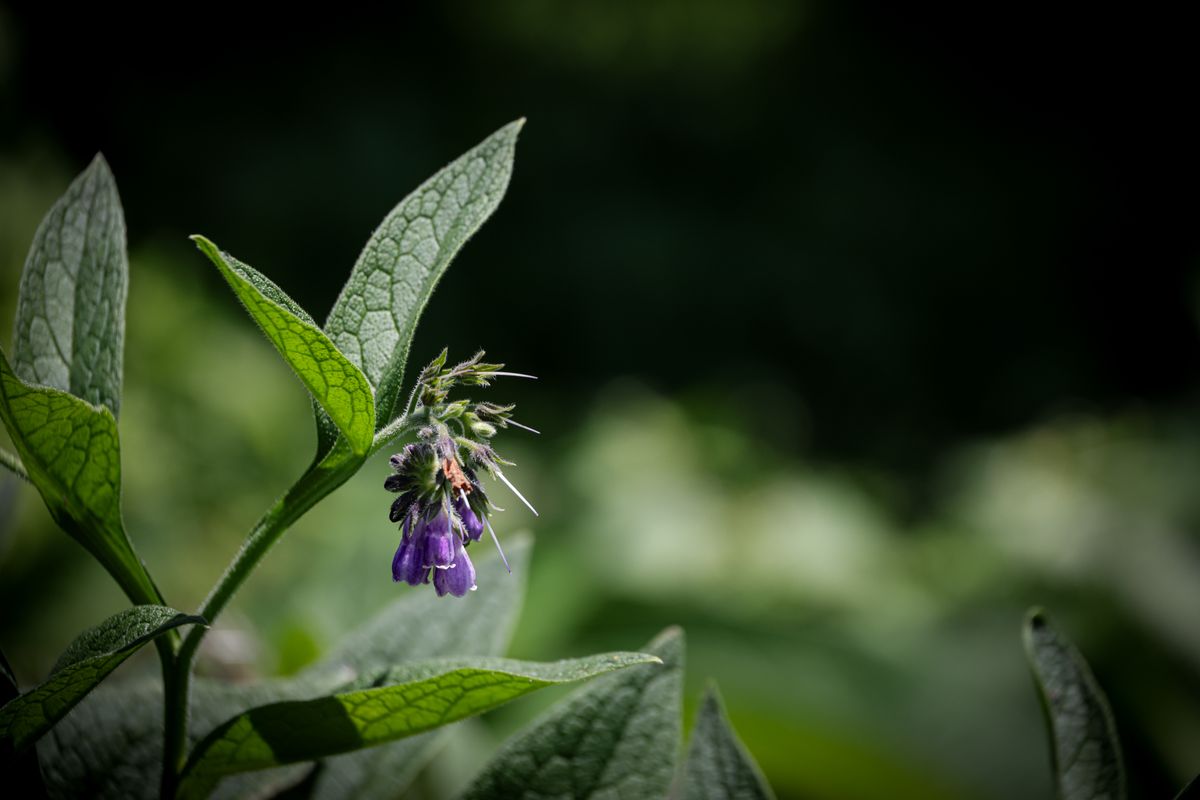
„"Comfrey" roughly translates to "well-being of the legs" - and the second name, wallwort, comes from walls In the sense of growing together. Both names describe what it has been used for since the Middle Ages.
Comfrey grows in damp meadows, along ditches, and on the banks of streams and rivers throughout Europe and Western Asia. It reaches a height of up to one meter, has large, rough, hairy leaves, and bell-shaped flowers in violet, pink, or white. The root is almost black on the outside, white on the inside, and exceptionally mucilaginous – when cut, it feels slimy. Botanically, it belongs to the borage family (Boraginaceae) and is thus related to borage, lungwort, and viper's bugloss, a chemically significant connection: this family is the classic pyrrolizidine alkaloid family.
Its use in treating bone fractures, sprains, and bruises is ancient and documented throughout Europe. The Latin genus name Symphytum comes from Greek symphyein - to grow together. In English, it's called... knitbone, in German, comfrey and walrus. The crushed root pulp was applied as a poultice, which hardened upon drying – a kind of early plaster cast containing the active ingredient.
He has had a second career in agriculture: The Comfrey (Symphytum × uplandicum, eine Kreuzung mit dem Rauen Beinwell) wird als Grünfutter und vor allem als Gründünger angebaut. Seine Blätter sind außergewöhnlich kaliumreich, und Beinwelljauche ist im Biogarten ein Standardmittel für Paradeiser und Starkzehrer - die nährstoffreichere Alternative zur Brennnesseljauche.
To useWhat comfrey can do for you
With comfrey, you have to clearly distinguish between two things, and then it works surprisingly well. external Its use is not only traditionally recognized, but also clinically investigated for standardized finished products – and to a greater extent than one would expect from an ointment. There are randomized, placebo-controlled studies on Ankle sprains, at acute back pain and at Knee osteoarthritis, Studies have shown that comfrey ointments significantly reduced pain and restricted movement more effectively than a placebo; in comparative studies, they performed similarly to diclofenac gel. The European Medicines Agency lists external application as a traditional use, and Commission E has given it a positive assessment.
Pharmacologically, this is due to an interplay of factors. Allantoin It promotes cell regeneration and granulation - therefore it is also added synthetically to many skin care products. Rosmarinic acid and other phenolic acids have anti-inflammatory effects. Mucus They retain moisture and make the compress comfortable. And the good fat solubility of some components explains why they penetrate the skin and reach the underlying tissue.
The internal However, its use in this context is a thing of the past, and for good reason. Comfrey contains Pyrrolizidine alkaloids Comfrey contains the same group of substances as borage and coltsfoot, but in higher concentrations. In the liver, these substances are metabolized into reactive intermediates that can damage the small veins of the liver; severe liver damage has been documented after long-term use. Therefore, comfrey tea, comfrey root for oral administration, or as a dietary supplement should not be kept in the home medicine cabinet – and in Germany, internal preparations are no longer commercially available.
The same rules apply to external application: Only for use on intact skin, because PAs are absorbed much better through damaged skin. Only PA-low or PA-free ready-made preparations, which are declared accordingly - for these, fixed maximum quantities apply. And limited time: usually no longer than four to six weeks per year. A homemade poultice made from fresh root does not meet any of these conditions.
IngredientsThis is what's in comfrey
The most well-known ingredient is Allantoin, which can make up to four percent of the root's composition. It promotes cell division and the formation of granulation tissue and is therefore now produced synthetically and added to many wound care and skincare products. In addition, Rosmarinic acid and other phenolic acids with anti-inflammatory effects, abundant Mucus (up to 29 percent in the root), tannins and triterpene saponins.
The problematic faction are the Pyrrolizidine alkaloids - especially symphytin, echimidin, lycopsamine, and intermedin. Their levels vary considerably: The root contains significantly more than that Sheet, Young leaves contain more toxins than old ones, and rough comfrey and fodder comfrey contain more than common comfrey. This very variation is the reason why homemade preparations are problematic: you don't know what you're dealing with.
Drug manufacturing solves the problem over defined maximum quantitiesFor externally applied preparations, there are limits on the amount of PA absorbed, and manufacturers either use PA-low varieties or extraction methods that reduce the alkaloids. This is indicated on the packaging. It is one of the cases where a commercially available preparation is not only more convenient but also significantly safer than a homemade compress.
Enhanced combinationsWhat makes comfrey stronger
An effective plant with strict rules - and the rules are the more important part here.
Only this one corresponds to the tested preparations and the safety limits.
Arnica for the initial inflammation, comfrey afterwards - two phases, two plants.
The studies used significantly larger quantities than usual - a thick strip, not a mere wisp.
Three to four times a day for the first few days after the injury.
Apply the ointment thickly and cover loosely - this way it will work for longer.
Kaliumreicher Gründünger für Paradeiser und Starkzehrer - eine ganz andere Verwendung.
What contradicts itselfIt's best to avoid these combinations.
Comfrey tea and internal preparations are obsolete because of the pyrrolizidine alkaloids.
The alkaloids are absorbed much better through broken skin.
The PA content fluctuates greatly and is unpredictable.
There is also a time limit on external aspects.
Avoid external appearances here as well.
Observe the age limits of the respective preparations - usually from three or twelve years.
ApplicationHow it is used
- Comfrey ointmentPA-low and standardized from the pharmacy - the form examined.
- In case of sprainApply a thick layer three to four times daily after the acute phase.
- In case of bruisesApply to intact skin over the bruise - not to abrasions.
- For back painEffective in studies for acute nonspecific back pain.
- For knee osteoarthritisSeveral controlled studies show pain relief.
- Ointment dressingApply thickly and cover loosely - especially effective overnight.
- After arnicaArnica for the initial inflammation, comfrey for the healing phase.
- Not internallyNo tea, no capsules, no tincture to be taken orally.
- Comfrey manureIm Garten als kaliumreicher Gründünger für Paradeiser und Kohl.
- garden perennialUndemanding on moist soil and an early source of nectar for bumblebees.
As a home remedyThe ointment dressing
Comfrey ointment for bruises and sprains
- Use a comfrey preparation low in PA (perioral therapy) from the pharmacy – identifiable by the corresponding information on the packaging. Homemade root poultices are not the better, but rather the riskier option.
- The ointment generous Apply to the intact skin over the affected area - in the studies, a strip approximately one millimeter thick was used, not a thin film.
- Cover loosely with a gauze bandage or a cloth to prevent the ointment from being wiped off and allow it to work longer. This is especially practical overnight.
- Reapply three to four times daily for the first few days after the injury. Then gradually reduce the frequency depending on the symptoms.
For bruises, strains, sprains, sore muscles, and painful joints—anywhere the skin has remained intact. The data is unusually strong for a herbal remedy: In randomized studies on ankle sprains, acute back pain, and knee osteoarthritis, comfrey ointments performed significantly better than placebo and similarly to diclofenac gel in comparative studies. The order of application is important: Arnica is the herb for the immediate, hot inflammation, while comfrey is for the days that follow.
Three to four times a day for a few days to weeks, for a total of no longer than four to six weeks per year. Only for use on intact skin Do not apply to abrasions, open wounds, or mucous membranes, as pyrrolizidine alkaloids are absorbed much more readily in these areas. Do not use during pregnancy or while breastfeeding, and observe the age limit for children. Severe swelling, misalignment, immobility, persistent pain, or suspected fractures require medical attention – an ointment is not a substitute for a diagnosis.
Ayurveda & TCMWhat the old systems say
Ayurveda
Comfrey is not a classic component of Ayurveda. Based on its properties, it would be classified as sweet, mucilaginous, cooling, and moisturizing. Vata and Pitta Soothing. This would be well-suited for external application to injuries; the Ayurvedic plant with a comparable role is... Arjuna-Bark in cases of bone fractures and Hadjod (Cissus quadrangularis), whose name literally means "bone connector".
Traditional Chinese Medicine
Comfrey is not listed in the Chinese Materia Medica. Its functional counterpart there is found in the herbs categorized as "uniting bones and healing tendons," for example. Xu Duan (Dipsacus asper), whose name also means "to reconnect what is broken", and Gu Sui Bu - "To mend the broken skeleton." The fact that three independent traditions have almost identical names for their herbs used to heal fractures is one of the more charming details of herbal medicine.
Warning noticesWhen you should be careful
Please note
- Not internally: Pyrrolizidine alkaloids can damage the liver - comfrey tea and internal preparations are obsolete.
- Only intact skin: The alkaloids are absorbed much better through damaged or open skin.
- Only PA-low finished products: The PA content of the plant varies greatly - home preparations are unpredictable.
- Duration of use: also not externally for longer than four to six weeks a year.
- Pregnancy and breastfeeding: also refrain from outward appearances.
- Clarification: Severe swelling, misalignment, inability to move, or suspected fracture warrant a visit to the doctor.
This page provides information and does not replace medical advice. If symptoms persist, please consult a doctor.
Related to the topicRead on and cook along!
Shop links lead to our product pages; it is indicated there if a partner is involved.
SourcesWhat is this based on?
- EMA/HMPC: European Union herbal monograph on Symphytum officinale L., radix - traditional use, exclusively external.
- Predel HG et al. Efficacy of a comfrey root extract ointment in comparison to a diclofenac gel in the treatment of ankle distortions. Phytomedicine 2005; 12(10): 707–714.
- Grube B et al. Efficacy of a comfrey root extract ointment in the treatment of patients with painful osteoarthritis of the knee. Phytomedicine 2007; 14(1): 2–10.
- Federal Institute for Risk Assessment: Pyrrolizidine alkaloids in food - updated risk assessment, 2020.
- Blaschek W (ed.): Wichtl - Herbal drugs and phytopharmaceuticals. 6th edition 2016, monograph Symphyti radix.


