OriginThe daisy on the doorstep
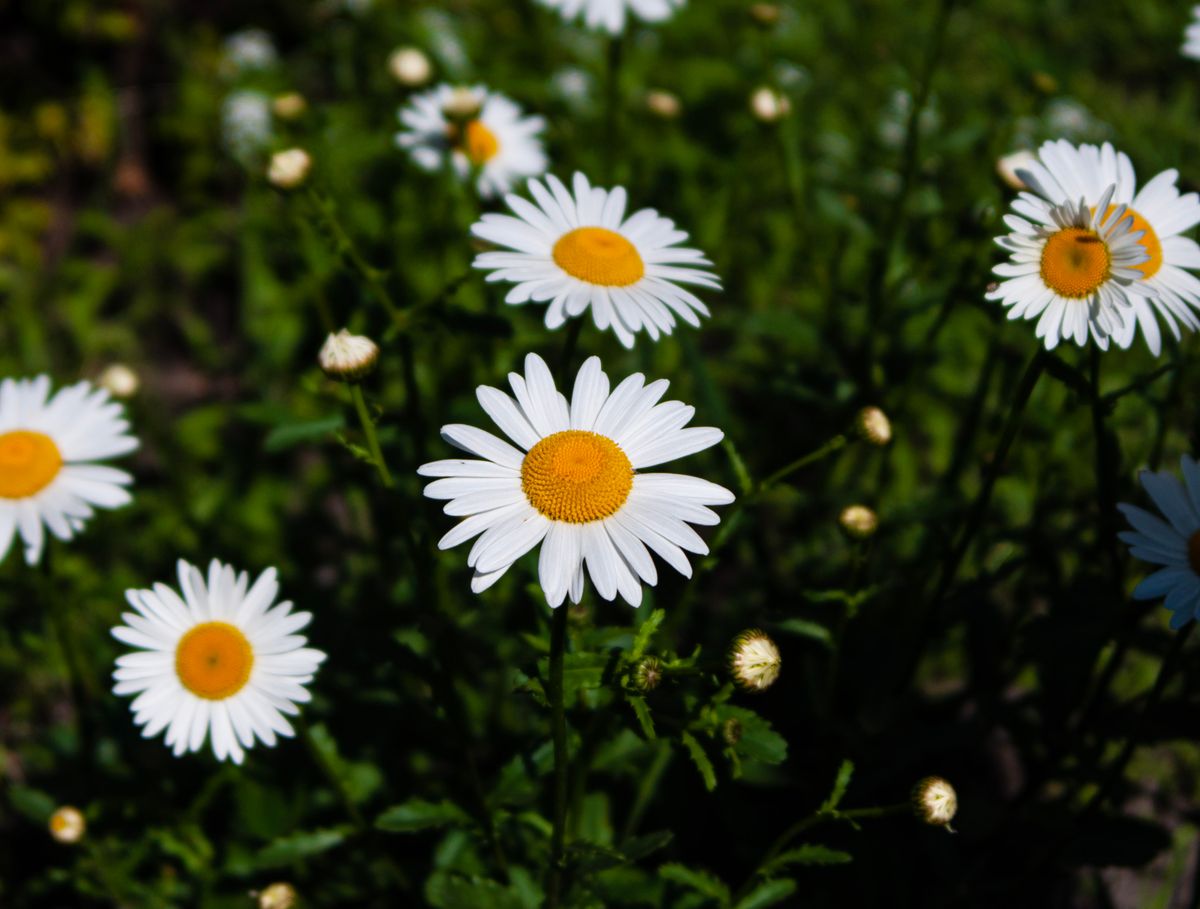
Bellis perennis heißt „das ausdauernd Schöne“ - und tatsächlich blüht es an milden Standorten das ganze Jahr, sogar im Jänner.
The daisy grows in every short-cropped meadow, lawn, and sports field – it tolerates trampling and frequent mowing better than almost any other flowering plant and thrives precisely where taller competitors are mowed down. It forms a flat rosette of leaves and individual flower heads on leafless stems. What looks like a flower is botanically a basket made up of many individual flowers: on the outside the white ray florets, on the inside the yellow tubular florets.
The common names are numerous and affectionate: daisy, common daisy, daisy, Mary's flower, monthly rose. In English it is called daisy - from day's eye, The flower heads are called "day eyes" because they close in the evening and during rain, and reopen in the morning. This movement is true plant physiology: the ray florets react to light and temperature.
In folk medicine, it had a firm, but always modest, place: as a cough remedy, as a "blood-purifying" spring herb, as a wound remedy, and especially for bruises and contusions - hence the nickname „"little arnica"“. In homeopathy, Bellis perennis To this day, it remains a well-known remedy for blunt injuries, especially in the abdominal and pelvic area. And it is one of the plants children first come into contact with – making wreaths, counting leaves, eating blossoms.
To useWhat the daisy does for you
No detours are needed here: There is no recognized medicinal use for the daisy. Neither Commission E nor the European Medicines Agency maintains a monograph, and clinical studies are practically nonexistent. What has been handed down – for coughs, wound healing, bruises, and spring tonics – is based on experience and similarity to other members of the Asteraceae family, not on research. We state this clearly because the opposite is often claimed online.
The chemical composition at least makes the tradition plausible: Saponins, which have an expectorant and mildly irritating effect on mucous membranes – this is the basis of the cough remedy – in addition to tannins, flavonoids, traces of essential oil, organic acids and rich in vitamin C. For a leafy vegetable, its nutrient content is decent, and as a wild herb in early spring, it is one of the first fresh plants available.
The most genuine benefit lies elsewhere, and it is not insignificant: The daisy is a Completely edible, available year-round, free wild vegetables right on your doorstep. The pickled buds can be used as a substitute for capers, the blossoms enhance any salad, and the young leaves provide a nutty, slightly bitter salad green. And it's the perfect plant to teach children that edible plants grow in the lawn. No studies are needed to prove that.
IngredientsThat's what's in the little flower
The most important group of substances are the Saponins - Triterpene saponins of the bellidioside and bellissaponin type. Saponins reduce surface tension and have a mildly irritating effect on the respiratory mucosa, which reflexively stimulates bronchial secretion. This is the same mechanism as with primrose and ivy and the understandable basis for the old cough remedy – only in a significantly weaker form.
Join in tannins (which explains the slightly bitter taste and the astringent effect on wounds), Flavonoids such as apigenin and quercetin, polyacetylenes, organic acids, mucilage, and inulin. Vitamin C content This is remarkable for a wild herb, which makes the daisy a useful component of the classic spring cleanse.
A practical tip for the kitchen: The taste varies significantly depending on the part of the plant used. Flower heads are mild and slightly nutty, which closed buds the strongest and spiciest – that's why they work so well as fake capers – which leaves These are the most bitter and become tough with age. For salad, use the young, light-colored leaves from the center of the rosette.
Enhanced combinationsWhat makes the daisy stronger
A herb for cold dishes and for your own, unsprayed lawn.
Not from dog parks, roadsides or fertilized areas - it is eaten raw.
Blüten und junge Blätter unter Kopfsalat oder Vogerlsalat - Farbe und eine nussige Note.
The closed buds in vinegar - the best use of all.
The slight bitterness needs fat as a counterweight.
The classic wild herb cure in March - three plants that grow everywhere.
It is distinctive, harmless and ubiquitous - the best introduction to wild herb gathering.
What contradicts itselfIt's best to avoid these combinations.
Flowers and leaves are eaten raw; the surface must be clean.
There is no recognized medicinal use and practically no studies.
In larger quantities, saponins can irritate the stomach and mucous membranes.
Like all members of the daisy family, it can trigger reactions in sensitive individuals.
With age they become bitter and fibrous - only the young ones from the center of the rosette.
The blossoms lose their color and shape immediately - they belong on the finished plate.
To which courtWhere it belongs
- Flower saladWhole flower heads scattered over lettuce leaves - edible and pretty.
- Fake capersLeave closed buds in salt, then pickle them in vinegar with bay leaves.
- herb quarkJunge Blätter und Blüten fein gehackt in Topfen mit Schnittlauch.
- Wild herb saladWith dandelion, nettle, chickweed and sorrel in spring.
- Buttered breadFlowers on a buttered slice of bread - the simplest and best option.
- Herb butterFinely chopped with lemon zest in soft butter.
- Soup garnishFlowers should only be placed on the finished plate, never in the pot.
- Edible cake decorationsFlowers candied in egg white and fine sugar.
- Spring cureAdd a handful to your food daily for two to three weeks - the old wild herb remedy.
- Wreath makingThe most important use is when children are present.
As a home remedyFake capers
Pickled daisy buds
- On a dry morning, collect closed, firm flower buds - a small bowlful is enough for one glass.
- Rinse briefly, dry thoroughly, place in a bowl and sprinkle with a tablespoon of salt. Leave overnight; this draws out the water and firms them up.
- Rinse the next day, fill into a clean screw-top jar, add a bay leaf, a few peppercorns and, if desired, a slice of onion.
- Pour heated, but not boiling, white wine vinegar over everything until covered. Seal and let it infuse in a cool, dark place for four weeks.
Für alles, wofür man sonst Kapern nimmt: Vitello tonnato, Sauce gribiche, Erdapfelsalat, Pasta mit Zitrone, Fischgerichte. Das ist ein reines Küchenrezept - ein Heilmittel ist es nicht, und wir behaupten das auch nicht. Was es wirklich leistet: Es macht aus einer Pflanze, an der die meisten Menschen täglich vorbeilaufen, eine Zutat, die man vermissen würde.
Use them in the kitchen as desired, like capers. Stored in a cool, dark place, they will keep for at least a year; once opened, keep them in the refrigerator and always use a clean spoon to remove them. Harvest only from areas that are not fertilized, sprayed with pesticides, or used as dog parks. If you have an allergy to plants in the Asteraceae family (such as mugwort, chamomile, or ragweed), test a small amount first.
Ayurveda & TCMWhat the old systems say
Ayurveda
The daisy is not represented in Ayurveda. Based on its properties, it would be described as slightly bitter, astringent, and cooling. Pitta and Kapha lowering, Vata In larger quantities, it increases its effects. As a fresh spring herb after the harsh winter – the Ayurvedic Kapha season – it would be a good fit. This is a classification based on principle, not tradition.
Traditional Chinese Medicine
It is also missing from the Chinese Materia Medica. Based on its characteristics, it would be a sweet-bitter, cooling herb that clears heat and eliminates toxins – in the vicinity of Pu Gong Ying, The dandelion, which plays precisely this role there and is also a member of the daisy family found along roadsides, is interesting. It's remarkable that European and Chinese traditions arrive at very similar attributions for these small roadside plants.
Warning noticesWhen you should be careful
Please note
- No recognized application: There is no positive monograph and practically no clinical studies.
- Collection points: Only from unfertilized, unsprayed areas away from dog parks and roads - it is eaten raw.
- Asteraceae allergy: As with all members of the Asteraceae family, reactions are possible - test in small quantities first.
- Crowd: The saponins contained can irritate the stomach and mucous membranes in larger quantities.
- Pregnancy: It is unproblematic as a salad ingredient; avoid concentrated extracts and tea cures.
- No replacement: If you have a cough, wounds or bruises that don't get better, you should have them checked out.
This page provides information and does not replace medical advice. If symptoms persist, please consult a doctor.
Related to the topicRead on and cook along!
Shop links lead to our product pages; it is indicated there if a partner is involved.
SourcesWhat is this based on?
- Blaschek W (ed.): Wichtl - Herbal drugs and phytopharmaceuticals. 6th edition 2016, genre Bellis - Ingredients and evaluation of traditional use.
- Fleischhauer SG, Guthmann J, Spiegelberger R: Encyclopedia of edible wild plants. AT Verlag - Bellis perennis.
- Hehner J et al. Saponins from Bellis perennis - Characterization of bellissaponins (phytochemical studies).
- Paulsen E. Contact sensitization from Compositae-containing herbal remedies and cosmetics. Contact Dermatitis 2002; 47(4): 189–198.
- USDA FoodData Central and Federal Food Code - Vitamin C content of wild herbs in comparison.