
OriginThe blue berry of the acidic forest floor
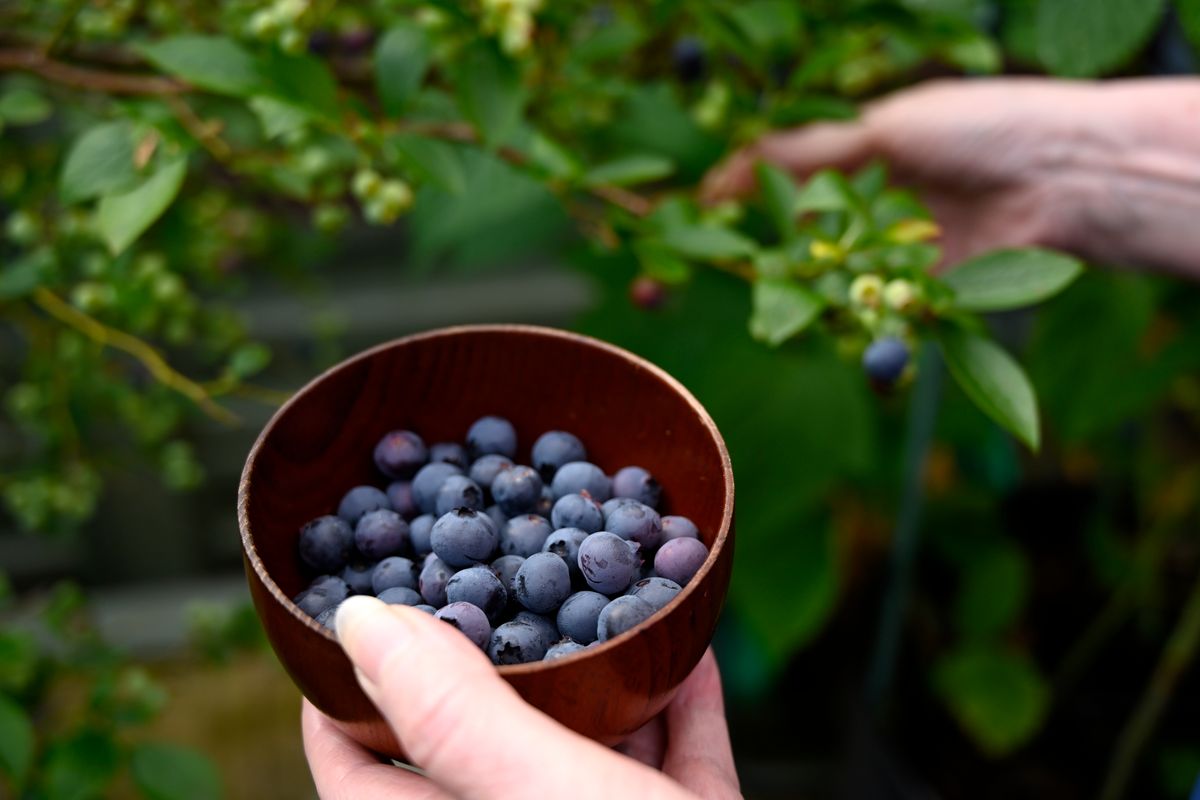
Blue teeth, blue fingers, blue tongue - anyone who picked blueberries as a child knows immediately whether they were wild or cultivated blueberries.
The wild bilberry is a small, deciduous dwarf shrub that grows on acidic, nutrient-poor soils: in open coniferous and mixed forests, on heaths, in bogs, and far up into mountainous regions. It forms extensive stands via underground runners, which can live for many decades – what looks like a thousand small shrubs is often a single clone. Its flowers are inconspicuous, pink-tinged bells that appear in May and are an important early source of nectar for bumblebees.
The most important practical difference concerns the Cultivated blueberry, which is available in supermarkets. It originates from North American species, especially from Vaccinium corymbosum, It grows as a man-high shrub and bears significantly larger berries - but white inside are. The wild blueberry is colored entirely blue, Because their anthocyanins are found throughout the entire flesh, not just in the peel. Practically speaking, this means: if you want the pigments, you need the wild variety – its anthocyanin content is many times higher. If you want to keep your mouth clean, choose the cultivated variety.
For centuries, dried blueberries were used in folk medicine as a remedy for diarrhea—a jar of dried blueberries was a staple in many households, just like chamomile. The leaves were used to make tea for bladder problems and high blood sugar; this is a use that modern medicine explicitly advises against, more on that below. And then there's the most famous story about this plant, which unfortunately isn't one at all—the one about improved night vision.
To useWhat the blueberry can do for you
The approved application applies exclusively to the dried Fruit. The European Medicines Agency and Commission E list it at nonspecific acute diarrhea and externally at mild inflammation of the oral and pharyngeal mucosa. The reason for this is... tannins, The amount of these substances increases proportionally during drying and, as with tormentil, thickens the irritated mucous membrane into a firmer protective layer. Dried blueberries can simply be chewed or prepared as a decoction – both methods work.
And here's the point that's done wrong in every other kitchen: Fresh blueberries do not help against diarrhea, but rather in the opposite direction. Fresh berries consist mainly of water, pectin, and sugar; they have a mild laxative effect. Reaching for fresh berries to treat diarrhea is not advisable. The recognized laxative effect is only achieved with dried fruit, which is predominantly composed of tannins.
The Anthocyanins The blue pigments are the second major ingredient and the reason for the blueberry's reputation as an antioxidant. They are highly effective in the laboratory, and there are plausible indications and a few small human studies regarding their effects on blood vessels and retinal circulation. This led to one of the most enduring nutritional myths of all time during World War II: The British Royal Air Force spread the rumor that its night fighter pilots were so accurate because they ate blueberry jam – in reality, this was intended to conceal the new radar technology. Controlled studies have found no effect on the night vision of healthy people. The story has persisted for eighty years, and it is a good example of how a marketing slogan becomes folk wisdom.
A word about the ScrollBlueberry leaf tea was traditionally drunk for bladder problems and to lower blood sugar. Commission E has advised against its use because its effectiveness is not proven and there are concerns about the hydroquinone precursors it contains with prolonged use. There are no such concerns with the berries themselves – but blueberry leaf tea should not be used for long-term treatment.
IngredientsThis is what's inside the berry
The dried fruit contains 5 to 12 percent tannins The catechin type is the active ingredient responsible for its recognized use in treating diarrhea. During drying, the berry loses water, and the tannin content increases accordingly; at the same time, the pectins and sugars, which dominate in the fresh fruit, become less prominent. This is precisely why the fresh and dried berries have different effects.
The Anthocyanins The color is primarily due to glycosides of delphinidin, cyanidin, and malvidin. Wild blueberries typically contain 300 to 700 milligrams of these per 100 grams of fresh fruit, many times more than the white-fleshed cultivated blueberry. Anthocyanins are powerful free radical scavengers, but the body only absorbs a small portion of them and quickly metabolizes them—what is impressive in a test tube cannot be directly extrapolated to humans. In addition, they contain vitamin C, manganese, flavonoids, and organic acids.
In the Scroll Tannins and flavonoids are also present, as well as... Arbutin and related hydroquinone precursors. Arbutin is the same substance that makes bearberry a valuable remedy for bladder problems – and which also necessitates a strict time limit for its use. This is why bilberry leaf tea is not suitable for long-term use, however widespread its traditional application may have been.
Enhanced combinationsWhat makes blueberries stronger
The most important decision is made before preparation: fresh or dried, forest or cultivated, fruit or leaf.
Simply chew two tablespoons thoroughly or simmer in water for ten minutes - then the tannins will take effect.
The second classic tannin drug - boiled together for acute diarrhea.
In cases of diarrhea, the water and salt balance is the determining factor, not the berry.
Those who want the anthocyanins need the fully colored forest variety - recognizable by the blue flesh.
Dried for the home medicine cabinet, frozen for the kitchen - both preserve the dyes well.
The classic combination; the acidity of the dairy products enhances the aroma of the wild berry.
What contradicts itselfIt's best to avoid these combinations.
When fresh, they have a rather mild laxative effect due to pectins and sugar - exactly the opposite.
Blueberry leaves contain hydroquinone precursors; their effectiveness is not proven and long-term use is not recommended.
The effect cannot be demonstrated in controlled studies - the story originates from war propaganda.
Tannins delay the absorption of other active ingredients - at least one hour interval.
Then the problem is not the dose, but the lack of clarification.
White pulp means significantly fewer anthocyanins.
To which courtWhere she belongs
- Dried blueberriesChew two tablespoons thoroughly - the simplest form of recognized use.
- Blueberry decoctionSimmer dried berries for ten minutes, strain, and drink lukewarm.
- MouthwashThe same decoction, made stronger, is used for sore gums and mouth ulcers.
- blueberry pancakesThe classic use of wild berries - fresh into the dough.
- Blueberry muffinsHere, the cultivated berry works better because it doesn't fall apart and doesn't stain.
- blueberry jamWild blueberries with little sugar - the color makes the difference.
- Cold soupWith milk or buttermilk, blended cold - a North German summer classic.
- SmoothieFrozen berries with banana and yogurt - the anthocyanins survive freezing well.
- Heidelbeer-TopfenThe simplest and most honest preparation.
- Wild berry supplyFreeze or dry - then you have both available all year round.
As a home remedyThe home medicine cabinet in a jar
Dried blueberries for diarrhea
- Have dried blueberries from the pharmacy or home-dried wild blueberries on hand - a jar of these belongs in every home medicine cabinet.
- Simplest option: Chew two to three tablespoons of dried berries thoroughly and swallow slowly several times a day. Chewing is important to release the tannins.
- As a decoction: Boil two tablespoons of dried berries in 250 ml of cold water, simmer gently for ten minutes, strain and drink lukewarm.
- Drink plenty of fluids and replace electrolytes at the same time - salted broth, diluted juice or an electrolyte mixture from the pharmacy.
For acute, nonspecific diarrhea and as a complementary treatment for sore mouth and throat mucosa. The tannins thicken the outermost layer of the mucous membrane and soothe the irritated intestinal wall; this is recognized by the EMA and Commission E. The dried berries have two practical advantages over tormentil tea: they taste significantly better, and school-aged children take them without question.
Two to three tablespoons several times a day, for a maximum of three days. Leave at least one hour between medications and other medications, because tannins delay their absorption. Seek immediate medical attention if you experience diarrhea lasting more than three days, bloody stools, high fever, severe abdominal pain, or signs of dehydration – and in infants, young children, pregnant women, and the elderly, always seek medical attention sooner.
Ayurveda & TCMWhat the old systems say
Ayurveda
Blueberries are not a traditional part of Ayurveda – they don't grow in India. Based on their properties, the dried fruit would be described as sweet-tart, cooling, and drying. Pitta and Kapha lowering Vata In large quantities, it tends to be drying. For diarrhea, which in Ayurvedic thought is an excess of movement and moisture, this would be the appropriate approach. A transfer of principle.
Traditional Chinese Medicine
The blueberry is also absent from the Chinese Materia Medica, but its role there is familiar: sweet-sour, astringent fruits such as Wu Mei, Smoked plums are used to treat chronic diarrhea and work via the same tannins. And here, too, the rule applies that astringents should be used sparingly during an acute infection so that the body can first get rid of what needs to be expelled.
Warning noticesWhen you should be careful
Please note
- Fresh instead of dried: Fresh berries tend to have a laxative effect in cases of diarrhea - the recognized effect requires dried fruit.
- Leaves: Blueberry leaf tea is not recommended for long-term use due to its lack of proven effectiveness and the presence of hydroquinone precursors.
- Medications: Tannins delay the absorption of other active ingredients - maintain a distance of at least one hour.
- Duration: Diarrhea lasting three days, accompanied by blood, fever, or severe pain, should be investigated by a doctor.
- Children and elderly people: Here, diarrhea is a case for the doctor earlier on due to the risk of dehydration.
- Night vision: The claimed effect is not demonstrable in controlled studies - do not base any expectations on it.
This page provides information and does not replace medical advice. If symptoms persist, please consult a doctor.
Related to the topicRead on and cook along!
Shop links lead to our product pages; it is indicated there if a partner is involved.
SourcesWhat is this based on?
- EMA/HMPC: European Union herbal monograph on Vaccinium myrtillus L., fructus siccus - traditional use for nonspecific acute diarrhea and mild inflammation of the oral mucosa.
- Commission E: Monograph Myrtilli fructus (blueberries), Federal Gazette 1994, as well as negative assessment for Myrtilli folium.
- Canter PH, Ernst E. Anthocyanosides of Vaccinium myrtillus (bilberry) for night vision - a systematic review of placebo-controlled trials. Survey of Ophthalmology 2004; 49(1): 38–50.
- Blaschek W (ed.): Wichtl - Herbal drugs and phytopharmaceuticals. 6th edition 2016, monograph Myrtilli fructus.
- Robert Koch Institute: Assessment of the risk of infection from the fox tapeworm when consuming wild berries.


