
Raspberry (Rubus idaeus)
OriginThe berry from Mount Ida
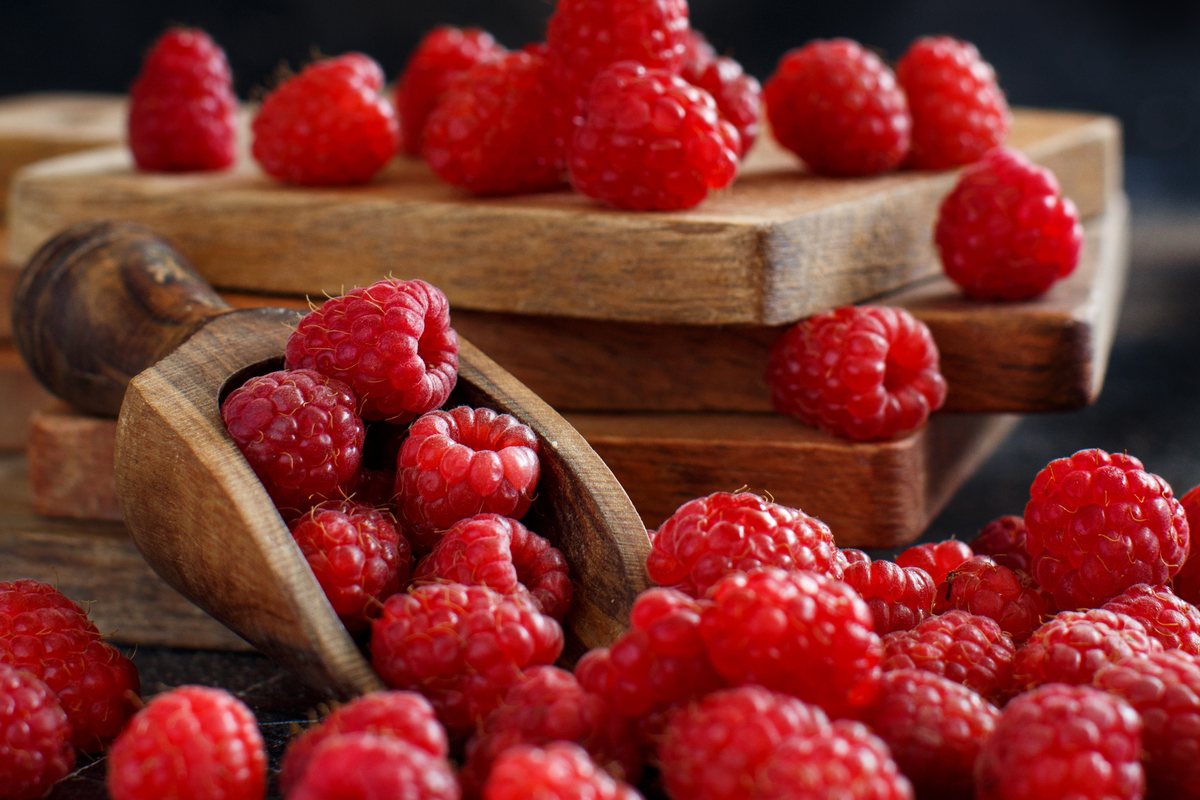
According to legend, nymphs on Mount Ida gathered the first raspberries for baby Zeus – hence the name. Idaeus.
The raspberry grows wild throughout Europe and northern Asia, preferring forest edges, clearings, and open areas. Seed finds dating back to the Stone Age show that humans have been collecting them for millennia. In the Middle Ages, it was cultivated in monastery gardens, but selective breeding only began in the 16th century. Like the blackberry, it belongs to the genus *Raspberry*. Rubus; the fruit is an aggregate drupe made up of many small individual fruits that detach from the cone when picked - hence the hole in the middle.
Today, a distinction is made between summer raspberries, which bear fruit on the previous year's canes, and autumn raspberries, which fruit on the current year's canes until the first frost. Besides red varieties, there are yellow and black ones. Because raspberries are extremely delicate and prone to mold, they are one of the most expensive fruits commercially available – and one of the most rewarding to grow in your own garden.
To useWhat the raspberry does for you
The raspberry is a Fiber berryWith approximately 6.5 g of fiber per 100 g, it surpasses almost all other fruits, while containing only around 4 g of sugar and about 50 kcal. It also contains vitamin C, manganese, vitamin K, and plenty of polyphenols – especially… Ellagitannine, which are converted into urolithins by bacteria in the intestine, and anthocyanins.
Small controlled studies have found that raspberries eaten with a meal can reduce the rise in blood sugar and insulin levels in people with prediabetes. Ellagitannins and urolithins are the subject of intensive research, for example, in relation to inflammation and gut health – so far primarily in laboratory settings and small human studies.
An honest indication of Raspberry ketoneRaspberry flavoring is sold in capsule form as a weight-loss aid. The claims are based on animal studies with very high doses; there is no reliable evidence for its effectiveness in humans. Eating the whole fruit with its fiber is a better option.
IngredientsThis is what's inside the raspberry
Raspberries contain Dietary fiber (much of it in the small kernels), vitamin C (about 25 mg per 100 g), manganese, vitamin K, folate, and potassium. The red color comes from cyanidin glycosides. Characteristic are the Ellagitannine, especially sanguine H-6 and lambertianine C, as well as free ellagic acid.
The characteristic aroma is created by raspberry ketone together with ionones, which are also found in violets. A single raspberry contains very little raspberry ketone – dozens of kilograms of berries would be needed for a single capsule dose, which is why the capsule powder is usually produced synthetically.
Enhanced combinationsWhat makes the raspberry stronger
Raspberry is aromatic and tart - it enhances chocolate, vanilla and cream, but it doesn't forgive pressure.
Raspberry and dark chocolate is one of the best flavor pairings in patisserie.
The fiber from the berry plus the protein from the yogurt keeps you feeling full for a long time.
Studies have shown that eating a handful of raspberries for breakfast reduces the rise in blood sugar.
For raspberry water, fruit salad or sorbet.
Frozen raspberries are available all year round and are almost equivalent in quality - perfect for smoothies and sauces.
Raspberry tiramisu, pavlova, panna cotta with raspberry sauce.
What contradicts itselfIt's best to avoid these combinations.
Raspberries get crushed and moldy quickly - spread them out flat, store in a cool place, and eat within one to two days.
Moisture causes them to mold immediately - rinse them briefly just before eating.
No reliable effects in humans; safety of high doses unclear.
Previously, it was advised against consuming them because of the kernels; today this is considered outdated - but avoid them during an acute flare-up.
Acid burns on sore spots.
As with all wild berries, the risk of fox tapeworm is very low; those who want to be on the safe side should heat them up.
In the kitchenWhere she belongs
- Raspberries with yogurtWith oatmeal and nuts - the best berry breakfast.
- Raspberry sauceBriefly heat frozen raspberries and strain them through a sieve.
- Raspberry tiramisuMascarpone, ladyfingers, raspberries instead of coffee.
- Panna cottaWith raspberry coulis.
- Raspberry chia jamCrushed raspberries with chia seeds - no cooking required, with little sugar.
- Raspberry vinegarSoak raspberries in white wine vinegar - for salads.
- chocolate tartTopped with fresh raspberries.
- SmoothieFrozen raspberries, banana, oat milk.
- Red fruit jellyMit Ribisel und Kirschen, mit Stärke gebunden.
- Raspberry waterCrushed raspberries with mint and cold water.
As a home remedyRaspberry syrup as a fever drink
Raspberry syrup
- Boil 500g of raspberries (fresh or frozen) briefly with 250ml of water.
- Strain through a fine sieve or cloth without pressing too hard.
- Boil the juice with 250g of sugar until dissolved, then pour hot into clean bottles.
- To drink, mix 1 part syrup with 5 to 8 parts water.
Raspberry syrup (Sirupus Rubi idaeiIt used to be listed in the pharmacopoeia as a flavor enhancer for bitter medicines and as a cooling drink for fever. Sick children like to drink it, and when you have a fever, the most important thing is to drink enough fluids.
Diluted as needed. Not a regular drink due to the sugar content. Any fever above 39°C, or in infants any fever lasting more than three days, requires medical attention.
Ayurveda & TCMWhat the old systems say
Ayurveda
The raspberry is not part of the classic Ayurvedic pharmacopoeia. Modern classifications describe it as sweet-sour and astringent, rather cooling – good for Pitta and Kapha in moderation, and for Vata when combined with some sweetness and warmth.
Traditional Chinese Medicine
In Traditional Chinese Medicine (TCM), the unripe fruit of a related species is primarily used., Fu Pen Zi (Rubus chingiiIt is considered sweet and sour, slightly warming and firming, strengthens the kidneys and is used for frequent urination and bedwetting. The ripe raspberry is considered a mild, nourishing fruit.
Warning noticesWhen you should be careful
Please note
- Raspberry ketone capsules: No reliable effect, safety of high doses unclear - not suitable for use during pregnancy and breastfeeding.
- Salicylates: Raspberries contain natural salicylates - use caution if you have a salicylate intolerance.
- Mold: Do not eat moldy berries, or any surrounding ones.
- Frozen goods: Imported frozen berries have repeatedly been contaminated with noroviruses - for desserts, briefly boil them without heating, as recommended by the BfR.
- Allergy: Rare, with cross-reactivity to other rose family plants.
This page provides information and does not replace medical advice. If symptoms persist, please consult a doctor.
Related to the topicRead on and cook along!
Shop links lead to our product pages; it is indicated there if a partner is involved.
SourcesWhat is this based on?
- Burton-Freeman BM, Sandhu AK, Edirisinghe I. Red raspberries and their bioactive polyphenols: cardiometabolic and neuronal health links. Advances in Nutrition 2016; 7(1): 44–65.
- Xiao D et al. Attenuation of postmeal metabolic indices with red raspberries in individuals at risk for diabetes: a randomized controlled trial. Obesity 2019; 27(4): 542–550.
- Federal Institute for Risk Assessment: Heat frozen berries before eating. Consumer tip.
- Morimoto C et al. Anti-obese action of raspberry ketone. Life Sciences 2005; 77(2): 194–204 (animal study).
- USDA FoodData Central: Raspberries, raw.


