OriginThe fur flower of the dry grasslands
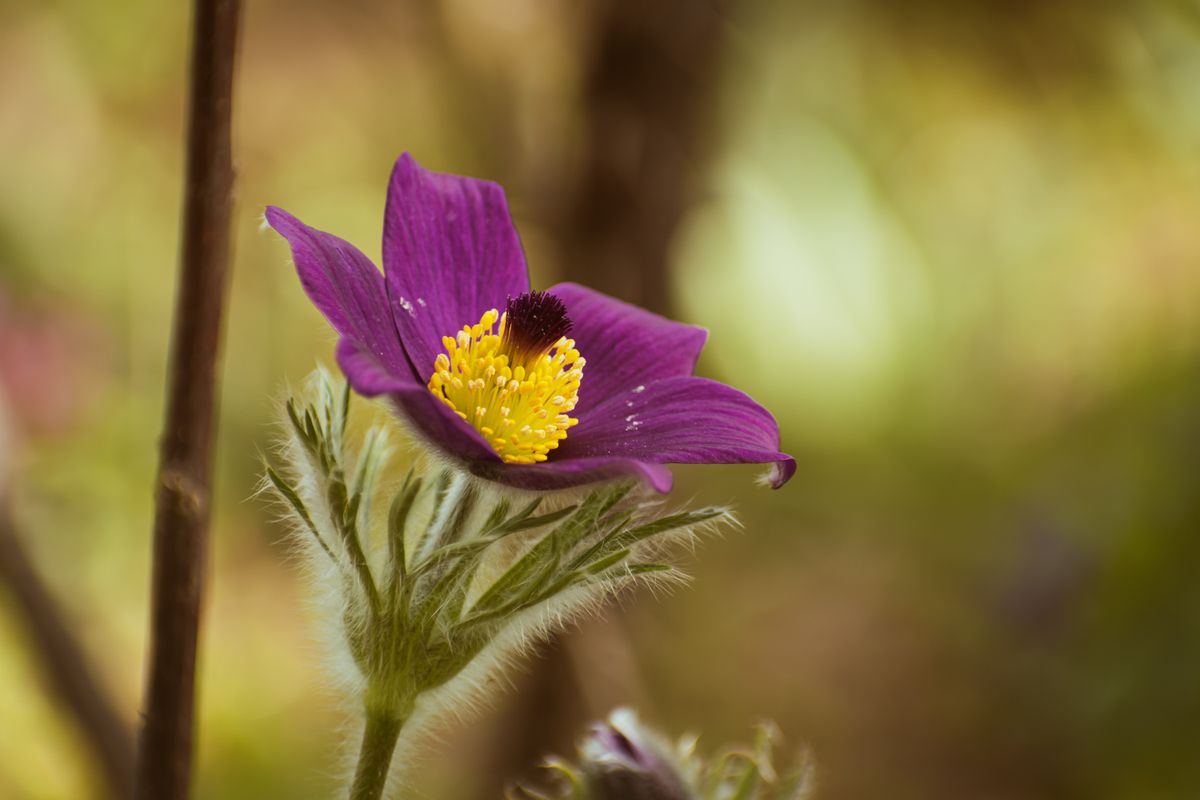
It blooms before anything else blooms: violet bells on silvery hairy stems, in the middle of barren limestone soil - and these soils are now almost nonexistent.
The common pasque flower grows on dry and semi-dry grasslands, calcareous grasslands, and sunny slopes throughout Central Europe. Its name has nothing to do with cooking: "cowbell" is the older form, referring to the bell shape of the flower. The botanical name Pulsatilla comes from Latin pulsare, The blossom sways even in the slightest breeze. After flowering, it forms the feathery, silvery seed heads by which it can still be recognized in summer and which have given it folk names like "Devil's Beard".
These habitats have become rare in Central Europe: dry grasslands are disappearing due to fertilizer runoff, afforestation, and the end of traditional sheep grazing. The pasque flower is therefore under special protection in Germany and is on the Red Lists of many federal states. Wild populations must not be collected – not even „just a few blossoms“. Those who want to have them in their garden buy plants propagated by nurseries; they thrive in rock gardens on permeable, calcareous soil and remain in the same place for decades.
In folk medicine, it held a firm, but always cautious, place: for spasmodic menstrual cramps, neuralgia, migraines, and nervous restlessness. The old herbals consistently included warnings – even then, the fresh plant was known to be pungent and blister-inducing. Its major breakthrough came via a different route: Samuel Hahnemann incorporated Pulsatilla into homeopathy early on, and to this day it remains one of the most frequently prescribed remedies.
To useWhat the pasque flower can do - and what it can't
Let's start with what really matters here: The pasque flower is a poisonous plant, and the difference between fresh and dried is not a detail, but everything. The fresh plant contains ranunculin. If the tissue is damaged—picked, crushed, chewed—protoanemonin is produced: a substance that strongly irritates skin and mucous membranes, causes blisters, and, if swallowed, leads to vomiting, diarrhea, and kidney irritation. Upon drying, protoanemonin is converted into the largely ineffective anemonin. Only this dried drug, Pulsatilla herb, was ever used medicinally.
There is currently no recognized, scientifically proven use for pasqueflower. It is one of the plants that has practically disappeared from modern phytotherapy – not because anything harmful was discovered, but because the ratio of unclear efficacy to clear irritant potential is unconvincing. What remains is homeopathy. Pulsatilla pratensis or Pulsatilla vulgaris ist dort ein Konstitutionsmittel ersten Ranges, klassisch eingesetzt bei Verkühlungen mit mildem gelblichem Sekret, bei Ohrenschmerzen von Kindern, bei Regelstörungen und bei wechselhaften, tränennahen Beschwerdebildern.
And let's be honest here: The effectiveness of homeopathic preparations beyond the placebo effect is not scientifically proven, and we're not claiming otherwise. If you've had good experiences with Pulsatilla, that's your experience, and no one can take that away from you. What we want to emphasize is the limit: This plant is not something you can prepare yourself, dose yourself, or take from nature. For the ailments it was traditionally used for—restlessness, tension, and spasmodic menstrual cramps—there are herbs that are safe, well-researched, and readily available.
IngredientsThat's what's inside the pasque flower
The key ingredient is Ranunculin, Ranunculin is a glycoside that characterizes the entire buttercup family – buttercups, wood anemones, Christmas roses, and, of course, pasque flowers. As long as the cell is intact, ranunculin is harmless. If the plant is damaged, an enzyme breaks it down, producing... ProtoanemoninSharp, volatile, highly irritating. On the skin, this leads to redness, burning and blisters (the old name was "meadow burn"), in the mouth to burning and swelling, in the stomach to vomiting and colic.
Something useful happens during drying: Two molecules of protoanemonin combine to form a stable Anemone, which has largely lost its irritant effect. Therefore, hay with buttercups and dried pasqueflower are unproblematic, while fresh material is not. This transformation is the entire reason why the drug exists at all – and the reason why a homemade fresh plant infusion would be exactly the wrong thing to do.
In addition, the plant contains saponins, tannins, flavonoids, and triterpenes. These play almost no role in the evaluation – with this plant, the ranunculin content is what matters; everything else is secondary.
Enhanced combinationsWhat the pasque flower goes with
This isn't about flavor combinations, but about what makes sense together - and what you're better off leaving alone.
Permeable, calcareous soil, full sun, no fertilizer: then it will live for decades and be the first to bloom every spring.
Those who want them can buy them at a perennial nursery. This protects wild populations and also provides more robust plants.
It blooms in March and April, when hardly anything else is in bloom - for wild bees and bumblebees, it is one of the first food sources of the year.
For the ailments for which it was traditionally used, these herbs are the safe and well-researched alternative.
This makes it significantly easier and less risky to treat cramping menstrual cramps.
If you use Pulsatilla at all, then only as a tested preparation from the pharmacy - never as a homemade remedy.
What contradicts itselfIt's best to avoid these combinations.
This species is specially protected. Removing it from the wild is prohibited and is punishable as an administrative offense.
Fresh herb releases protoanemonin – causing skin irritation, blisters, and a severe burning sensation in the mouth. Do not use fresh plant tincture, chew, or apply directly to the skin.
Despite its name, this is not a kitchen plant and never has been. Not even as a decoration on a plate.
The active ingredient content varies greatly and the irritation threshold is low - home preparations are not an option here.
For these groups, there is absolutely no security data – do without it completely.
Fresh buttercup plants also irritate the mouth and stomach of horses, cattle and sheep; animals usually avoid them on their own.
ApplicationHow it is used today
- Homeopathic globulesBy far the most common form: Pulsatilla in various potencies, from the pharmacy, after consultation.
- Homeopathic dilutionDrops as a liquid preparation, also available only from a pharmacy and after consultation.
- Combination preparationsPulsatilla ist Bestandteil einiger Fertigarzneimittel bei Verkühlungs- und Frauenbeschwerden.
- Dried drugPulsatilla herb - historically used as a tea infusion, today practically only in professional hands and not for self-application.
- Never fresh plantNo fresh tincture, no poultice, no application - the plant blisters when fresh.
- garden plantIn the rock garden on limestone and in full sun, from the perennial nursery - long-lasting and easy to care for.
- Bee pastureEarliest nectar source in March and April, valuable for bumblebees and wild bees.
- nature reserveOn calcareous grasslands, it is an indicator species for intact, unfertilized dry habitats.
- Photo opportunityThe silvery fruit cluster backlit - that's the use we most recommend.
- Alternative herbsFor restlessness, tension and menstrual cramps: valerian, lemon balm, chamomile, yarrow, chaste tree.
As a home remedyThe safe alternative
Calming tea instead of a pasque flower
- Put one teaspoon each of dried lemon balm leaves and chamomile flowers into a cup; in case of severe restlessness, add half a teaspoon of cut valerian root.
- Pour 250 ml of boiling water over it and let it steep, covered, for ten minutes - covering it keeps the essential oils in the infusion.
- Strain and drink slowly while warm. If using valerian, allow a quarter of an hour before bedtime.
- For cramping menstrual pain, use equal parts yarrow and lady's mantle, two teaspoons to 250 ml, also covered for ten minutes.
These herbs are precisely for the ailments for which the pasque flower has traditionally been used: nervous restlessness, tension, difficulty falling asleep, and spasmodic menstrual cramps. The difference is that these herbs are safe, readily available, and—especially in the case of valerian and chamomile—well-researched. Valerian has a recognized traditional use for sleep disturbances; the research is mixed, but the safety profile is very good.
Two to three cups spread throughout the day, preferably in the evening if using valerian. Those allergic to plants in the daisy family should omit chamomile. If restlessness or sleep problems persist for more than a few weeks, or if menstrual cramps worsen or occur for the first time, a medical evaluation is necessary – tea should then be used as a supportive measure, not a solution.
Ayurveda & TCMWhat the old systems say
Ayurveda
The pasque flower is not an Ayurvedic plant; it doesn't grow in India and isn't mentioned in the classical texts. An Ayurvedic classification would have to be invented, and we won't do that. Anyone looking for something for restlessness and excess Vata within the Ayurvedic framework will end up with Ashwagandha, Brahmi, or warm milk with nutmeg—not here.
Traditional Chinese Medicine
Even in the Chinese Materia Medica Pulsatilla vulgaris no space. However, there is a related species that is firmly established there: Pulsatilla chinensis, the root as Bai Tou Weng. It is considered bitter and cold and is traditionally used for heat-related diarrhea and dysentery - a completely different plant, a completely different application, and no argument for using the native pasque flower on your own.
Warning noticesWhen you should be careful
Please note
- Fresh plant is poisonous: Protoanemonin is highly irritating to the skin and mucous membranes, causes blisters, and, if swallowed, leads to vomiting, colic, and kidney irritation.
- No skin contact: Do not pick, crush or apply - the juice of the fresh plant can cause persistent skin inflammation.
- Nature conservation: This species is specially protected in Germany; taking it from the wild is prohibited.
- Do not use on your own: Do not use homemade tinctures, teas or extracts - the active ingredient content and irritation threshold are unpredictable.
- Pregnancy, breastfeeding, children: No application is available; no security data is available.
- Children and animals: Plants in the garden in such a way that small children cannot nibble on them; if swallowed, call the poison control center.
This page provides information and does not replace medical advice. If symptoms persist, please consult a doctor.
Related to the topicRead on and cook along!
Shop links lead to our product pages; it is indicated there if a partner is involved.
SourcesWhat is this based on?
- Spektrum Academic Publishing: Encyclopedia of medicinal plants and drugs, entry Pulsatilla-Types - Ranunculin, Protoanemonin and the restriction of application to homeopathy.
- Blaschek W (ed.): Wichtl - Herbal drugs and phytopharmaceuticals. 6th edition 2016, monograph Pulsatilla herb.
- Roth L, Daunderer M, Kormann K: Poisonous plants - plant toxins. 6th edition - Protoanemonin, skin irritation and poisoning symptoms of the buttercup family.
- Federal Species Protection Ordinance (BArtSchV), Annex 1 - Pulsatilla vulgaris as a specially protected species.
- Hänsel R, Sticher O: Pharmacognosy - Phytopharmacy. 9th edition - ranunculin-containing drugs and the conversion of protoanemonin to anemonin upon drying.