Nectarine (Prunus persica var. nucipersica)
OriginA peach without fur
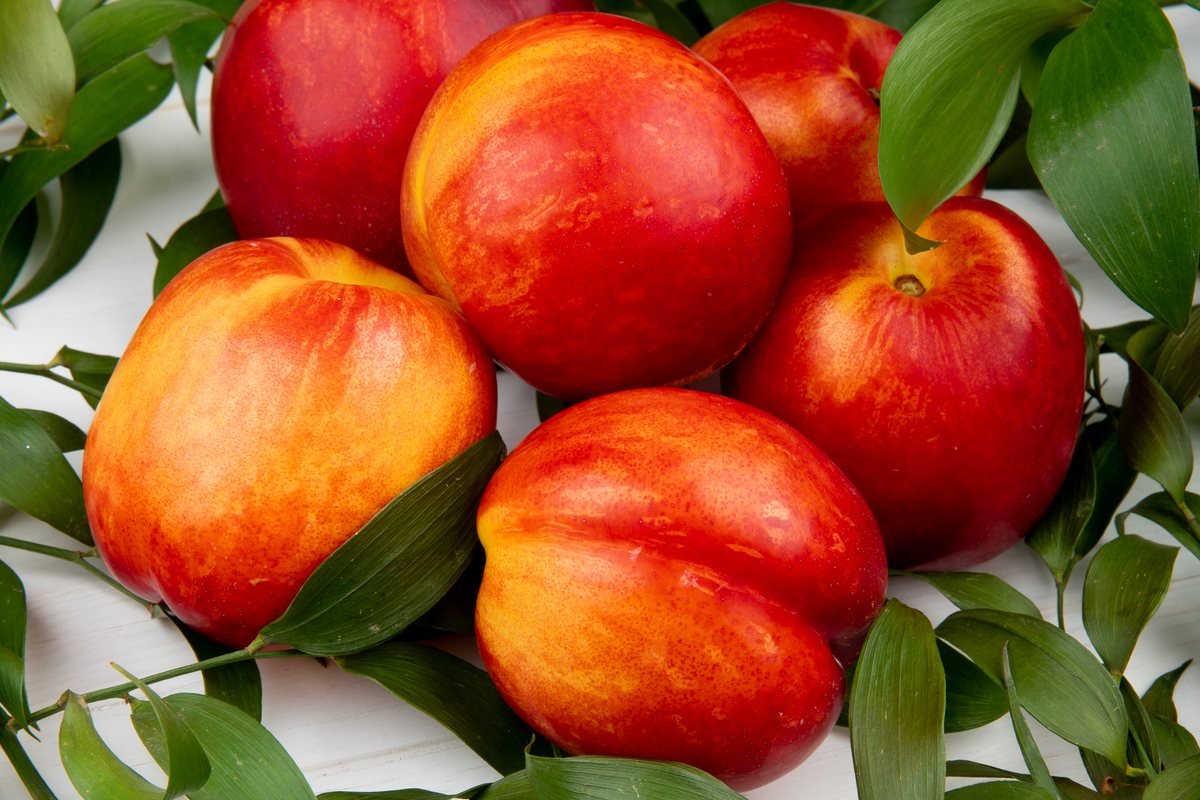
The name comes from "nectar" - the sweet drink of the gods of the Greeks.
Peaches were cultivated in China thousands of years ago and reached Europe via Persia - hence the Latin name. persica. At some point, a branch with smooth fruit appeared on a peach tree. Today we know that a single change in a gene makes the hairs disappear. A nectarine can grow from the seed of a peach and vice versa; the traits are inherited recessively.
The persistent claim that the nectarine is a cross between a peach and a plum is therefore incorrect. It only became a mass-produced fruit in Europe in the 20th century, and today it comes primarily from Spain, Italy, and Greece. In Germany, stone fruits of this type only grow in mild climates such as along the Moselle River or in the Palatinate – the majority are imported.
To useWhat the nectarine does for you
100g of nectarine contains only about 44 kcal, plus around 1.7g of vitamin D. Dietary fiber, approximately 200 mg potassium and about 5 mg Vitamin C. A medium-sized fruit weighing 150g provides around 8mg of vitamin C – a small contribution, not a vitamin C powerhouse. With almost 88% water, it's a good thirst quencher in summer.
It owes its yellow-orange color to Carotenoids, especially beta-carotene and beta-cryptoxanthin, which the body can partially convert into vitamin A. The peel and the red coloring also contain other nutrients. Polyphenols such as chlorogenic acid, catechins, and anthocyanins. Because the smooth skin is eaten along with the peach, more of these substances end up in the mouth than with a peeled peach.
There are hardly any studies on the specific health effects of nectarines. They are among the fruits whose abundant consumption has been linked to fewer cardiovascular diseases in large studies. Their value lies in their enjoyment with few calories, not in any particular medicinal properties.
IngredientsThis is what's in the nectarine
Nectarines contain water, sugars (sucrose, glucose, fructose), sorbitol, dietary fiber such as pectin, fruit acids, potassium, magnesium, phosphorus, vitamin C, niacin, vitamin E, as well as carotenoids (beta-carotene, beta-cryptoxanthin, lutein) and polyphenols such as chlorogenic acid, catechins, flavonols and anthocyanins.
In den Kernen steckt wie bei Pfirsich und Marille Amygdalin, aus dem Blausäure entstehen kann. Den Stein daher nicht knacken oder mitverarbeiten.
Enhanced combinationsWhat makes the nectarine stronger
The nectarine needs little - a little fat, a little acid, a little warmth.
It helps with carotenoids.
Dietary fiber and fruit sweetness.
Freshness and more vitamin C.
Caramelized in 3 minutes.
Summer salad.
The stone fruit family in the cake.
What contradicts itselfIt's best to avoid these combinations.
The same allergen Pru p 3.
It becomes mealy instead of ripe.
Amygdalin can form hydrogen cyanide.
The smooth peel is eaten as well.
May cause bloating.
Pressure sores rot quickly.
In the kitchenWhere she belongs
- Fresh from the handWashed, with peel.
- fruit saladWith berries and mint.
- Grilled nectarineWith honey and thyme.
- summer saladWith arugula and mozzarella.
- CrumbleWith oat crumble.
- Overnight OatsDice rolled on top.
- compoteWith vanilla.
- SmoothieWith yogurt and raspberries.
- SalsaServe with chili and lime with fish.
- Sheet cakeWith almond flakes.
As a home remedyNectarine compote for later use
Nectarine compote
- Wash 1 kg of ripe nectarines, halve them, remove the stones and cut them into wedges.
- Place 100 ml of water, the juice of half a lemon and a tablespoon of honey (to taste) in a pot.
- Cover and simmer gently for 5 to 8 minutes, until the wedges are soft but not falling apart.
- Pour hot into clean screw-top jars, seal and let cool.
To extend the short season and save overripe fruit. When eaten warm, compote is often easier on sensitive stomachs than raw fruit, and the carotenoids are largely preserved during the brief cooking process.
It will keep for about a week in the refrigerator, or for several months in portions frozen. A small bowl for breakfast or as dessert.
Ayurveda & TCMWhat the old systems say
Ayurveda
In Ayurveda, the peach (and therefore the nectarine) is described as sweet, slightly sour and rather warming - balancing for Vata, ripe and in moderation also for Pitta, sparingly for Kapha.
Traditional Chinese Medicine
In Traditional Chinese Medicine (TCM), the peach is considered warm, sweet, and sour. It is said to nourish the body's fluids, moisten the intestines, and strengthen the middle; however, it should not be eaten in large quantities if there is internal heat.
Warning noticesWhen you should be careful
Please note
- LTP allergy: The lipid transfer protein Pru p 3 is found mainly in the peel and can trigger severe reactions up to and including anaphylaxis; those who react to peaches also avoid nectarines.
- Cross-allergy: People with birch pollen allergies often experience a tingling sensation in the mouth; peeling or heating usually helps with this type of allergy.
- Cores: Do not crack or eat - amygdalin can release hydrocyanic acid.
- Sorbitol: If you have a sorbitol or fructose intolerance, test small amounts.
- Residues: Wash thoroughly, as the peel will be eaten.
This page provides information and does not replace medical advice. If symptoms persist, please consult a doctor.
Related to the topicRead on and cook along!
Shop links lead to our product pages; it is indicated there if a partner is involved.
SourcesWhat is this based on?
- USDA FoodData Central: Nectarines, raw (FDC 169914).
- Vendramin E et al. A unique mutation in a MYB gene cosegregates with the nectarine phenotype in peach. PLoS ONE 2014; 9(3): e90574.
- Pastorello EA et al. The major allergen of peach (Prunus persica) is a lipid transfer protein. Journal of Allergy and Clinical Immunology 1999; 103(3 Pt 1): 520–526.
- Federal Centre for Nutrition (BZfE): Peaches and nectarines. Press release.