
Cranberry (Vaccinium vitis-idaea)
OriginThe berry of the coniferous forests
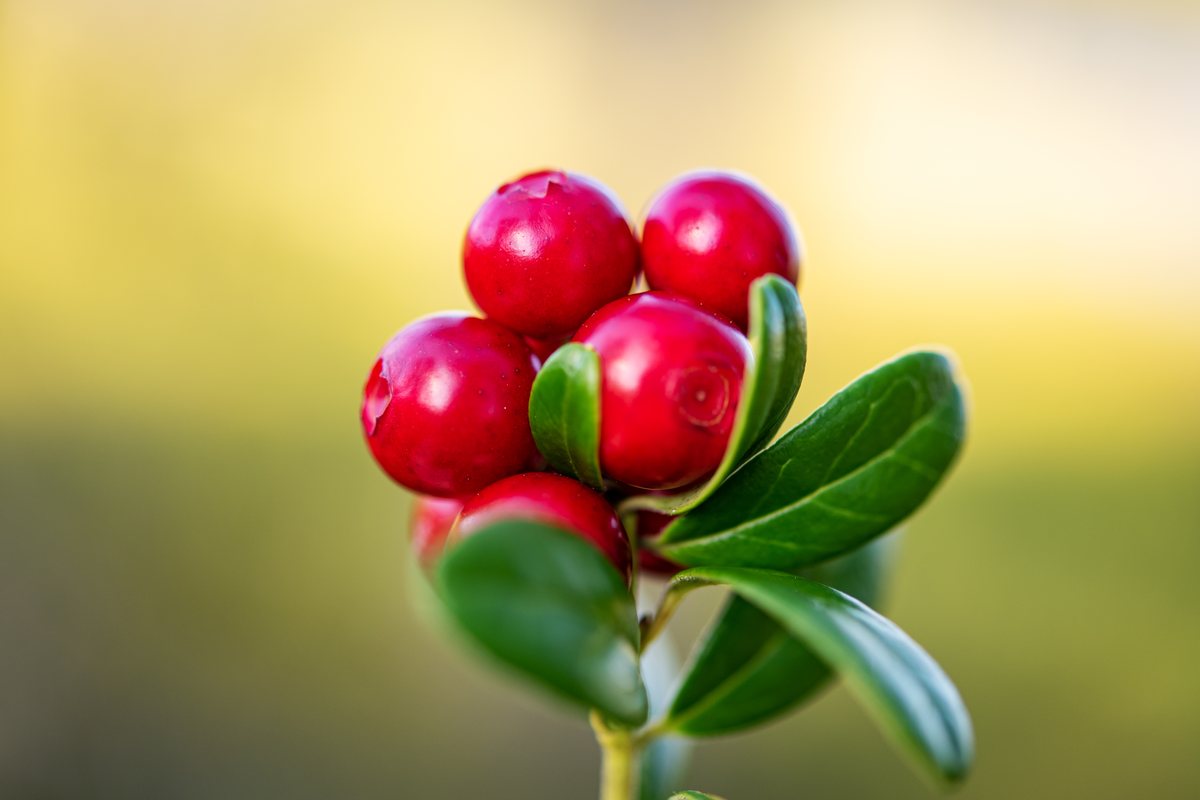
In Scandinavia, cranberries are as commonplace as applesauce is in Germany – served with meatballs, game, and reindeer.
The lingonberry is a small, evergreen dwarf shrub of northern coniferous forests, heaths, and bogs. In Germany, it grows primarily in the low mountain ranges and the Alps; it is harvested like the blueberry, usually with the berry comb, which is prohibited in many protected areas.
Their natural benzoic acid makes them exceptionally durable – in the past, cranberries were preserved raw in water and kept all winter. The American cranberry (Vaccinium macrocarpon) is a close relative with larger berries; in our region it is often mistakenly called "cultivated cranberry".
To useWhat the cranberry can do for you
Cranberries contain Type A procyanidins, Anthocyanins, vitamin C, vitamin E, manganese, and dietary fiber. The procyanidins are the reason for the great research interest: In the laboratory, they make it more difficult for E. coli bacteria to adhere to the bladder wall.
For the related Cranberry A 2023 Cochrane review of 50 studies found that cranberry products reduce the risk of recurrent urinary tract infections in women, children, and after surgical procedures. Less data exists for lingonberries; however, a Finnish study found that a lingonberry-cranberry juice significantly reduced recurrences in women.
The classification: Lingonberries and cranberries can help prevent recurring bladder infections - they do not treat acute infections and do not replace antibiotics when necessary.
IngredientsThis is what's in the cranberry
Cranberries contain fruit acids and little sugar., Procyanidins, Anthocyanins, flavonols such as quercetin, vitamin C, vitamin E, manganese, and dietary fiber. The natural Benzoic acid It has a preservative effect.
Like bearberry leaves, the leaves contain arbutin, a urinary tract disinfectant – but unlike the berries, they are not used as food. Commercial cranberry compote often contains over 40 percent sugar.
Enhanced combinationsWhat makes the cranberry stronger
Cranberries provide the acidity needed for hearty dishes - and they need a little sweetness to shine.
The classic side dish for venison, wild boar and roasts.
Köttbullar mit Erdapfelpüree und Preiselbeeren.
Baked Camembert with cranberries.
Pear halves with cranberries - a classic accompaniment to game, sweetened without much sugar.
Those who want to take preventative measures should drink plenty of fluids – that is the most important protection.
Dried cranberries in oats.
What contradicts itselfIt's best to avoid these combinations.
Ready-made compote and dried cranberries are heavily sweetened - even when cooking with little sugar.
Fever, flank pain, or blood in the urine warrant a visit to the doctor.
In isolated cases, increased blood thinning has been reported for cranberry – consult your doctor before consuming large quantities.
Cranberry concentrates can increase oxalate excretion.
Very sour and bitter - more palatable when cooked.
It damages the plants and is prohibited in many places.
In the kitchenWhere she belongs
- Cranberry compoteCooked briefly with a little sugar.
- Venison roastWith cranberries and pear.
- MeatballsSwedish meatballs with cranberries.
- Baked CamembertWith cranberries.
- Cranberry pearsPear halves filled with compote.
- Cranberry chutneyWith onion and vinegar.
- PorridgeWith dried cranberries.
- Cranberry juiceDiluted as a spritzer.
- KaiserschmarrnWith cranberries instead of applesauce.
- sauceFor poultry and duck.
As a home remedyPrevention of recurring bladder infections
Cranberry juice cure
- Drink 200 ml of unsweetened cranberry or lingonberry juice diluted with water daily.
- Alternatively, use low-sugar cranberry compote or standardized cranberry preparations.
- Drink at least 1.5 to 2 liters throughout the day.
- Maintain for several months - it's about prevention, not treatment.
For women with recurrent urinary tract infections, as a preventative measure. The procyanidins make it difficult for bacteria to adhere to the bladder wall; drinking plenty of fluids also helps flush the bladder.
One serving daily. Not a substitute for the treatment of an acute bladder infection. Consult a doctor beforehand if you are taking warfarin or have kidney stones.
Ayurveda & TCMWhat the old systems say
Ayurveda
Cranberries are not mentioned in classical Ayurveda. Based on their sour and tart taste, they would now be classified as reducing Kapha and increasing Pitta – cooked with a touch of sweetness, they are considered more digestible.
Traditional Chinese Medicine
Even in Traditional Chinese Medicine (TCM), cranberries are not traditionally used. Modern classifications see them as acidic-cooling and as eliminating damp-heat in the lower burner – which aligns with their use in treating cystitis.
Warning noticesWhen you should be careful
Please note
- Acute cystitis: Seek medical treatment, especially if you have a fever or flank pain.
- Blood thinners: Coordinate large quantities of cranberry with warfarin.
- Kidney stones: Use concentrated preparations with caution.
- Sugar: Ready-made products are often heavily sweetened.
- Confusion: Do not confuse them with the poisonous berries of lily of the valley or daphne - only collect berries that are definitely identified.
This page provides information and does not replace medical advice. If symptoms persist, please consult a doctor.
Related to the topicRead on and cook along!
Shop links lead to our product pages; it is indicated there if a partner is involved.
SourcesWhat is this based on?
- Williams G et al. Cranberries for preventing urinary tract infections. Cochrane Database of Systematic Reviews 2023; (11): CD001321.
- Kontiokari T et al. Randomized trial of cranberry-lingonberry juice and Lactobacillus GG drink for the prevention of urinary tract infections in women. BMJ 2001; 322(7302): 1571.
- Howell AB et al. A-type cranberry proanthocyanidins and uropathogenic bacterial anti-adhesion activity. Phytochemistry 2005; 66(18): 2281–2291.
- Kylli P et al. Lingonberry (Vaccinium vitis-idaea) and European cranberry (Vaccinium microcarpon) proanthocyanidins: isolation, identification, and bioactivities. Journal of Agricultural and Food Chemistry 2011; 59(7): 3373–3384.
- Fineli - Finnish Food Database: Lingonberry.