
OriginThe savior from the monastery garden
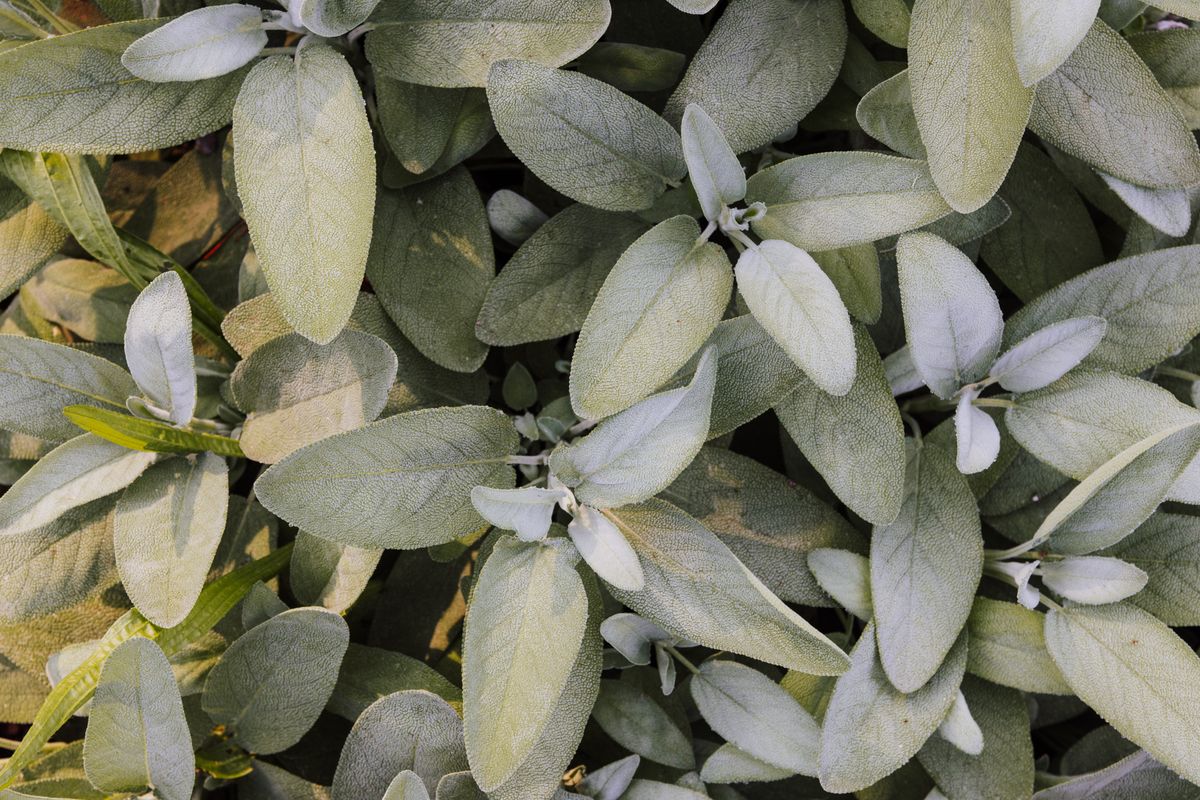
The name says it all: salvia comes from salvare, save - and the medieval school of Salerno asked in a famous verse how a person could die who had sage growing in their garden.
Common sage originates from the northern Mediterranean region, primarily the Dalmatian coast and Italy, where it grows wild on dry, calcareous slopes. It was brought north by the Romans, and with monastic medicine, it became one of the most important medicinal plants in Central Europe: it is mentioned in Charlemagne's Capitulare de villis, the Lorsch Pharmacopoeia, in the writings of Hildegard von Bingen, and in virtually every herbal of the early modern period. Few plants have enjoyed such an unbroken reputation for such a long time.
It is important to distinguish him from his relatives. True sage (Salvia officinalisThe plant with the grey-green, velvety leaves is used medicinally and in cooking. Meadow sage (Salvia pratensisThe plant that blooms blue in our meadows is a pretty wild perennial with no significant effect and no aroma. Clary sage (Salvia sclareaIt smells completely different, almost like ambergris, and is cultivated for its essential oil. And the Pineapple sage The one from the garden center is a Mexican ornamental plant with a fruity scent, but without the medicinal ingredients.
In the garden, common sage is a subshrub that tolerates drought better than wet conditions and becomes more aromatic in poor soil. It becomes woody and bare if not regularly pruned; the best time is spring, cutting into new wood, never old. Harvesting is best done shortly before flowering on a sunny morning when the oil content is highest. And unlike most herbs, sage loses little when dried – dried leaves are a perfectly good alternative.
To useWhat sage does for you
With sage, you have to keep the two applications separate because they have different levels of effectiveness. external It is in the highest category at the European Medicines Agency - well-established use - For inflammation of the oral and pharyngeal mucosa: Gargle and rinse for a scratchy throat, sore gums, canker sores, and after dental procedures. This works in two ways simultaneously: The tannins constrict the outermost layer of mucous membrane and form a protective film over it, while the essential oil has an antibacterial and mildly anti-inflammatory effect.
The internal The application is based on tradition and primarily concerns one thing: excessive sweating. Commission E has given sage a positive assessment, and there are smaller studies on menopausal symptoms such as hot flashes that point in the same direction – good indications, but not strong evidence. The mechanism is not fully understood; a direct effect on the sweat glands is suspected. In addition, the bitter substances and tannins have a digestive effect, aiding bloating and flatulence.
And then there is another property that one should be aware of, because it works in both directions: Sage inhibits milk production. Traditionally, sage is therefore the herb used for weaning – three cups of strong sage tea a day are an old and effective method. Precisely for this reason, it is unsuitable during breastfeeding if you wish to continue breastfeeding. Finally, and most importantly: sage contains Thujone, a substance that can induce spasms in high doses. This isn't an issue in a cup of tea or a serving of saltimbocca; however, it is a concern with weeks of high-dose tea, alcoholic extracts, and especially pure essential oil.
IngredientsThat's what's in the leaf
The essential oil It makes up one to two and a half percent of the dried leaf. Its main components are Thujone (α- and β-thujone, together often 30 to 50 percent), Camphor and Cineole This combination produces the characteristically bitter, slightly medicinal note. Thujone is the critical substance: in high doses, it affects the central nervous system and can trigger cramps. Therefore, there are maximum limits for it in food products, and that's why pure sage oil is not suitable for self-medication.
The second large group are the tannins (three to eight percent, primarily rosmarinic acid and Lamiaceae tannins). These are responsible for the astringent effect when gargling and, incidentally, also for the furry feeling that sage tea makes in the mouth. In addition, it contains bitter substances, diterpenes such as carnosic acid – a powerful antioxidant shared by sage and rosemary – as well as flavonoids.
There is a difference in preparation that is often overlooked: Tannins are needed for the mouth, oil is needed internally. For gargling, let it steep longer and more thoroughly, ideally for ten minutes and two teaspoons per cup, to ensure all the tannins are extracted. For drinking, steep for a shorter time and cover the cup to prevent the essential oil from evaporating. A cold infusion left overnight extracts a particularly high amount of tannins and very little bitterness – ideal if the taste is otherwise too strong.
Enhanced combinationsWhat makes sage stronger
Sage is a powerful herb that needs a counterweight - fat in the kitchen, tannin partners in the throat, a limit in the cup.
Salbei bringt die Gerbstoffe, Kamille beruhigt, Thymian wirkt in die Bronchien hinein - die Verkühlungsmischung.
Saltimbocca, sage butter, roast pork: The resinous aroma cuts through fat like almost no other herb.
Frying whole leaves in hot butter or oil for a few seconds makes them glassy, crispy, and significantly milder.
Two teaspoons, gargle for ten minutes with lukewarm water - the tannins need time and heat.
Traditionally, it is drunk as cold tea throughout the day, not hot, to combat hot flashes.
The Tuscan combination: cannellini, sage, garlic, good oil - that's all you need.
What contradicts itselfIt's best to avoid these combinations.
Because of the thujone, sage tea is a therapeutic remedy for several days, not an everyday drink for months.
Sage oil is rich in thujone and in undiluted form a real risk - it doesn't belong on a spoon.
Sage inhibits milk production - that's precisely why it's the classic weaning herb.
Thujone is undesirable during pregnancy; sage remains unproblematic as a spice in food.
Thujone lowers the seizure threshold - in cases of epilepsy, high-dose preparations should be avoided altogether.
If sage is cooked for too long, it becomes bitter and overpowering; a few leaves at the end or briefly fried are better.
To which courtWhere he belongs
- SaltimboccaVeal schnitzel with sage leaf and raw ham, fried in butter - the Roman original.
- Sage butterWhisk butter with whole leaves - for ravioli, gnocchi and pumpkin.
- Fried sage leavesA few seconds in hot oil, add salt - as a snack or garnish.
- White beansCannellini slowly braised with sage, garlic and olive oil.
- Roast porkSage under the rind and in the roasting juices - classically with rosemary.
- Sage teaOne teaspoon per 250 ml, covered for five minutes - internally; for gargling, stronger and longer.
- gargle solutionTwo teaspoons, ten minutes, lukewarm - the best-documented application.
- Cold sage teaPrepared cold overnight - for hot flashes, spread throughout the day.
- Sage vinegarLeaves in white wine vinegar - for vinaigrette and for deglazing.
- Oven-roasted vegetablesKürbis, Erdapfel, Pastinake mit Salbei und Olivenöl bei 200 Grad.
As a home remedyGargling with sage
Sage gargle
- Put two heaped teaspoons of dried sage leaves into a cup - deliberately more than for drinking tea.
- Pour 250 ml of boiling water over the product and let it steep, covered, for ten full minutes; the tannins need this time.
- Strain and allow to cool to a pleasantly lukewarm temperature - too hot will irritate the already irritated mucous membrane.
- Gargle with half a cup three to four times a day, for about one minute each time, and do not drink or eat immediately afterwards.
For a scratchy throat, the onset of a sore throat, sore gums, canker sores, and after dental procedures. This is the application for which sage has the highest level of evidence from the EMA – there's no need for qualification here. The tannins form a protective film on the inflamed area, and the essential oil also has an antibacterial effect.
Three to four times a day for a few days, at most one to two weeks. The solution is gargled and then spat out, so the thujone plays practically no role here. Severe, one-sided sore throat pain, fever, difficulty swallowing, or white coating on the tonsils should be checked by a doctor – this could be a sign of bacterial tonsillitis.
Ayurveda & TCMWhat the old systems say
Ayurveda
Sage is not part of the classical Ayurvedic materia medica, but in modern practice it is classified as pungent, bitter, astringent, and warming: reducing Kapha, and increasing Vata and Pitta in larger quantities. Because it is drying, it is well-suited for damp, phlegmy conditions and excessive sweating – a classification based on principle, not tradition.
Traditional Chinese Medicine
European sage is also not represented in the Chinese Materia Medica - the one listed there Dan Shen is the red root sage (Salvia miltiorrhiza), another species with a completely different profile: its root is considered bitter and slightly cooling and is used for blood congestion and heart problems, not for sore throats. Culinary sage, by its very nature, would be a warm, drying herb that transforms moisture and strengthens the surface.
Warning noticesWhen you should be careful
Please note
- Thujone: Avoid high-dose continuous tea and never take pure essential sage oil - thujone can cause cramps in high doses.
- Epilepsy: For seizure disorders, completely avoid concentrated preparations and essential oils.
- Breastfeeding period: Sage inhibits milk production - unsuitable for continued breastfeeding, but traditionally used for weaning.
- Pregnancy: It is safe to use as a spice; avoid using it in treatments, tinctures, and essential oils.
- Duration of use: Sage tea should be consumed internally for days to a few weeks, not as a constant everyday drink.
- For sore throats: One-sided severe pain, fever or coating on the tonsils should be checked by a doctor.
This page provides information and does not replace medical advice. If symptoms persist, please consult a doctor.
Related to the topicRead on and cook along!
Shop links lead to our product pages; it is indicated there if a partner is involved.
SourcesWhat is this based on?
- EMA/HMPC: European Union herbal monograph on Salvia officinalis L., folium - well-established use externally for inflammation of the oral and pharyngeal mucosa.
- Commission E: Monograph Salviae folium (sage leaves), Federal Gazette 1985 - Dyspepsia, excessive sweating, externally inflammation in the mouth and throat.
- Blaschek W (ed.): Wichtl - Herbal drugs and phytopharmaceuticals. 6th edition 2016, monograph Salviae officinalis folium.
- Bommer S, Klein P, Suter A. First time proof of sage's tolerability and efficacy in menopausal women with hot flushes. Advances in Therapy 2011; 28(6): 490–500.
- European Pharmacopoeia (Ph. Eur.): Monograph Salviae officinalis folium - Minimum content of essential oil and thujone limits.


