
OriginThe star that tastes like anise
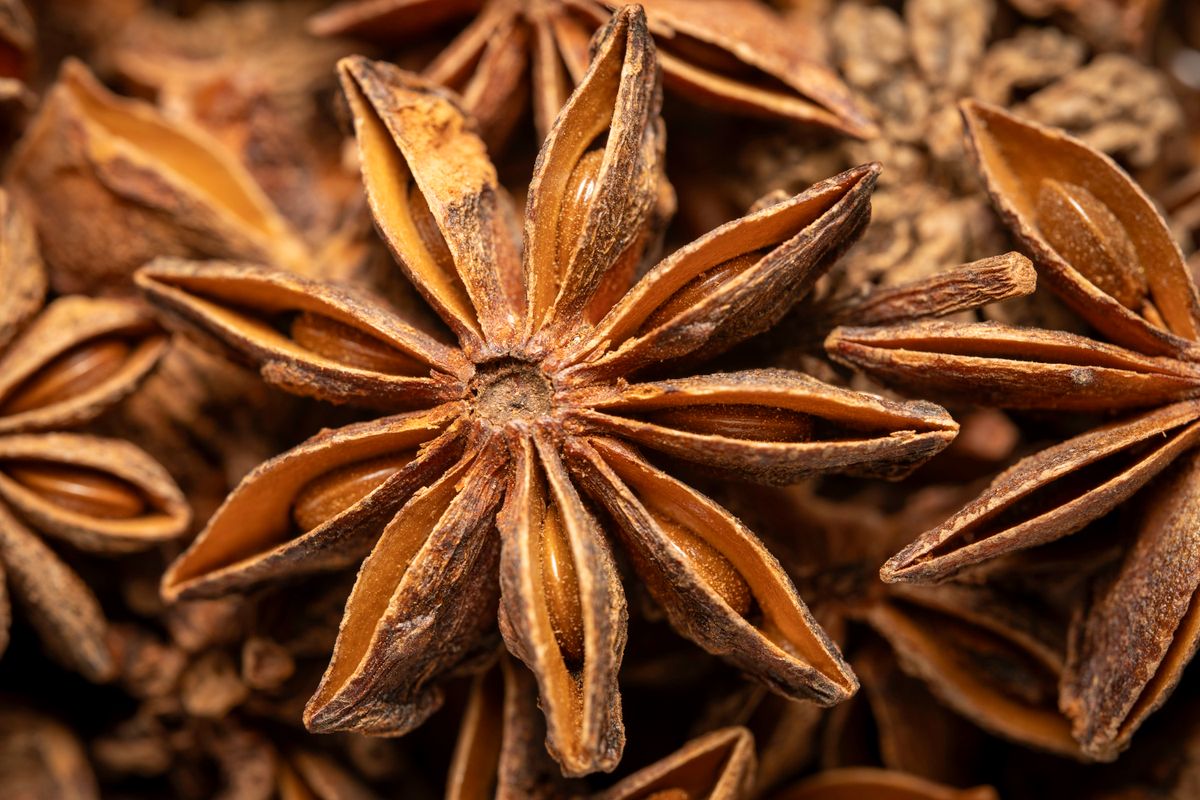
Star anise is not related to anise – it is a tree from southern China that produces the same aromatic compound. And it is the raw material from which a flu medication was derived.
The star anise tree is an evergreen relative of the magnolia, native to the mountains of southern China and northern Vietnam. Its fruits—eight-pointed stars, each chamber containing a shiny seed—are picked unripe and dried. In China, star anise has been used as a spice and medicine for millennia; it only arrived in Europe around 1600, when English sailors brought it from the Philippines.
Almost all of the world's star anise production is concentrated in China and Vietnam. Star anise became known outside the kitchen when the pharmaceutical industry used its shikimic acid to produce the flu medication oseltamivir (Tamiflu) – it became scarce during the avian flu pandemic. Important: Japanese star anise (Illicium anisatum) looks almost identical and is poisonous – therefore, never use wild or untested star anise.
To useWhat star anise does for you
Star anise is the stronger brother of anise - mit demselben Wirkstoff und derselben Richtung: Anethol löst Krämpfe im Darm, treibt Blähungen aus und lockert Schleim in den Bronchien. In der chinesischen Medizin ist er das Mittel gegen Kälte im Bauch, gegen Erbrechen und Bauchschmerzen; die europäische Arzneimittelbehörde führt ihn traditionell bei Verdauungsbeschwerden und Verkühlungshusten.
Its antibacterial and antiviral potential – clearly demonstrated in the laboratory, but little studied in humans – is the basis of the Tamiflu raw material: Shikimic acid is the starting molecule, not the active ingredient itself. Star anise tea is therefore not a flu remedy, but a warming, antispasmodic tea for the cold season.
To be honest, the same applies to star anise as to anise: a reliable stomach and cough remedy with good tolerability - as long as it is the genuine product.
IngredientsThat's what's inside the star
trans-anethole This makes up 85 to 90 percent of the essential oil – the licorice-sweet note that star anise shares with anise and fennel. In addition Lemons, Linalool and Estragole in small quantities. The oil content of the fruit is between five and eight percent – higher than that of anise, therefore one star is sufficient.
Besides that Shikimic acid (up to 7 percent), flavonoids and tannins. The aroma is located in the fruit wall, not in the seed – therefore, use the whole star, not the kernels.
Enhanced combinationsWhat makes star anise stronger
Star anise is a braising spice: it releases its flavor slowly in liquid and loves meat, warmth, and dark aromas.
Chinese five-spice powder – star anise is the base note. For duck, pork belly, and red stew.
Vietnamese noodle soup gets its depth from star anise, cinnamon, clove, cardamom and roasted ginger - for hours.
Red-braised pork (Hong Shao Rou): star anise, soy, rice wine, rock candy - the sweetness comes from the anise.
Mulled wine, punch, baked apple: a star instead of anise - stronger, more decorative.
Poached pears in red wine with star anise - the French answer.
As a tea for a cold, cramping stomach: two anethole plants and ginger for warmth.
What contradicts itselfIt's best to avoid these combinations.
Sweet versus earthy and spicy: Star anise belongs in East Asia, not in India or Mexico.
Anethol und saure Paradeiser vertragen sich schlecht.
One per pot. Two, and everything tastes like licorice candy.
The oil evaporates. Buy whole stars, grind them if necessary.
Japanese star anise (toxic, containing anisatin) is almost indistinguishable from other herbs. Poisonings in babies from contaminated tea have been documented – only use tested, commercially available products.
Even real star anise is not suitable for babies - the authorities explicitly warn against it.
To which courtWhere he belongs
- Pho BoBeef bones, roasted ginger and onion, star anise, cinnamon, clove - six hours, then rice noodles and thinly sliced meat.
- Red-braised porkPork belly with soy, rice wine, rock candy, star anise, ginger - two hours.
- Five-spice duckDuck rubbed with five-spice powder, slowly roasted.
- Mulled wineA star, a cinnamon stick, orange slices - never boil.
- Poached pearsSoak in red wine with sugar, star anise and cinnamon for 30 minutes.
- Chinese tea eggsEggs marbled in black tea, soy and star anise.
- plum compoteA star to go with the plums, with cinnamon - with semolina pudding.
- Ramen brothStar anise in the pork broth for tonkotsu.
- Star anise teaBreak a star, let it steep for 10 minutes - for bloating.
- SambucaToday, Italian anise liqueur is mostly made from star anise.
As a home remedyStar anise tea for a cold stomach and cough
Star anise tea
- Roughly break a star (made from certified merchandise).
- Pour 250 ml of boiling water over it, cover and let it steep for 10 minutes.
- Abseihen, mit Honig; bei Verkühlung mit einer Scheibe Ingwer.
- One to two cups a day - only for adults and older children.
Bloating, abdominal cramps, feeling of fullness, chesty cough, chills. Warming anise tea for winter.
One star anise per cup, up to two cups daily. Never for infants and toddlers – even real star anise can cause cramps in them.
Ayurveda & TCMWhat the old systems say
Ayurveda
Not a classic Ayurvedic spice – anise (Shatapushpa) plays the same role there. In modern Ayurvedic practice, star anise, like anise, is used as a Vata-reducing, warming digestive spice.
Traditional Chinese Medicine
Ba Jiao Hui Xiang (Octagonal fennel) warms the kidneys and spleen in Traditional Chinese Medicine (TCM), dispels cold, and moves Qi – used for abdominal pain caused by cold, vomiting, hernia pain, and a cold back. It's a common remedy, often found in cooking.
Warning noticesWhen you should be careful
Please note
- Confusion: Japanese star anise (Illicium anisatum) contains the neurotoxin anisatin. Only tested, commercially available products; no broken stars or powder of unclear origin.
- Infants: Do not give star anise tea to babies - seizures have been reported, even with real star anise.
- Essential oil: never internally; externally only in diluted form.
- Pregnancy: Kitchen quantities are safe, tea treatments and oil are not.
- Allergy: Rare; cross-reactions with anise and fennel are possible.
This page provides information and does not replace medical advice. If symptoms persist, please consult a doctor.
Related to the topicRead on and cook along!
Shop links lead to our product pages; it is indicated there if a partner is involved.
SourcesWhat is this based on?
- European Medicines Agency (EMA), HMPC: Community herbal monograph on Illicium verum Hook. f., fructus, 2013 - Verdauungsbeschwerden, Verkühlungshusten.
- Federal Institute for Risk Assessment (BfR): Star anise - Contamination with Japanese star anise, statement.
- Ize-Ludlow D et al. Neurotoxicities in infants seen with the consumption of star anise tea. Pediatrics 2004; 114(5): e653–e656.
- Wang GW et al. Illicium verum: a review on its botany, traditional use, chemistry and pharmacology. Journal of Ethnopharmacology 2011; 136(1): 10–20.


