OriginThe heather bush and the spirit of gin
A Dutch doctor distilled juniper in alcohol in the 17th century - and accidentally invented gin.
Juniperus communis The cedar is the most widespread conifer in the world: it grows across the Northern Hemisphere, from North America through Europe to Asia, from sea level to the tree line. It grows as a shrub or small tree up to ten meters tall, is extremely undemanding, and thrives where the soil is poor and acidic – in heaths, on dry grasslands, and on rocky slopes. In Germany, it is a characteristic tree of the Lüneburg Heath and the Swabian Alps.
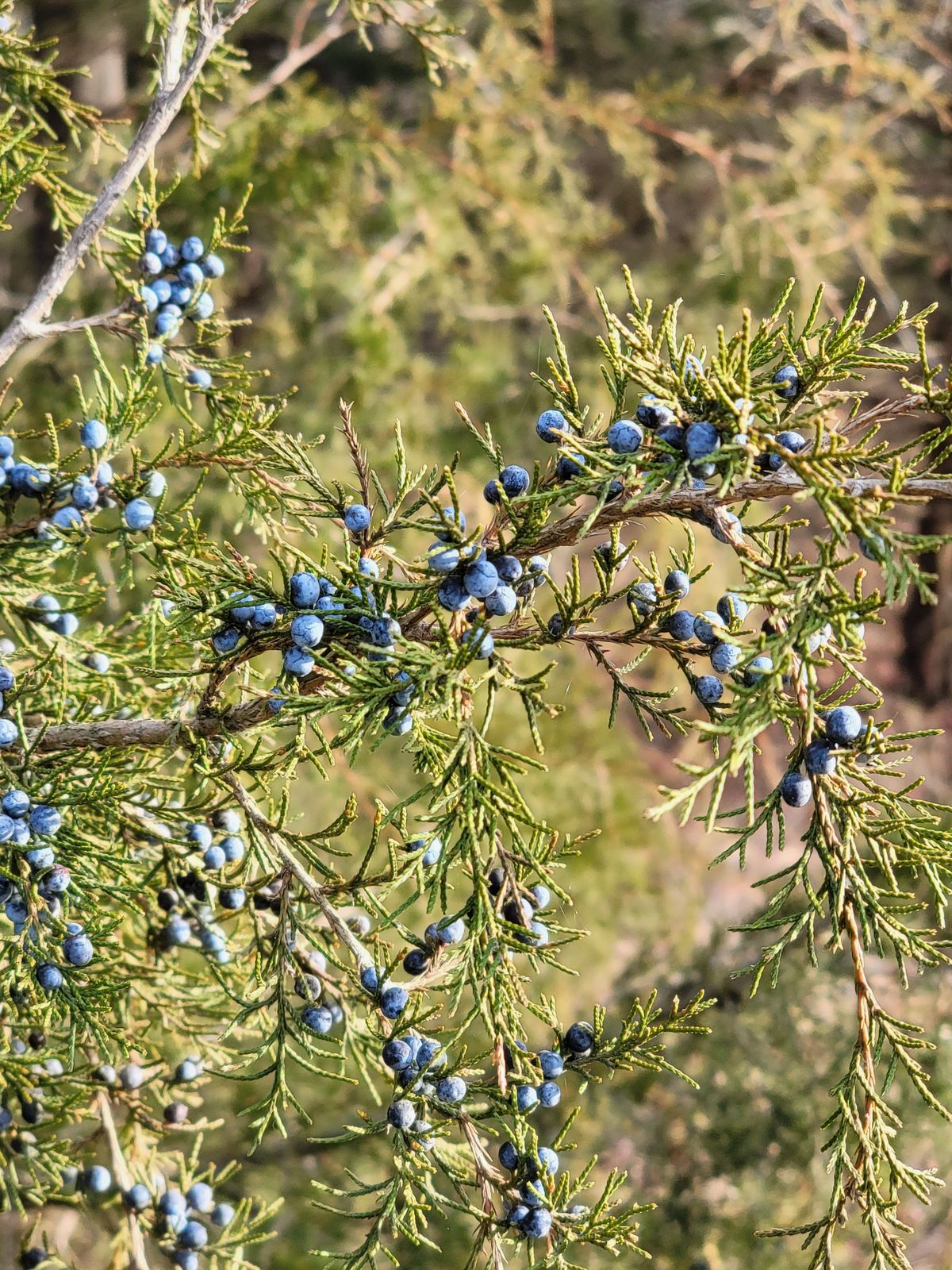
Botanically speaking, a clarification is needed: the "berries" are not berries at all. Juniper is a conifer, and what looks like a berry is actually a cone whose scales are fused together to form a fleshy mass – a berry cone. It takes two to three years to ripen, which is why a single bush always has both green and bluish-black cones hanging from it. Only the fully ripe, bluish-black cones are harvested, and because the branches are prickly, traditionally a cloth is placed underneath and the bush is shaken.
The most famous use is gin, and its history begins medicinally. In the 17th century, the Dutch physician Franciscus Sylvius distilled juniper berries in alcohol to create a diuretic – the result was called gin. Genever. English soldiers in the Netherlands brought the taste home, where it evolved into gin in the 18th century, along with the gin epidemic of London's slums, which Hogarth documented in his "Gin Lane." To this day, juniper is the legally required key flavor: without it, a spirit cannot be called gin.
To useDigestion and flushing - with a time limit
The European Medicines Agency lists juniper berries as traditional use With two areas of application: for the relief of mild dyspeptic symptoms such as bloating and flatulence, and for increasing urine output to flush out the urinary tract in cases of mild urinary tract discomfort. Commission E issued a positive monograph for its use in dyspeptic symptoms in 1984. Both applications are subject to strict time limits: a maximum of two weeks for digestive problems and a maximum of four weeks for flushing out the urinary tract.
The digestive effect is that of an aromatic bitter: the essential oil stimulates saliva and gastric juice production, and has a mild antispasmodic and carminative effect. This is plausible, well-established, and the reason why juniper is used with sauerkraut, cabbage, and fatty game—the same logic as with caraway. The diuretic effect is due to the terpinen-4-ol in the essential oil, which, in animal studies, increases renal blood flow and thus urine production.
Now, regarding the warning one encounters everywhere concerning juniper: that prolonged use can damage the kidneys. This claim stems from older animal studies conducted with oils containing turpentine-like impurities. More recent studies using pure juniper oil have not confirmed direct kidney damage. Nevertheless, caution remains warranted – hence the time limit specified in the monograph, and the continued warning against use in cases of pre-existing kidney disease. We believe it is appropriate to acknowledge this uncertainty rather than repeating an outdated warning or simply omitting it.
The same condition applies to flushing out the urinary tract as with goldenrod, lovage, and nettle: it only works with sufficient fluid intake, around two liters a day, and it is not recommended for kidney or heart failure with fluid retention. And as always, fever is the limiting factor: bladder problems accompanied by fever, chills, flank pain, or blood in the urine are not a situation for self-treatment.
IngredientsResinous, sweet, and with a dangerous relative
The essential oil of ripe berry cones contains predominantly monoterpenes: α-pinene provides the resinous, pine-like note, myrcene and sabinene the herbaceous depth, and limonene the freshness. Terpinen-4-ol is present in smaller quantities but is considered the component responsible for the diuretic effect—the same substance that also plays a key role in tea tree oil. In addition, it contains invert sugars (up to 30%), resins, tannins, and flavonoids.
The sugar content explains a peculiarity: Ripe juniper berries taste distinctly sweet when chewed, before the resinous bitterness sets in. This is a good indicator of ripeness – unripe green cones are hard, bitter, and lack sweetness, and belong neither in the kitchen nor in tea.
Now to the most important security point on this page. There is a close relative, the savin tree. Juniperus sabina, which is poisonous. Its essential oil contains sabinyl acetate and is a strong irritant to the kidneys and uterus; it was historically used as an abortifacient, often with fatal results. Fortunately, the difference is easy to recognize: Common juniper has sharp, prickly needles in whorls of three, each with a white longitudinal stripe at the top. Savin has scale-like, appressed leaves like a cypress and emits an unpleasantly pungent odor when crushed. Remember: prickly and needle-like is good, scaly and foul-smelling is dangerous.
The juniper grows wild in the Alps of Central Europe, but is also planted as an ornamental shrub – and this is precisely what makes it a risk. Low, creeping ornamental varieties of juniper are found in gardens and parks, and anyone collecting "juniper berries" without identification could end up with the wrong species. Therefore, for culinary use, the rule is: buy from a store or only collect from clearly identified shrubs with prickly needles.
Enhanced combinationsJuniper in the kitchen, glass and teapot
Juniper is a spice for fatty and heavy dishes – and for anything that simmers for a long time. This isn't a matter of taste, but rather follows the same digestive logic as with caraway.
The most classic of all combinations: five to six crushed berries in the cabbage pot. They make the cabbage more aromatic and more digestible at the same time.
In marinades and braising liquids. The resinous note complements the strong, inherent flavor of game better than any other spice.
Juniper has been firmly established in curing mixtures for ham and game for centuries.
The legally required main flavoring. For those making their own: steep berries in neutral alcohol, add coriander, citrus peel, and angelica root.
Juniper branches in the smoker give ham and fish a distinctive resinous flavor.
For medicinal use in cases of bloating: a mild mixture in which juniper provides the resinous element.
What contradicts itselfIt's best to avoid these combinations.
Juniperus sabina It is poisonous and grows as an ornamental shrub in gardens. Distinguishing features: scaly, appressed leaves instead of prickly needles, and an unpleasantly strong odor.
Juniper should not be used in cases of impaired kidney function. This applies regardless of how the old kidney damage warning is assessed today.
The monograph limits the duration: a maximum of two weeks for digestive problems, four weeks for flushing. This is not merely a formality.
Juniper is considered to have an effect on the uterus and is contraindicated in medicinal quantities during pregnancy. As a culinary spice, it is safe in small amounts.
As with all flushing drugs: Do not use in cases of edema due to heart or kidney failure.
Use only fully ripe, bluish-black berry cones. Unripe ones are hard, bitter, and irritate the stomach.
To which courtWhat happens to the blue-black cones?
- sauerkrautFive to six crushed berries per pot - the standard seasoning.
- Game marinadeWith red wine, bay leaf, thyme and onion; marinate the meat for two days.
- SauerbratenIn the pickling solution, alongside vinegar, bay leaf and clove.
- red cabbageTwo to three berries with apple and clove - adds depth without spiciness.
- curing mixtureWith coarse salt, pepper and bay leaf for ham and game.
- Incense branchesFresh juniper branches in the smoker for ham, trout and eel.
- Gin baseBerries with coriander, citrus peel and angelica root in neutral alcohol.
- Spiced butterFinely ground in butter and served with roasted game.
- Digestive teaTwo to three crushed berries per cup, cover and let steep.
- ChewChewing two to three ripe berries slowly is the simplest traditional way to use them after a meal.
As a home remedyJuniper tea - with clear boundaries
Juniper berry infusion
- Check beforehand: no known kidney disease, no pregnancy, no fluid retention due to heart or kidney failure, no fever, and no flank pain. If any of these apply, this tea is not the right choice.
- Press two to three ripe, bluish-black berry cones in a mortar - do not grind them, just break them open.
- Pour a cup of boiling water over the herbs and let them steep, covered, for ten minutes. Covering the herbs helps retain the essential oil in the infusion.
- Strain and drink slowly, after meals or when your stomach feels bloated. Two cups a day are sufficient.
- When using the flushing method, an additional two liters of total fluid per day is required - without this amount, no flushing will take place.
- Stop after a maximum of two weeks (digestion) or four weeks (flushing). This is the limit specified in the monograph and not a guideline for negotiation.
For mild digestive problems – bloating, flatulence – and for flushing out minor urinary tract issues. Not for use in cases of kidney disease, during pregnancy, or with a feverish urinary tract infection.
According to Commission E, 2 to 10 g of berries daily, which in practice means about four to six crushed berries per day. Strictly limit the duration of consumption. Medicinal use is not recommended for children under twelve years of age.
Ayurveda & TCMWhat the old systems say
Ayurveda
Common juniper is not a central component of classical Ayurveda; related species Juniperus-Species from the Himalayas, however, are: Hapusha It refers to juniper berries and describes them as sharp, bitter, and warming., Kapha- and vata-lowering, relating to urinary excretion and digestion. The classification corresponds remarkably closely to the European monograph - two independent traditions, the same two areas of application.
Traditional Chinese Medicine
In Chinese materia medica, it plays a role Juniperus communis hardly plays a role; related species are considered Gui Bai and used in regional traditions. Juniper is more significant in Tibetan medicine and in the ritual traditions of the Himalayas, where juniper branches are burned as incense. Sang —and this incense has both religious and purifying significance. The combination of juniper and smoke is thus the same across continents as with European smoked ham, only with a different purpose.
Warning noticesWhen you should be careful
Please note
- Confusion with the savin tree: Juniperus sabina It is poisonous and is grown as an ornamental shrub in many gardens. Distinguishing features: scaly, appressed leaves instead of prickly needles and a strong, unpleasant odor. If in doubt, do not collect it.
- Not suitable for kidney disease: Juniper should not be used in cases of impaired kidney function – neither as a tea nor as a preparation.
- Limit the duration of use: Maximum two weeks for digestive problems, four weeks for flushing. Then take a break.
- Not during pregnancy: Juniper is considered to have an effect on the uterus; medicinal amounts are contraindicated during pregnancy.
- Only ripe berries: Unripe green cones are hard, bitter, and irritate the stomach. Only the fully ripe, bluish-black cones are used.
- Fever is the limit: Urinary tract problems accompanied by fever, chills, flank pain or blood in the urine should be investigated by a doctor on the same day.
This page provides information and does not replace medical advice. If symptoms persist, please consult a doctor.
Related to the topicRead on and cook along!
Shop links lead to our product pages; it is indicated there if a partner is involved.
SourcesWhat is this based on?
- European Medicines Agency, HMPC: European Union herbal monograph on Juniperus communis L., pseudo-fructus - traditional use.
- Commission E, Monograph „Juniperi fructus“, Federal Gazette No. 228 of 05.12.1984.
- Schilcher H., Leuschner F.: On the question of the nephrotoxicity of juniper berry oil - investigations for reassessment. Arzneimittelforschung 1997.
- Federal Institute for Risk Assessment: Information on Juniperus sabina (Vine tree) as a poisonous plant.
- Blaschek W. (ed.): Wichtl - Herbal Drugs and Phytopharmaceuticals, Chapter Juniperi pseudo-fructus.