OriginThe shrub of the maquis
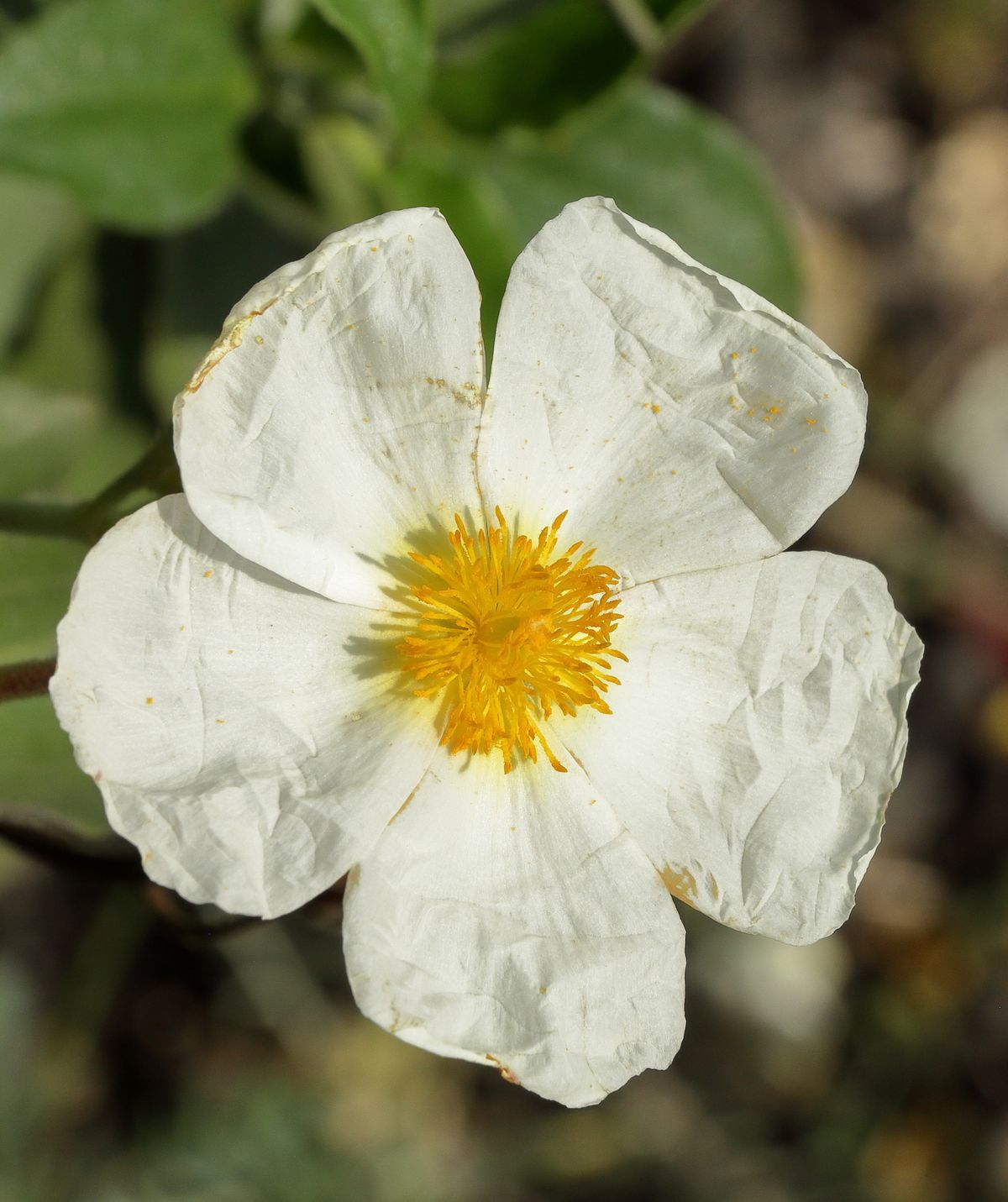
The rockrose survives fire, drought and barren soils - and its sticky resin has been used since antiquity to produce the fragrance labdanum, one of the oldest incense materials of all.
Rockroses are low, evergreen shrubs of the Mediterranean maquis. They grow on karst and limestone soils, in garrigue and maquis, where hardly anything else grows, and they are adapted to fire: their seeds germinate particularly well after fires, and the populations are thus regularly renewed. Their crumpled, wrinkled-looking flowers last only a single day – they open in the morning, and by afternoon the petals are lying on the ground.
The most culturally important type is the Lacquer rockrose (Cistus ladanifer), from whose sticky resin since antiquity Labdanum The resin extracted is a heavy, amber-like fragrance that remains indispensable in perfumery to this day. Traditionally, the resin was harvested by driving goats through the groves and then combing it from their fur; today, this is done with cloths and straps. Labdanum is considered one of the oldest incense materials of the Mediterranean region.
The type of tea in question is usually the Grey-haired rockrose (Cistus incanus, also known as Cistus creticus geführt). Sie wächst auf Kreta, in Griechenland, der Türkei und auf Zypern. In der dortigen Volksmedizin wurde ein Aufguss aus dem Kraut bei Verkühlungen, Hautproblemen und Magenbeschwerden getrunken. In Deutschland ist sie seit etwa zwanzig Jahren populär geworden - getragen von einer Vermarktung, die der Datenlage weit vorausgeeilt ist.
To useWhat the rockrose can do - a sober assessment
Let's start with what is actually certain: The rockrose belongs to the most polyphenol-rich plants in the world. Its tannin and flavonoid content significantly exceeds that of green tea, red wine, and most berries. Laboratory tests show correspondingly high antioxidant levels, and cell culture studies have demonstrated antiviral and antibacterial effects. This is a fact, and it's the reason why research is even focusing on it.
What it not gibt: eine anerkannte arzneiliche Anwendung. Weder die europäische Arzneimittelagentur noch die Kommission E führen eine Monographie für Zistrosenkraut. Es wird als Lebensmittel und als Nahrungsergänzung vermarktet, nicht als Arzneimittel. An klinischen Studien am Menschen gibt es sehr wenig - im Wesentlichen zwei kleinere kontrollierte Untersuchungen zu Verkühlungssymptomen, die eine schnellere Abnahme der Beschwerden zeigten, sowie einige Arbeiten zu Hautanwendungen. Das ist ein Anfang, aber weit entfernt von dem, was in der Werbung behauptet wird.
Two promises need to be made particularly clear. First, the „Heavy metal detoxification“The idea is that tannins in the intestines bind metals. They do this in a test tube – tannins bind metal ions; this is basic chemistry. However, there is no evidence that this results in a meaningful "detoxification" of the body, and the notion of a general heavy metal burden that needs to be eliminated does not correspond to current medical knowledge. Secondly, the Tick protectionThere is no reliable data to support this, and relying on a remedy that doesn't work is not a harmless decision when it comes to ticks.
So what is it good for? As aromatic herbal tea, very high in tannins Pleasantly tart, caffeine-free, and well-tolerated in normal amounts. For gargling to soothe a scratchy throat, the tannin principle works just like sage and tormentil: the mucous membrane is astringent and forms a protective film. This is a straightforward, simple application. Anything beyond that would be a promise we cannot keep.
IngredientsThat's what's in the weed
The dominant group are the Polyphenols, which, depending on their origin and harvest time, can make up to twenty percent of the dry matter. These include Ellagitannine (Punicalagin, punicalin - the same substances as in pomegranate), Proanthocyanidins and a large number of flavonoids, especially myricetin and quercetin derivatives. This combination explains the exceptionally high antioxidant laboratory values.
In addition, there is a essential oil with resinous, amber-like notes and the Labdanum resin, This substance is produced in large quantities by the Rockrose (Cistus lucidum) and in smaller quantities by the Rockrose (Cistus vulgaris). It is the reason for the characteristic, slightly balsamic scent of the dried product.
The high tannin content has two implications for its application, and both are practically important. First: Tannins bind iron Iron from plant-based foods is very effective – those with low iron levels should drink rockrose tea between meals. Secondly: You can... Delaying the absorption of medication; A one- to two-hour interval will resolve this. And anyone who drinks very strong rockrose tea on an empty stomach should expect nausea – this applies to all infusions with a high tannin content.
Enhanced combinationsWhat makes the rockrose stronger
It works well as a tea and for gargling - if you follow the rules regarding tannins.
For a scratchy throat, the tannin principle works the same way as with sage and tormentil.
This makes the harshness much more approachable.
Two plants with recognized uses complement the rockrose tea in a meaningful way.
The tannins need time and heat to fully convert.
Thus, the tannin does not interfere with iron absorption.
For slightly irritated skin - small tests are available.
What contradicts itselfIt's best to avoid these combinations.
There is no recognized use and very little clinical data.
In a test tube, tannins bind metals - but this has not been proven to have any effect on the body.
There is no reliable data to support this – and with ticks, this is not a harmless misconception.
Tannins bind plant iron very effectively.
Keep a distance of one to two hours.
Concentrated tannin solutions can cause nausea.
ApplicationHow it is used
- Rockrose teaOne to two teaspoons per 250 ml, let it steep for ten minutes.
- gargle solutionApply a stronger, cooled compress – for a scratchy throat.
- Cold remedy mixtureWith sage and thyme, which have a recognized use.
- With lemon and honeyIt makes the pronounced harshness more approachable.
- Skin washingCooled infusion for slightly irritated skin.
- MouthwashThe same tannin principle applies to sore gums.
- cold extractPrepared overnight - milder in taste.
- Labdanum in perfumeryThe resin of the rockrose, one of the oldest fragrances.
- IncenseDried herbs and resin - a very old Mediterranean tradition.
- garden plantHardy in mild locations and on well-drained soil.
As a home remedyThe gargle solution
Rock rose tea for a scratchy throat
- Put two heaped teaspoons of dried rockrose herb into a cup - deliberately stronger for the gargling solution than for the drinking tea.
- Pour 250 ml of boiling water over it and let it steep, covered, for ten minutes; the tannins need time and heat.
- Strain and allow to cool to lukewarm - too hot will further irritate the already irritated mucous membrane.
- Gargle with half a cup three to four times a day, for about one minute each time; do not eat or drink immediately afterwards.
For a scratchy throat, the beginning of a sore throat, and sore gums. This is the application where the chemistry of rockrose can be based on something comprehensible: tannins bind to the proteins of the outermost mucous membrane layer and form a thin protective film – just like with sage, tormentil, and black tea. There are no specific studies for rockrose itself, but there are for the principle.
Three to four times a day for a few days. Gargle with the solution and spit it out. If you also drink rockrose tea: take it between meals and one to two hours apart from medications, because the tannins bind iron and active ingredients. Severe, one-sided sore throat pain, fever, difficulty swallowing, or white coating on the tonsils should be checked by a doctor – this could be a sign of bacterial tonsillitis, in which case tea will not help.
Ayurveda & TCMWhat the old systems say
Ayurveda
The rockrose is a Mediterranean plant and not used in Ayurveda. Based on its properties, it would be classified as bitter (Kashaya), cool and drying strongly - Pitta and Kapha lowering, Vata Significantly increasing, because bitters dry out. A transfer based on principle, not a tradition.
Traditional Chinese Medicine
It is also absent from the Chinese Materia Medica. Based on its characteristics, it would be a bitter, cooling remedy that astringes and clears damp-heat – similar to the tannin-rich drugs used there for diarrhea and weeping skin problems. The true tradition of this plant lies in the eastern Mediterranean, where it has been used as a tea and incense since antiquity.
Warning noticesWhen you should be careful
Please note
- No recognized application: There is no medicinal monograph - rockrose is marketed as a foodstuff.
- No heavy metal detoxification: The binding of tannins in a test tube cannot be transferred to a "detoxification" of the body.
- No tick protection: There is no reliable data on this – relying on an ineffective method is risky.
- Iron: The tannins bind plant-based iron very effectively - drink between meals if you have an iron deficiency.
- Medications: Leave a one to two hour gap, because the recording may be delayed.
- Stomach: Very strong infusions can cause nausea on an empty stomach.
This page provides information and does not replace medical advice. If symptoms persist, please consult a doctor.
Related to the topicRead on and cook along!
Shop links lead to our product pages; it is indicated there if a partner is involved.
SourcesWhat is this based on?
- Klaus U et al. Cistus incanus (CYSTUS052) for treating patients with infection of the upper respiratory tract. Antiviral Research 2009; 84(3): 267–271.
- Riehle P et al. Phenolic compounds in Cistus incanus herbal infusions - antioxidant capacity and thermal stability. Journal of Functional Foods 2014.
- Federal Institute for Risk Assessment: General information on herbal teas rich in tannins and their influence on iron absorption.
- Blaschek W (ed.): Wichtl - Herbal drugs and phytopharmaceuticals. 6th edition 2016 - for the classification of drugs not covered in monographs.
- Papaefthimiou D et al. Genus Cistus: a model for exploring labdane-type diterpenes' biosynthesis. Frontiers in Chemistry 2014.