
OriginOne tree, one stretch of land, many women's hands
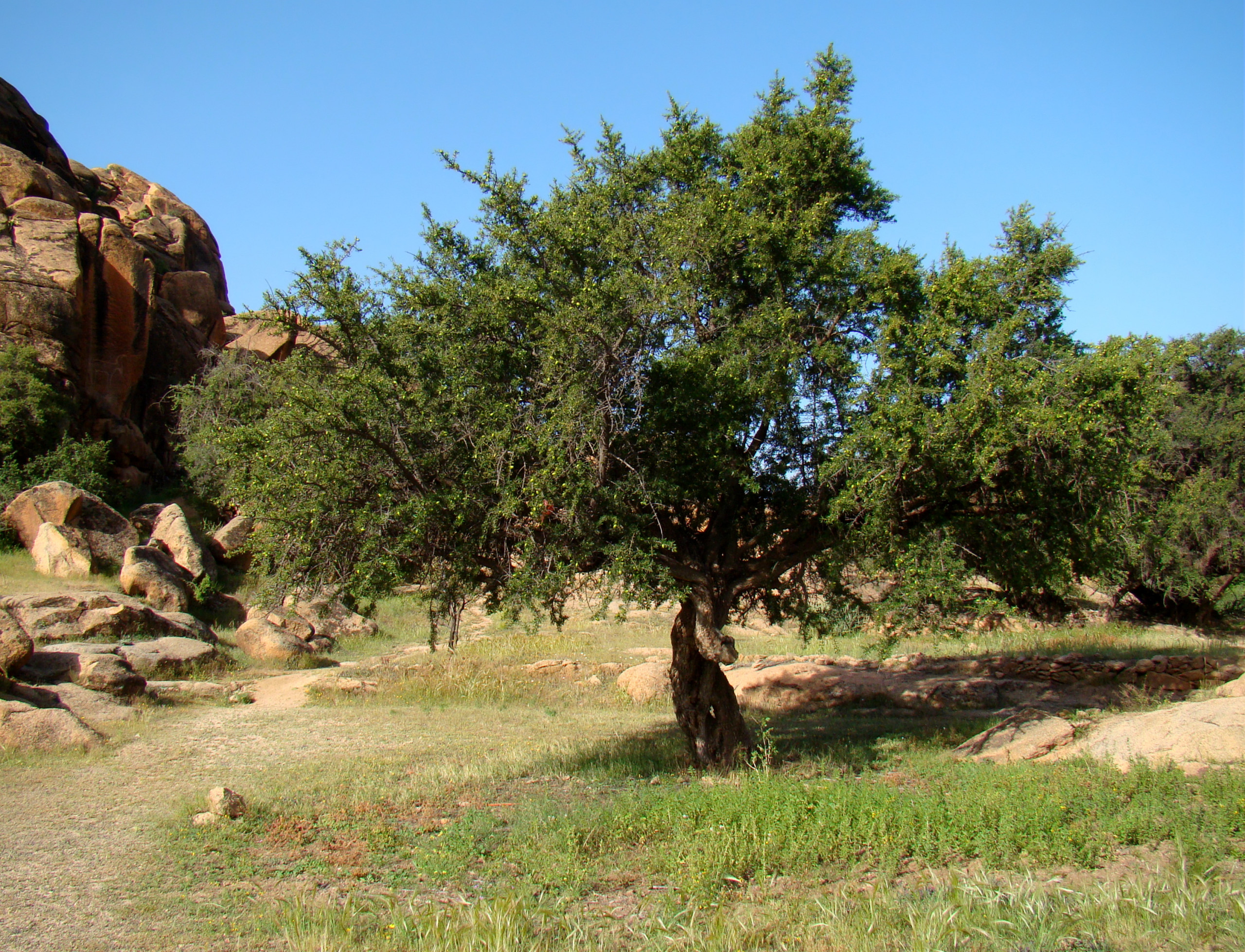
The Arganeraie is a UNESCO Biosphere Reserve - the tree stops the desert and feeds entire regions.
Argania spinosa The argan tree is a thorny, gnarled tree that grows to a height of eight to ten meters and can live up to two hundred years. Its distribution area is remarkably narrow: the Arganeraie in southwestern Morocco between Essaouira and Agadir, an area of approximately eight hundred thousand hectares. There, it grows on barren soils with one hundred to two hundred millimeters of annual rainfall, and its deep roots hold the soil firmly in place. UNESCO declared the Arganeraie a Biosphere Reserve in 1998 because it acts as a natural barrier against the expansion of the Sahara.
Oil extraction is extremely labor-intensive. The fruits are harvested, the pulp removed, the rock-hard nuts cracked open individually between two stones – a task for which no functioning machine yet exists – and the kernels are then ground and pressed. Approximately thirty kilograms of fruit and many hours of manual labor are needed for one liter of oil. Traditionally, this is women's work, and the women's cooperatives that have emerged since the 1990s have become an important economic factor and a highly regarded example of development cooperation.
And then there are the goats. Goats climb argan trees and eat the fruit – images of this have circulated around the world for years. The story goes that the undigested kernels are collected from the dung and processed. Historically, this was indeed a method, but it plays virtually no role today; modern production uses harvested fruit. And the famous photos are often staged: goats are placed in the trees for tourists. Furthermore, goat browsing is a serious problem for the regeneration of the trees – too many goats prevent young trees from growing back.
To useA good oil with limited but existing data.
Argan oil has no drug monograph; it is a food and a cosmetic raw material. Its distinguishing features are a favorable fatty acid profile and a high content of tocopherols – vitamin E compounds that act as antioxidants and simultaneously protect the oil from rancidity.
For cosmetic applications, there is a limited but existing body of data. A Moroccan randomized study with sixty postmenopausal women investigated the daily use of argan oil—partly as food, partly topically—over sixty days and found an improvement in skin elasticity. Other small studies describe an improvement in the skin barrier and hydration. These are small studies, but they exist, and they are consistent with what one would expect from an oil rich in tocopherols and oleic acid.
For internal use, there are some Moroccan studies on blood lipids in which regular consumption of roasted argan oil lowered LDL cholesterol and raised HDL. Again, these studies are small, regional, and methodologically limited. One can conclude from this that argan oil is a good cooking oil—just as olive oil is a good cooking oil. No special medicinal properties can be inferred from this.
Argan oil has similar properties to other oils: it smooths the hair cuticle, reduces friction, and makes hair softer and shinier. Specific studies on argan oil in hair care are rare; the effect is primarily physical. Our assessment: an excellent, lightweight conditioning oil and a very good cooking oil with a distinctive flavor – not a miracle cure, but worth every penny if you know what you're paying for.
IngredientsTwo oils from the same kernel
The fatty acid profile is similar to that of olive oil: approximately 45 to 50 percent monounsaturated oleic acid and 30 to 35 percent polyunsaturated linoleic acid, along with saturated palmitic and stearic acids. The tocopherol content is noteworthy, at 600 to 900 milligrams per kilogram, significantly higher than that of olive oil – one reason for its relatively good shelf life despite the high proportion of polyunsaturated fatty acids.
Also characteristic are the sterols: Argan oil contains schottenol and spinasterol, two plant sterols that occur in this combination practically only here. They therefore serve as markers of authenticity in analysis – argan oil that has been diluted with cheaper oils can be detected this way. This is only indirectly relevant for the consumer, but it explains why reputable suppliers can provide certificates of analysis.
The crucial difference on the shelf is the roasting process. For cosmetic oil, the kernels are pressed unroasted; it is pale yellow and practically odorless. For culinary oil, they are roasted before pressing, which produces an intense, nutty-hazelnut flavor and a darker color. The two are not interchangeable: the cosmetic oil tastes bland, and the culinary oil has a distinct nutty scent on the skin.
Regarding shelf life: Thanks to its tocopherols, argan oil keeps better than most oils with a comparable fatty acid profile, but it is not stable indefinitely. Stored in a cool, dark place and sealed, an opened bottle will keep for about six months. Rancid argan oil smells harsh and stale – then it should be discarded, whether used on skin or in salads. And the oil is only suitable for limited use in cooking: Traditionally, it is used cold, drizzled over finished dishes.
Enhanced combinationsArgan oil in the bathroom and kitchen
Two products, two areas of application - and a number of questions about the origin that are particularly worthwhile in the case of this oil.
It absorbs quickly, leaves little greasy residue and is well tolerated by most skin types - one of the best options for face and décolleté.
One or two drops applied to dry ends smooth the cuticle and reduce frizz. (More weight is added.).
Massaged into the nail fold - classic application and very effective against cracked cuticles.
Moroccan paste made from argan oil, almonds, and honey – spread on bread for breakfast. The best way to get to know this cooking oil.
Drizzle cold over finished dishes. Not for frying – the flavor cannot withstand high heat.
Women's cooperatives with fair trade or organic certification are the more sensible choice in terms of social quality.
What contradicts itselfIt's best to avoid these combinations.
Unroasted argan oil tastes bland; roasted argan oil smells nutty on the skin. The two are not interchangeable.
It is traditionally used cold. High heat destroys aroma and tocopherols.
Despite its good tocopherol content, it will become rancid. Store in a dark, cool, sealed container and consume within six months.
The effort involved is real. Very cheap products are often adulterated – Schottenol and Spinasterol are the markers of authenticity.
Argan oil is not botanically a nut, but allergic reactions have been reported. If you have a known nut allergy, test carefully.
The goats in the trees are usually staged, and the goat browsing harms the regeneration of the trees. The image has nothing to do with product quality.
To which courtKitchen and care
- AmlouRoasted argan oil, ground almonds and honey - the Moroccan breakfast paste.
- CouscousDrizzled cold over the finished dish.
- salad dressingWith lemon and honey - the nutty note works well.
- VegetablesOver roasted root vegetables after baking.
- FishA few drops on fried fish, just before serving.
- facial oilApply two to three drops to damp skin after washing.
- hair endsOne or two drops into the dry ends.
- cuticleMassaged into the nail fold in the evening.
- Body oilAfter showering - absorbs easily and quickly.
- Do not fryThe cooking oil is used cold.
As a home remedyAmlou - the best argument for cooking oil
Moroccan almond and argan oil paste
- Roast 200g of blanched almonds on a baking sheet in the oven at 160 degrees for about ten minutes, until fragrant and lightly golden. Let cool.
- Grind the almonds in a blender or a powerful food processor until they form a paste - this takes a few minutes, and you have to scrape off the edges every now and then.
- Slowly pour in about 100 ml of roasted argan oil while the machine is running, until a smooth, spreadable paste is formed.
- Stir in two to three tablespoons of honey and season with a pinch of salt. Sweetness is a matter of taste – traditionally, Amlou is quite sweet.
- Pour into a clean glass jar. At room temperature, the oil will separate and rise to the top; simply stir. The paste will keep for several weeks in the refrigerator.
- Spread it on bread, flatbread, or use it for dipping. For cosmetic use, use unroasted argan oil – roasted oil smells nutty on the skin.
As a spread for bread, it's the best way to get to know roasted cooking oil. The unroasted cosmetic oil is a light, fast-absorbing treatment for face, hair, and cuticles.
Use as desired in food. Cosmetically as needed – a few drops are sufficient. Test carefully if you have a known nut allergy; allergic reactions have been reported.
Ayurveda & TCMWhat the old systems say
Ayurveda
The argan tree is native to southwestern Morocco and is not used in Ayurveda. The role that argan oil plays in Moroccan tradition—as both a cooking oil and skincare product—is similar to that of sesame oil in India. Both oils have shaped an entire region for centuries and are indispensable in both cooking and personal care.
Traditional Chinese Medicine
The Chinese materia medica also lacks this. Argania spinosa. The traditional use of argan oil is part of the Amazigh culture of Morocco, where it has served for centuries as a food, medicine, and beauty product – for skin problems, hair loss, and as a fortifying food. This tradition is well-documented and arose independently of the major Asian systems; it is one of the reasons why the Arganeraie is now protected as a cultural landscape.
Warning noticesWhen you should be careful
Please note
- Distinguish between roasted and unroasted: Unroasted oil is used for cosmetics, roasted oil is used for cooking. They are not interchangeable.
- Not for frying: The cooking oil is traditionally used cold; heat destroys aroma and tocopherols.
- It turns rancid: Store in a dark, cool, and sealed container. Once opened, consume within approximately six months. A scratchy, stale smell means discard.
- Authenticity: The effort involved is significant, and the price reflects that. Very cheap products are often diluted; Schottenol and Spinasterol are the telltale signs.
- Nut allergy: Argan oil is not botanically a nut, but allergic reactions have been reported. If you have a known nut allergy, test carefully.
- Check origin: Certified women's cooperatives are the more sensible choice, both socially and in terms of quality. The pictures of goats are for tourism purposes, not an indicator of quality.
This page provides information and does not replace medical advice. If symptoms persist, please consult a doctor.
Related to the topicRead on and cook along!
Shop links lead to our product pages; it is indicated there if a partner is involved.
SourcesWhat is this based on?
- Boucetta KQ et al.: The effect of dietary and/or cosmetic argan oil on postmenopausal skin elasticity. Clinical Interventions in Aging 2015.
- Charrouf Z., Guillaume D.: Argan oil - occurrence, composition and impact on human health. European Journal of Lipid Science and Technology 2008.
- UNESCO: Arganeraie Biosphere Reserve, Morocco - Documentation of the biosphere reserve.
- Hilali M. et al.: Detection of argan oil adulteration using quantitative campesterol GC analysis. Journal of the American Oil Chemists' Society 2007.
- Lybbert TJ et al.: Booming markets for Moroccan argan oil appear to benefit some rural households while threatening the endemic argan forest. PNAS 2011.


