
OriginThe bush that saved the sperm whale
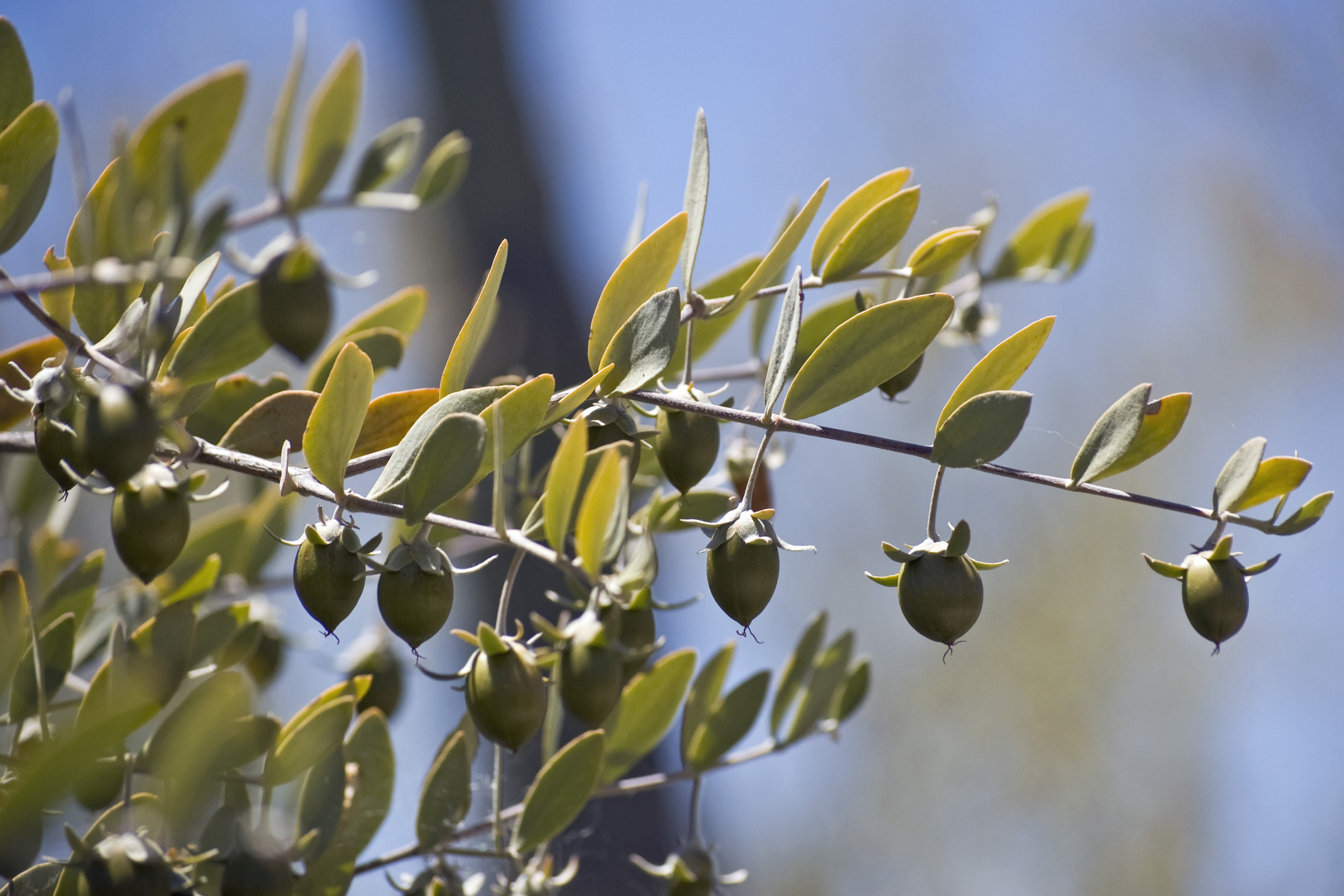
When the import of whale products into the USA was banned in 1971, the industry sought a substitute - and found it in a desert shrub.
Simmondsia chinensis is an evergreen shrub, growing up to three meters tall, native to the Sonoran Desert in the border region of Arizona, California, and the Mexican state of Sonora. It is the only species in its family—a botanical loner with no close relatives. The species name chinensis This is a mistake: A 19th-century botanist misclassified the herbarium specimens, and the name remained according to the rules of nomenclature. The plant has no connection to China.
The shrub is dioecious and extremely drought-tolerant: its taproot reaches several meters deep, and it can survive years with hardly any rainfall. The Tohono O'odham and other indigenous peoples of the region have long used the seeds – as food in times of scarcity, for hair and skin care, and for wounds.
Its industrial career began for an unusual reason. Until the 1970s, spermaceti—a wax from the head of the sperm whale—was an important raw material for cosmetics, lubricants, and transformer oils. In 1971, the Marine Mammal Protection Act in the US banned the import of whale products, and industry sought a substitute. Jojoba wax proved to be chemically almost equivalent, and its commercial cultivation was heavily promoted. That a desert shrub helped reduce hunting pressure on sperm whales is one of the more pleasant stories in this archive.
To useChemistry explains why it feels so good.
Jojoba oil has no pharmaceutical monograph – it is a cosmetic raw material. What distinguishes it is a chemical peculiarity that translates directly into practical application: unlike all other plant oils, it does not consist of triglycerides, but of wax esters – long-chain fatty acids esterified with long-chain fatty alcohols. This is almost unique in the plant world.
Firstly, this results in exceptional oxidative stability. The double bonds are located in positions that are difficult to attack, and jojoba oil contains virtually no polyunsaturated fatty acids. Therefore, it hardly ever becomes rancid and keeps for years without special storage conditions. For this reason, it is popular in cosmetic formulations, and it even stabilizes more delicate oils with which it is blended.
Secondly, there's its affinity for the skin. Human sebum also consists largely of wax esters. Jojoba oil is therefore chemically closer to it than any other plant oil, meaning it spreads evenly and doesn't leave a heavy film. Compared to many other oils, it's considered low-comedogenic – an important difference from coconut oil, for example, which can be problematic for blemish-prone skin.
Clinical studies on jojoba oil are few and mostly small. There are studies on jojoba-containing face masks for acne and wound healing, with positive but inconclusive results. Our assessment: Jojoba oil is not an active ingredient, but an excellent carrier oil and a very well-tolerated basic skincare product. That's perfectly sufficient – you don't need to attribute healing properties to appreciate it.
IngredientsWax esters, tocopherols, and a substance that doesn't belong on the skin
Approximately ninety-seven percent of jojoba oil consists of wax esters, predominantly of the monounsaturated fatty acids gadoleic acid and erucic acid, esterified with corresponding fatty alcohols. It also contains tocopherols – vitamin E compounds that act as antioxidants – as well as phytosterols and small amounts of free fatty acids.
The consistency depends on the temperature: at room temperature, jojoba oil is liquid; below about ten degrees Celsius, it solidifies into a soft mass. This is normal and not a quality defect – it will become liquid again at room temperature. Natural, cold-pressed jojoba oil is golden yellow; refined jojoba oil is colorless and odorless, but lower in tocopherols.
One important point to consider: Jojoba seeds contain simmondsin, a glycoside that suppresses appetite and has been shown in animal studies to cause weight loss—but also toxicity. Therefore, jojoba oil is not a cooking oil, and jojoba seeds are not a foodstuff. The oil is used exclusively externally. The press cake, after the simmondsin has been removed, is used as animal feed.
When buying jojoba oil, cold-pressed, unrefined jojoba oil is the more wholesome option. It should be a clear golden yellow and practically odorless to slightly nutty in scent. Because it hardly oxidizes, unlike linseed oil or tea tree oil, no special storage precautions are necessary; a sealed bottle will easily keep for two years or more.
Enhanced combinationsThe universal carrier oil
Jojoba oil is the oil that can be mixed with almost anything - and that's exactly why it appears in almost every recipe on this website.
The standard carrier oil for all dilutions of essential oils. It is stable, odorless, and skin-friendly – and it prevents the essential oil from becoming rancid.
Less comedogenic than most plant oils and chemically similar to sebum. Often the best choice for facial care of combination skin.
Based on the principle of "like dissolves like," it removes sebum and makeup without drying out the skin. Apply, massage in, and remove with a warm cloth.
As a light scalp treatment - it is less greasy than coconut or olive oil and is easier to wash out.
When mixed with rosehip seed, evening primrose or other delicate oils, it extends their shelf life.
As shaving oil and as aftershave care - it doesn't sting and absorbs quickly.
What contradicts itselfIt's best to avoid these combinations.
Not for cooking. The seeds contain simmondsin, which has been shown to be toxic in animal studies. Jojoba oil is for external use only.
It is an excellent conditioning and carrier oil, not an active ingredient. Clinical studies on its therapeutic effects are small and not reliable.
It solidifies below ten degrees Celsius. This is not a defect – it becomes liquid again at room temperature.
Rare, but documented. Test a small area before the first large-scale application.
Refined oil is lower in tocopherols. For skincare purposes, cold-pressed, golden-yellow oil is the better choice.
Cultivation is labor-intensive and limited to a few regions. Conspicuously cheap products are often adulterated.
ApplicationWhat it is used for
- carrier oilFor each dilution of essential oils - one to five percent essential oil on jojoba oil.
- Facial careApply a few drops to damp skin after washing.
- Oil cleaningApply, massage in, remove with a warm cloth - dissolves makeup and sebum.
- Body oilAfter showering; it absorbs quickly and is non-greasy.
- scalpAs a light treatment for dry scalp, easier to wash out than coconut oil.
- Beard oilThe classic base for beard oils - absorbs without leaving a shine.
- Shaving oilApply a thin layer before wet shaving.
- massage oilAs a base, alone or mixed with almond oil.
- stabilizerMix it with delicate oils to make them last longer.
- lip balmMade with beeswax to create a simple balm.
As a home remedyOil cleansing for the face
Facial cleansing with jojoba oil
- Place about half a teaspoon of cold-pressed jojoba oil into your dry palms and warm it up.
- Apply to a dry, unwashed face and gently massage in for one to two minutes – even over makeup and sunscreen. The principle: The oil dissolves sebum and oil-soluble residues.
- Soak a washcloth or cotton cloth in warm - not hot - water and squeeze out the excess.
- Place the warm cloth on your face for about twenty seconds, then gently remove the oil with it. Do not rub, but wipe.
- If needed, cleanse again with a mild facial wash. For dry skin, the oil alone is sufficient.
- Then apply two to three drops of jojoba oil to damp skin as a moisturizer. If you have skin prone to blemishes, test it on a small area first for a week.
As a gentle facial cleanser that removes makeup and sebum without damaging the skin barrier – and as daily care for face, body and hair. For external use only.
As needed. Jojoba oil is very well tolerated; contact allergies are rare, but have been reported - test a small area before the first large-scale application.
Ayurveda & TCMWhat the old systems say
Ayurveda
Jojoba is a North American desert plant and is not used in Ayurveda. Sesame oil plays the role it does today as a universal carrier oil. Tila Taila —which is considered the quintessential oil and forms the basis for countless medicinal oil preparations. The comparison is interesting: Both are relatively stable, well-tolerated oils, and both are primarily valued as carriers for other active ingredients.
Traditional Chinese Medicine
Jojoba is also absent from the Chinese materia medica. Traditionally, sesame- and pork fat-based preparations are used for external applications there. Jojoba oil is now a common cosmetic ingredient in China, but without a traditional classification – one of the few products in this archive that simply has no East Asian history.
Warning noticesWhen you should be careful
Please note
- Only externally: Jojoba oil is not a cooking oil. The seeds contain simmondsin, which has been shown to be toxic in animal studies.
- No active ingredient: It is an excellent conditioning and carrier oil. Clinical studies on its therapeutic effects are small and not conclusive.
- Contact allergy: Rare, but documented. Test a small area before the first large-scale application.
- Frozen in the cold: Below about ten degrees Celsius it becomes solid - this is normal and not a quality defect.
- Prefer cold-pressed: Refined oil is colorless, odorless, and lower in tocopherols.
- Check very cheap goods: Cultivation is complex; conspicuously cheap offers are often diluted.
This page provides information and does not replace medical advice. If symptoms persist, please consult a doctor.
Related to the topicRead on and cook along!
Shop links lead to our product pages; it is indicated there if a partner is involved.
SourcesWhat is this based on?
- Wisniak J.: Jojoba oil and derivatives. Progress in the Chemistry of Fats and other Lipids, Overview of the Chemistry of Wax Esters.
- Pazyar N. et al.: Jojoba in dermatology - a succinct review. Giornale Italiano di Dermatologia e Venereologia 2013.
- Marine Mammal Protection Act 1972 (USA) - historical background on spermaceti substitutes.
- Meyer SE / USDA Forest Service: Simmondsia chinensis - Woody Plant Seed Manual.
- Cappillino P. et al.: Composition of Chihuahuan Desert jojoba seed - on simmondsin content. Industrial Crops and Products 2003.