
Iceberg lettuce (Lactuca sativa var. capitata)
OriginA salad for long journeys
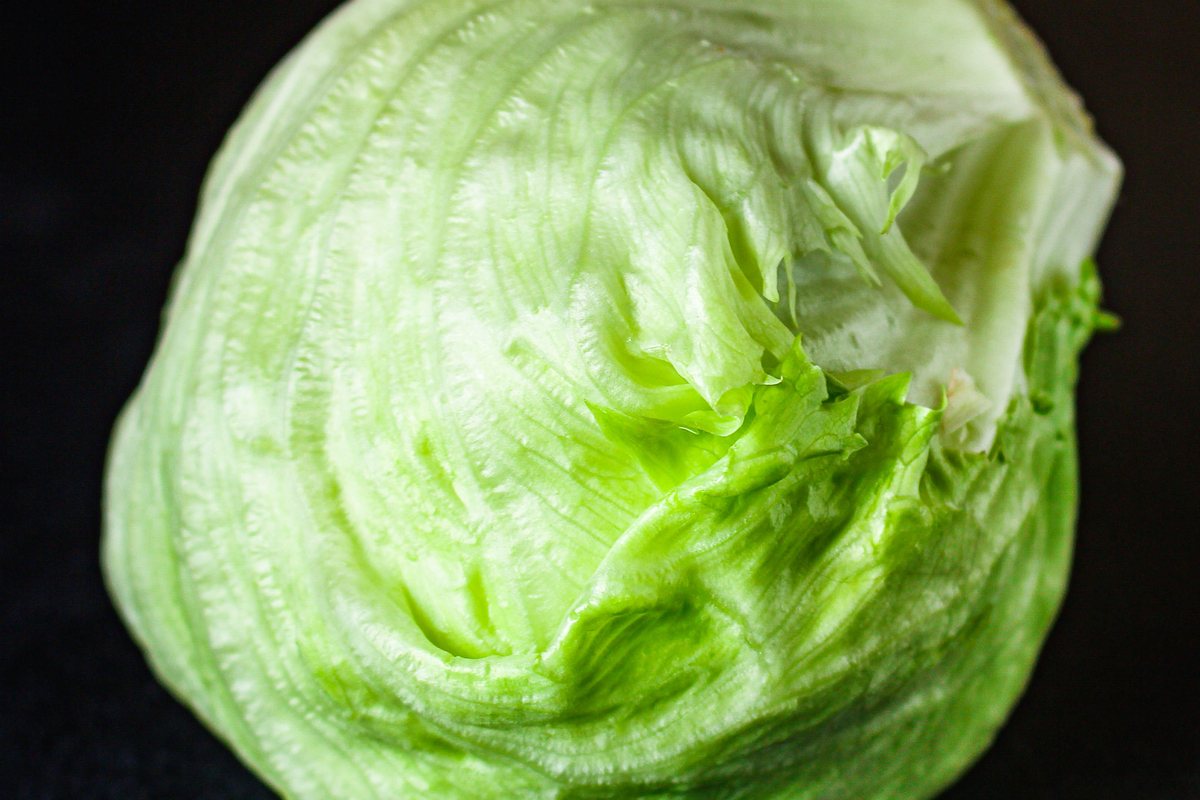
According to one common explanation, it owes its name to the ice loads under which the heads from California traveled by rail across the USA.
Iceberg lettuce is an American variety. At the end of the 19th century, a US seed company introduced a variety called "Iceberg," and in the following decades, its firm heads became the standard lettuce of North America. They survived transport over thousands of kilometers without wilting—a major advantage in times without a continuous cold chain.
In Germany, it became very popular starting in the 1970s, first in canteens and snack bars, then in supermarkets. Botanically, it's an iceberg lettuce or crisphead lettuce, the same species as head lettuce, only with firmer, thicker, and more tightly curled leaves. In summer, it's grown in fields here as well, while in winter it comes primarily from Spain.
To useWhat iceberg lettuce does for you - and what it doesn't
According to the USDA, 100 g of iceberg lettuce contains approximately 14 kcal, 1.2 g of fiber, and is about 96 percent water. It also provides approximately 24 µg of vitamins. Vitamin K, just under 30 µg Folate and hardly any carotenoids. For comparison: Butterhead lettuce provides approximately four times as much vitamin K and more than twice as much folate; romaine and leafy greens even more. The reason is the light – the inner, lighter leaves hardly produce any pigments or protective substances.
His value is still real: He is water-rich, It's low in calories and crunchy, and it entices people to eat salad who don't like bitter or soft vegetables. A plate of iceberg lettuce is better than no vegetables at all. Plus, it usually has fewer calories. nitrate such as lettuce or rocket; the EU sets lower maximum levels for it.
The real issue is hygiene. Pre-cut, packaged salad offers germs a large, moist surface area. BfR It points out that some germs can continue to multiply in such packages despite refrigeration, and advises pregnant women, the elderly, and people with weakened immune systems to avoid pre-cut bagged salads altogether. A whole head, washed and freshly cut, is the safer choice.
IngredientsThis is what's in iceberg lettuce
Iceberg lettuce consists mainly of water, some sugar, protein, and fiber, as well as vitamin K, folate, some vitamin C and provitamin A, potassium, calcium, and small amounts of phenolic acids such as chlorogenic acid. It contains almost no bitter substances – that's why it has such a mild taste.
The green outer leaves contain significantly more vitamins and carotenoids than the lighter inner part. Those who don't tear them off immediately, but wash and eat them, get more nutrients from the head.
Enhanced combinationsWhat makes iceberg lettuce stronger
The iceberg provides the bite. The nutrients are obtained through the partners.
More folate, vitamin K and carotenoids.
It also contains bitter substances and anthocyanins.
Vitamin C and carotenoids.
Aroma and vitamins.
For the fat-soluble vitamins.
It's filling.
What contradicts itselfIt's best to avoid these combinations.
Avoid pregnant women and people with weakened immune systems.
Germs multiply rapidly.
Use up bagged salad quickly.
Too few nutrients.
Then only calories matter.
That's where most of the vitamins are found.
In the kitchenWhere he belongs
- Mixed saladMit Rucola, Paradeiser und Gurke.
- Salad wrapsWhole leaves as a covering.
- Burgers and sandwichesCrisp instead of wilted.
- Taco fillingIn fine stripes.
- Chef saladWith egg and cheese.
- Asian saladWith sesame and lime.
- Wedge SaladA quarter of a head with yogurt dressing.
- Fried icebergBriefly stir-fried in a wok, Chinese style.
- Doner kebab and gyrosMit Zwiebel und Paradeiser.
- Crisp coleslaw mixWith carrot and apple.
As a home remedySalad bowl with bite and color
Iceberg Bowl
- Wash a quarter of an iceberg lettuce and cut it into strips.
- Eine Handvoll Rucola oder Vogerlsalat und ein paar Blätter Radicchio dazugeben.
- Eine Paradeiser, ein Stück Gurke und eine geriebene Möhre untermischen.
- Dress with 1 tablespoon of olive oil, lemon juice, mustard, salt and pepper, and sprinkle with roasted seeds.
Here's an everyday idea to use iceberg lettuce not on its own, but as a crisp base for dark greens and colorful vegetables. This adds vitamin K, folate, carotenoids, and bitter compounds.
A large bowl as a side dish or with chickpeas as a main course. Prepare fresh and store unseasoned.
Ayurveda & TCMWhat the old systems say
Ayurveda
Iceberg lettuce is not described in classical Ayurveda. According to current understanding, it is considered, like other lettuces, to be cooling, watery, and light – balancing for Pitta, but better with warm side dishes for Vata.
Traditional Chinese Medicine
Even in Traditional Chinese Medicine (TCM), iceberg lettuce is not classically described. Western TCM dietary theory classifies lettuce as cool to cold; therefore, in Chinese cuisine, it is often stir-fried.
Warning noticesWhen you should be careful
Please note
- Bagged salad: Pregnant women, the elderly, and people with weakened immune systems should avoid pre-cut, packaged salad and prepare salad fresh from whole heads.
- Cold chain: Buy pre-packaged salad only when chilled, bring it home quickly and store it at a maximum temperature of 7°C; do not eat bloated bags or mushy leaves.
- Wash: Also, wash entire heads thoroughly with drinking water before eating.
- One-sidedness: Iceberg lettuce alone does not cover the need for folate, vitamin K and carotenoids - combine with dark leafy vegetables.
- Allergy: Rare; cross-reactions with other members of the Asteraceae family are possible.
This page provides information and does not replace medical advice. If symptoms persist, please consult a doctor.
Related to the topicRead on and cook along!
Shop links lead to our product pages; it is indicated there if a partner is involved.
SourcesWhat is this based on?
- USDA FoodData Central: Lettuce, iceberg (includes crisphead types), raw.
- Mou B. Nutrient content of lettuce and its improvement. Current Nutrition & Food Science 2009; 5(4): 242–248.
- Kim MJ, Moon Y, Tou JC, Mou B, Waterland NL. Nutritional value, bioactive compounds and health benefits of lettuce (Lactuca sativa L.). Journal of Food Composition and Analysis 2016; 49:19–34.
- Federal Institute for Risk Assessment (BfR): Resistant germs: Wash raw vegetables and salads thoroughly and prepare them fresh yourself. Statement No. 013/2019 of 12 April 2019.
- Consumer Advice Center: Risk of bacterial growth: Always refrigerate pre-cut salads!
- Commission Regulation (EU) 2023/915 on maximum levels of certain contaminants in foodstuffs (nitrate in fresh lettuce and iceberg lettuce).


