OriginThe herb with the dewdrop
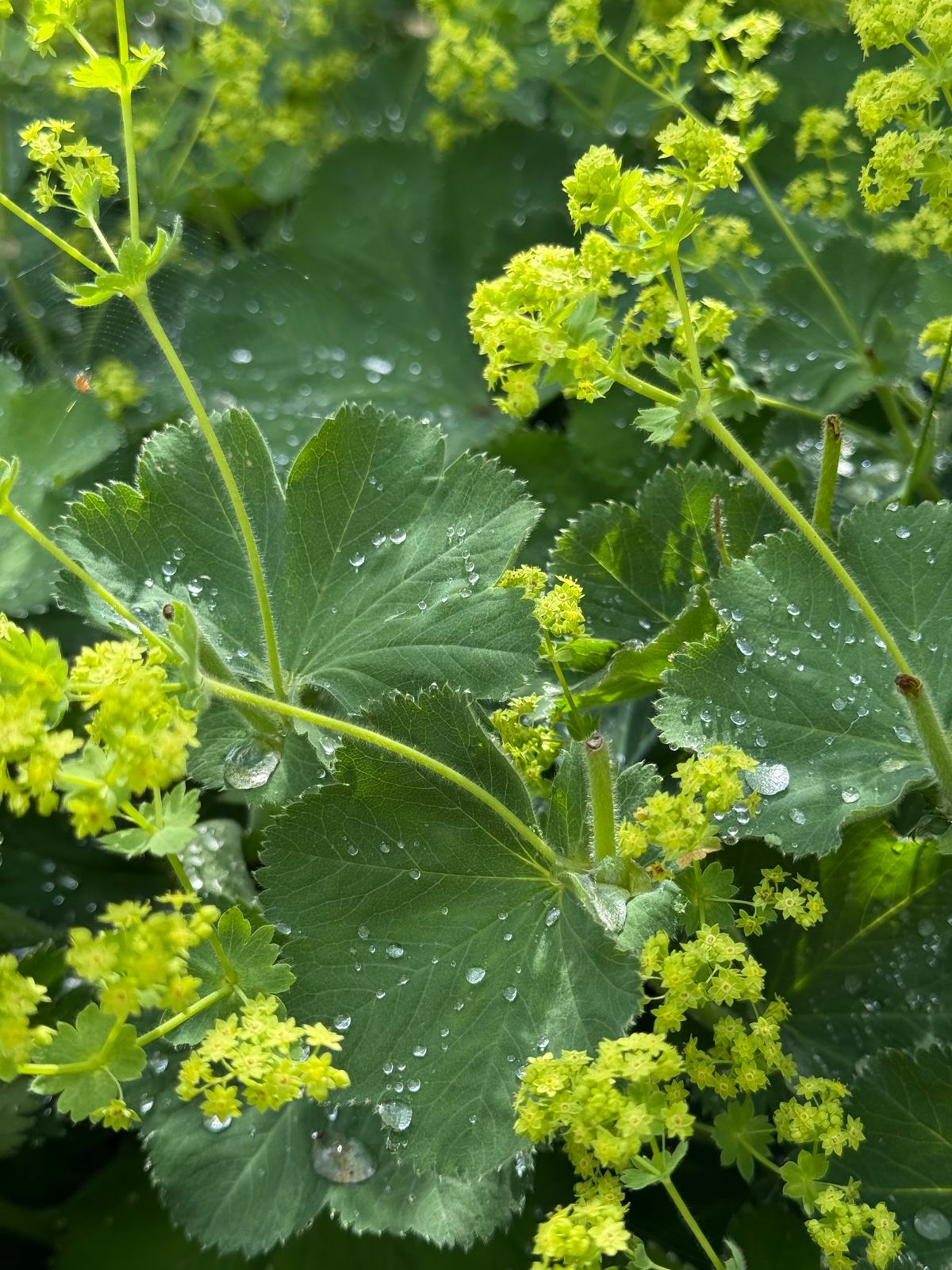
Alchemists collected the drop from the center of the leaf in the morning because they believed it to be heavenly water - hence the name Alchemilla.
Lady's mantle grows in meadows, at forest edges, and along stream banks throughout Europe, from lowlands to altitudes of over 2,000 meters. Its folded, fan-shaped leaves trap dew and rain in the center—a droplet that lingers until mid-morning and fascinated medieval alchemists. They believed they could extract the philosopher's stone from this "heavenly dew.".
The German name comes from the leaves, which resemble a pleated cloak, and from its uses: Since the Middle Ages, lady's mantle has been the herb of midwives, used to treat vaginal discharge, for the postpartum period, and for menstrual cramps. The flowering herb is harvested from May to July; the inconspicuous yellow-green flowers are only visible upon closer inspection.
To useWhat lady's mantle can do for you
Lady's mantle is a Tannin herb. Up to eight percent tannins constrict mucous membranes, seal them, and deprive germs of their breeding ground – this is the basis for everything the plant can do: It stops mild diarrhea, soothes inflamed gums when gargling, and helps small wounds and weeping skin areas to dry.
That's precisely why it's officially recognized: The European Medicines Agency lists lady's mantle as a traditional remedy for mild diarrhea and minor inflammations of the mouth and throat. It's not a major medicine, but a reliable home remedy.
And what about its use in women's health? Its reputation for treating menstrual cramps, menopausal symptoms, and postpartum pain is centuries old and passed down by many midwives. However, it's not scientifically proven – the research is limited, and its effects are most likely explained by the tannins and the warmth of the tea. We're stating it as it is: a tradition valued by many women, not a proven hormone-regulating herb.
IngredientsThat's what's in the weed
The tannins Ellagitannins such as agrimoniin and pedunculagin make up six to eight percent of the dry mass – they are responsible for the bitter taste and the astringent effect. In addition, there are... Flavonoids (Quercetin glycosides), some bitter substance and traces of salicylic acid.
What lady's mantle not Contains: Plant hormones in significant quantities. The old classification as a "progesterone plant" originates from folk medicine, not from analysis.
Enhanced combinationsWhat makes lady's mantle stronger
As a tannin-rich herb, lady's mantle amplifies others - and itself needs partners to soften its harsh tone.
Three tannin-containing plants, three levels of strength. In cases of mild diarrhea, they complement each other – bilberry is mild for children, tormentil is strong for adults.
Sage provides essential oil to fight germs, lady's mantle provides tannins - together they form the classic gargle for irritated gums.
The traditional remedy for menstrual cramps: yarrow for its antispasmodic properties, lemon balm for its calming effect, and lady's mantle for its astringent properties. Honestly, it's just tradition, not based on any studies – but it's well-tolerated.
As a wash or compress: chamomile is anti-inflammatory, calendula promotes wound healing, and lady's mantle is drying. For weeping sores and eczema.
Raspberry leaf makes the tea rounder, mint fresher - this is why lady's mantle is often enjoyed over several days.
The tannins dissolve much better in hot water. Let it steep, covered, for ten minutes, then it will take effect.
What contradicts itselfIt's best to avoid these combinations.
Tannins bind iron. If you are taking iron supplements, drink the tea at least two hours later.
Tannins can inhibit the absorption of many active ingredients - never take lady's mantle together with tablets.
Tannins can irritate the stomach over time. If diarrhea occurs, consume them for two or three days, then take a break. If symptoms persist for more than three days, consult a doctor.
Milk protein binds the tannins and reduces the tea's effectiveness. Drink it plain or with honey.
Anything that constricts the intestines also slows them down. For sluggish digestion, this is the wrong herb.
Lady's mantle is not a substitute for treatment of menstrual irregularities or menopausal symptoms. Anyone wishing to address these issues should consult their gynecologist.
In the kitchenWhere he belongs
- Wild herb saladYoung leaves in spring, finely cut, with dandelion and daisy - tart, nutty, just a few leaves.
- herb quarkWith chives, parsley and a little lady's mantle - the tannins give a slight bitter note.
- SmoothieTwo or three leaves with apple, cucumber and lemon - no more, otherwise it will get fuzzy.
- Lady's mantle teaThe actual "dish": 2 teaspoons of dried herb to 250 ml, steep for 10 minutes.
- gargle solutionStronger brew, cooled - for gums and throat.
- Herb butterFreshly chopped in butter, served with potatoes and bread - subtle, yet distinctive.
- SoupsAdd a handful of leaves to an herb or potato soup, just before serving.
- Sitz bathA strong infusion into the bathwater - the midwifery tradition after birth.
- facial tonerCold tea as a tonic for oily, impure skin - it tightens the pores.
- Herb saltDried and finely ground with sea salt - the meadow aroma for winter.
As a home remedyLady's mantle tea for mild diarrhea
Lady's mantle tea
- Pour 2 teaspoons of dried herb with 250 ml of boiling water.
- Let it steep, covered, for 10 minutes - longer than with other teas, so that the tannins are released.
- Strain and drink warm, unsweetened or with a little honey.
- Drink up to three cups a day for two to three days. For gargling, brew the same tea with twice the strength.
Mild, nonspecific diarrhea, irritated gums, scratchy throat. As a compress for small, weeping wounds and eczema. Traditional uses for menstrual cramps are considered well-tolerated, but not scientifically proven.
Two to three cups a day, for no longer than a week at a time. If diarrhea lasts for three days, accompanied by fever or blood, consult a doctor immediately – tea is not the right remedy.
Ayurveda & TCMWhat the old systems say
Ayurveda
Lady's mantle is a European plant and not known in classical Ayurveda. In terms of its effects, it would be classified as cooling, astringent, and Pitta-Kapha reducing – like other tannin-containing plants.
Traditional Chinese Medicine
It is not part of the Chinese Materia Medica. In Europe, however, the plant has its own tradition, dating back to Hildegard von Bingen: as a wound herb and women's herb in monastery gardens and among midwives.
Warning noticesWhen you should be careful
Please note
- Iron and medication: Tannins bind both. Always drink tea two hours apart from tablets and iron supplements.
- Stomach: If you have a sensitive stomach, the tea can cause nausea - in that case, brew it with a weaker solution and drink it after meals.
- Duration: Not for more than one week daily. Diarrhea lasting longer than three days requires a doctor's visit.
- Pregnancy: Traditionally used in midwifery, but not systematically studied - only after consultation.
- Children: Tea in half dose for children of school age and older; for diarrhea in toddlers, fluids are what counts, not herbs.
This page provides information and does not replace medical advice. If symptoms persist, please consult a doctor.
Related to the topicRead on and cook along!
Shop links lead to our product pages; it is indicated there if a partner is involved.
SourcesWhat is this based on?
- European Medicines Agency (EMA), HMPC: Community herbal monograph on Alchemilla vulgaris L., herba, 2010 - traditional use for mild diarrhea and mild inflammation of the oral and pharyngeal mucosa.
- Commission E: Monograph Alchemillae herba (Lady's mantle herb), Federal Gazette 1986 - mild non-specific diarrheal diseases.
- Blaschek W (ed.): Wichtl - Herbal drugs and phytopharmaceuticals. 6th edition, Scientific Publishing Company 2016, entry Alchemillae herba.
- Schilcher H, Kammerer S, Wegener T: Guide to phytotherapy. 5th edition, Elsevier 2016.