
Spring onion (Allium fistulosum)
OriginThe onion from the East
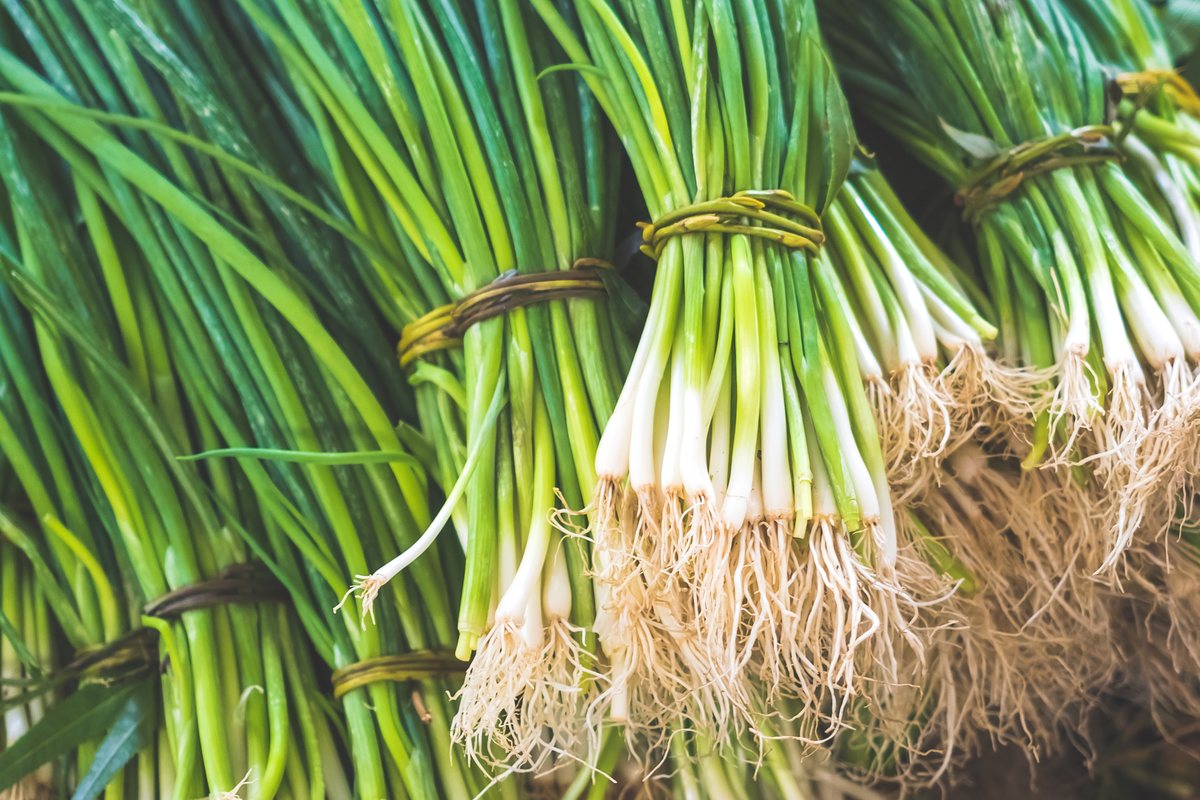
The English name Welsh onion It has nothing to do with Wales - it goes back to the old German word "welsch" for "foreign".
The Welsh onion originates from Central and East Asia; its wild ancestor is considered to be the Altai onion (Allium altaicumIt has been cultivated in China for more than 2,000 years, and in Japan it is known as Negi to this day one of the most important vegetables.
It came to Europe via Russia and was particularly valued here as a robust garden plant: it is perennial, survives frost, and sprouts fresh green shoots in early spring – hence the names winter onion, Welsh onion, or chiving onion. Young kitchen onions are also often available in supermarkets (Allium cepa) - hardly any difference in the kitchen.
To useWhat spring onions can do for you
According to the USDA, 100g of raw spring onions provide only about 32 kcal, but about 207 µg of vitamin D. Vitamin K This is more than the daily requirement of an adult, which the German Nutrition Society (DGE) estimates at 60 to 80 µg. In addition, there are approximately 19 mg. Vitamin C, 64 µg Folate, It contains 2.6 g of fiber, as well as potassium and the carotenoids beta-carotene and lutein. Almost all of this is found in the green part.
Like all members of the allium family, spring onions contain sulfur compounds that release their aroma when cut, as well as flavonoids such as... Quercetin and kaempferol. Japanese researchers have derived a substance from the green leaf mucilage. Fructan A compound has been isolated that, after oral administration, increased antibody production against influenza viruses in mice. In a small study with 54 adults, the activity of natural killer cells increased with a leaf extract – but also with a placebo; the difference was not significant.
Das klingt spannend, ist aber Grundlagenforschung. Dass Frühlingszwiebeln Verkühlungen verhindern oder verkürzen, ist beim Menschen nicht belegt. Ihr sicherer Wert liegt in der Küche: frisch, vitaminreich und würzig.
IngredientsThis is what's in the spring onion
Spring onions contain sulfur-containing amino acids such as alliin and their breakdown products, flavonoids (quercetin, kaempferol, and anthocyanins in the red stem), phenolic acids such as ferulic acid, saponins, fructans and mucilage, as well as vitamin K, vitamin C, folate, beta-carotene, lutein, potassium and calcium.
The green part is richer in vitamins and carotenoids, while the white stem is milder and slightly sweeter. Vitamin C and folate are heat-sensitive – they are best preserved when eaten raw or only briefly heated.
Enhanced combinationsWhat makes spring onions stronger
Spring onions provide a quick burst of freshness - eaten raw over food or briefly stir-fried.
Vitamin K and carotenoids are fat-soluble.
The three pillars of Chinese cuisine.
Fresh herb quark with onion greens.
Vitamin C helps with absorption.
Crisp and spring-like.
Only go in at the very end.
What contradicts itselfIt's best to avoid these combinations.
The green leaves become limp and lose vitamins.
Eat plenty of vitamin K – evenly.
It absorbs and releases odors.
Fructans - the green color is more tolerable.
Stronger, larger, used differently.
Generously cut away any spoiled parts.
In the kitchenWhere she belongs
- scrambled eggsWith onion greens and pepper.
- Fried riceFry the white part along with the green part, put the green part on top.
- Miso soupFinely sliced and placed in the bowl.
- potato saladInstead of onions.
- herb quarkServe with radishes and boiled potatoes.
- Spring onion pancakesChinese Cong You Bing.
- Asian saladWith cucumber, sesame seeds and lime.
- GrilledAll together with a little oil.
- Stir-fried vegetablesTwo minutes with ginger.
- Tacos and BowlsAs a fresh topping.
As a home remedySpring onion and ginger tea for chills
Spring onion and ginger tea
- Thoroughly wash the white stalk ends of 3 to 4 spring onions, including the root base, and roughly chop them.
- Add 3 to 4 slices of fresh ginger.
- Bring 400 ml of water to a boil and simmer gently for 5 to 10 minutes.
- Strain, sweeten with a little honey if desired, and drink hot in small sips, then cover to keep warm.
Ein chinesisches Hausmittel bei beginnender Verkühlung mit Frösteln und leichtem Kopfdruck - in der TCM, um „Kälte auszuleiten“. Die Wärme tut gut, der Ingwer wärmt zusätzlich. Eine Wirkung gegen Verkühlungsviren ist beim Menschen nicht nachgewiesen.
One to two cups a day for a few days. Consult a doctor if you experience high fever, shortness of breath, or symptoms lasting more than a week. Do not give honey to children under one year old.
Ayurveda & TCMWhat the old systems say
Ayurveda
In Ayurveda, the spring onion is classified like the onion: pungent and sweet, heating when raw, milder when cooked - balancing for Vata and Kapha, but rather irritating to Pitta when eaten raw in larger quantities.
Traditional Chinese Medicine
In Traditional Chinese Medicine (TCM), the white shaft is called... Cong Bai. It is considered sharp and warming, said to open the surface, have a mild diaphoretic effect, and dispel "wind-cold". A classic combination is with fermented soybeans (Cong Chi Tang) oder frischem Ingwer bei beginnender Verkühlung ohne Schweiß.
Warning noticesWhen you should be careful
Please note
- Blood thinners: Those taking vitamin K antagonists such as phenprocoumon (Marcumar) should not suddenly eat large quantities of spring onions, but rather gradually – and discuss any changes with their doctor.
- Irritable bowel syndrome: The fructans in the white part can cause bloating; the green tubular leaf is usually better tolerated.
- Hygiene: Wash raw greens thoroughly, as soil often gets trapped between the leaves.
- Allergy: Cross-reactions with onion, leek and garlic are rare.
- Pets: Toxic to dogs and cats, like all bulbous plants.
This page provides information and does not replace medical advice. If symptoms persist, please consult a doctor.
Related to the topicRead on and cook along!
Shop links lead to our product pages; it is indicated there if a partner is involved.
SourcesWhat is this based on?
- USDA FoodData Central: Onions, spring or scallions (including tops and bulb), raw.
- Lee JB et al. Anti-influenza A virus effects of fructan from Welsh onion (Allium fistulosum L.). Food Chemistry 2012; 134(4): 2164–2168.
- Hirayama Y, Takanari J, Goto K, Ueda H, Tanaka A, Nishihira J. Effect of Welsh onion (Allium fistulosum L.) green leaf extract on immune response in healthy subjects: a randomized, double-blind, placebo-controlled study. Functional Foods in Health and Disease 2019; 9(2): 123–133.
- Cheong SI et al. Bioactive phytochemicals and health-promoting effects of green onion (Allium fistulosum L.): a scoping review. Journal of Ethnic Foods 2026; 13:22.
- German Nutrition Society (DGE): Reference values for nutrient intake - Vitamin K.


