
Shallot (Allium cepa var. aggregatum)
OriginThe Askalon onion
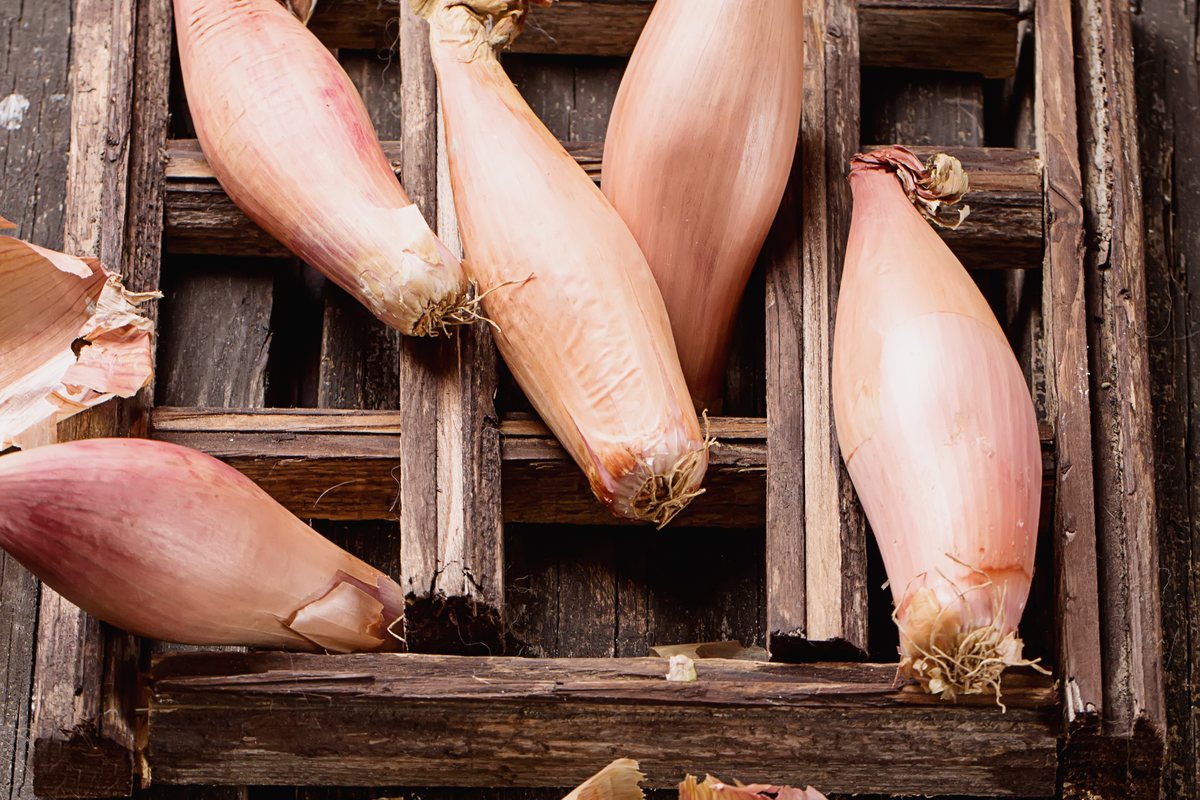
The name originates from French. échalote on the Ascalonia caepa back, the „Onion from Askalon“.
Like the onion, the shallot originates from Central and Western Asia. Its name recalls Askalon, an ancient port city on the Mediterranean coast, through which, according to tradition, it came to Europe. It became established in France during the Middle Ages, where it still plays a central role today: Beurre blanc, béarnaise sauce, and Bordelaise all begin with finely chopped shallots.
For a long time, the shallot was considered a separate species, Allium ascalonicum. Today it is mostly classified as a variety of onion. Allium cepa var. aggregate or as an "aggregate group". The difference: Several daughter bulbs grow from a single shallot planted on the stem, similar to garlic. There are round and oblong varieties; the large, oblong "eschalion" or banana shallots are often hybrids with onions. In Europe, shallots are primarily cultivated in France, the Netherlands, and to a lesser extent in Germany.
To useWhat the shallot does for you
100g of raw shallots provide approximately 72 kcal, 2.5g of protein, and about 3g of carbohydrates. Dietary fiber and about 330 mg potassium, It also contains vitamin B6, folate, and some vitamin C. Some of the fiber consists of fructans such as inulin, which serve as food for gut bacteria – and can cause bloating in sensitive individuals.
More interesting are the Polyphenols. In a Cornell University study comparing ten onion varieties, shallots had the highest phenol content and were among the varieties with the strongest antioxidant activity in the laboratory. The most important flavonoid is... Quercetin, Flavonoids, which are present in onions primarily as glycosides, are relatively well absorbed from them. Most flavonoids are located in the outer layers – peeling too much off means losing some of them.
In addition, sulfur compounds are released when the onions are cut, contributing to the aroma and causing tears. Observational studies link a high consumption of onions to a slightly lower risk of some cancers and cardiovascular diseases. Whether shallots play a special role in this has not been investigated. Above all, they are a way to regularly include flavorful vegetables and valuable phytonutrients in our meals.
IngredientsThis is what's in the shallot
Shallots contain carbohydrates (sugars and fructans such as inulin), protein, fiber, potassium, manganese, vitamin B6, folate and vitamin C, flavonoids such as quercetin glycosides and - in red varieties - anthocyanins, phenolic acids, saponins as well as sulfur-containing flavorings (cysteine sulfoxides, which are converted into thiosulfinates when cut).
Compared to onions, shallots have less water and therefore a more concentrated flavor. The reddish-purple varieties are particularly rich in pigments and flavonoids.
Enhanced combinationsWhat makes shallots stronger
Shallots need patience and a little fat - then they become sweet and round.
Gently steam until translucent, do not brown.
The basis for Beurre blanc and Béarnaise.
French sauce cuisine.
Finely chopped, milder than an onion.
Caramelized, with balsamic vinegar.
Spices and quercetin in the stew.
What contradicts itselfIt's best to avoid these combinations.
Shallots burn quickly and become bitter.
Most of the flavonoids are located on the outside.
Onions and bulbs destroy red blood cells.
Fructans can cause bloating.
Moisture promotes mold and sprouting.
Aroma is lost.
In the kitchenWhere they belong
- Beurre blancWhite butter sauce with fish.
- Béarnaise sauceWith tarragon.
- VinaigretteFinely diced.
- Glazed shallotsWith balsamic vinegar and honey.
- Coq au vinIt was all braised together.
- RisottoAs a mild base.
- Roasted shallotsCrispy fried, like in Asia.
- Lentil stewInstead of onion.
- red wine sauceFor roasts and mushrooms.
- Pickled shallotsSweet and sour.
As a home remedyShallot vinaigrette for every day
Shallot vinaigrette
- Peel a shallot and dice it very finely.
- Mix with 2 tablespoons of white wine or apple cider vinegar, a pinch of salt and half a teaspoon of mustard and let it sit for 5 minutes.
- Whisk in 4 to 5 tablespoons of olive oil or rapeseed oil and season with pepper.
- Über Blattsalat, Linsen, Erdäpfel oder gedünstetes Gemüse geben.
A simple base sauce that makes raw vegetables and salads more flavorful. The shallot adds aroma and polyphenols, while the oil aids in the absorption of fat-soluble vitamins from the vegetables.
Keeps for 2 to 3 days in a sealed jar in the refrigerator. Shake before use.
Ayurveda & TCMWhat the old systems say
Ayurveda
In Ayurveda, onions and shallots (PalanduThey are described as heating, pungent, and sweet. Cooked, they are considered nourishing and balancing Vata; raw, they are said to stimulate Pitta. Onions are avoided in strictly sattvic cuisine.
Traditional Chinese Medicine
In Traditional Chinese Medicine (TCM), onions are considered pungent and warming. They are said to move Qi and Yang, warm the stomach, and loosen phlegm. Shallots are used similarly in Chinese cuisine, especially fried as a seasoning.
Warning noticesWhen you should be careful
Please note
- Dogs and cats: All members of the onion family are poisonous and can cause anemia – as little as 15 to 30 grams of onion per kilogram of body weight in dogs and 5 grams per kilogram in cats. Cats are more sensitive. This applies even when the onion is cooked, dried, or in powdered form.
- Irritable bowel syndrome: Fructans can cause bloating and abdominal pain.
- Heartburn: Raw shallots can worsen reflux in sensitive individuals.
- Allergy: Rare; cross-reactions with other bulbous plants are possible.
- Storage: Discard any moldy or soft onions.
This page provides information and does not replace medical advice. If symptoms persist, please consult a doctor.
Related to the topicRead on and cook along!
Shop links lead to our product pages; it is indicated there if a partner is involved.
SourcesWhat is this based on?
- USDA FoodData Central: Shallots, raw.
- Yang J, Meyers KJ, van der Heide J, Liu RH. Varietal differences in phenolic content and antioxidant and antiproliferative activities of onions. Journal of Agricultural and Food Chemistry 2004; 52(22): 6787–6793.
- Slimestad R, Fossen T, Vågen IM. Onions: a source of unique dietary flavonoids. Journal of Agricultural and Food Chemistry 2007; 55(25): 10067–10080.
- Fattorusso E et al. Chemical composition of shallot (Allium ascalonicum Hort.). Journal of Agricultural and Food Chemistry 2002; 50(20).
- Salgado BS, Monteiro LN, Rocha NS. Allium species poisoning in dogs and cats. Journal of Venomous Animals and Toxins including Tropical Diseases 2011; 17(1): 4–11.


