
Kiwi (Actinidia deliciosa)
OriginA Chinese gooseberry with a new name
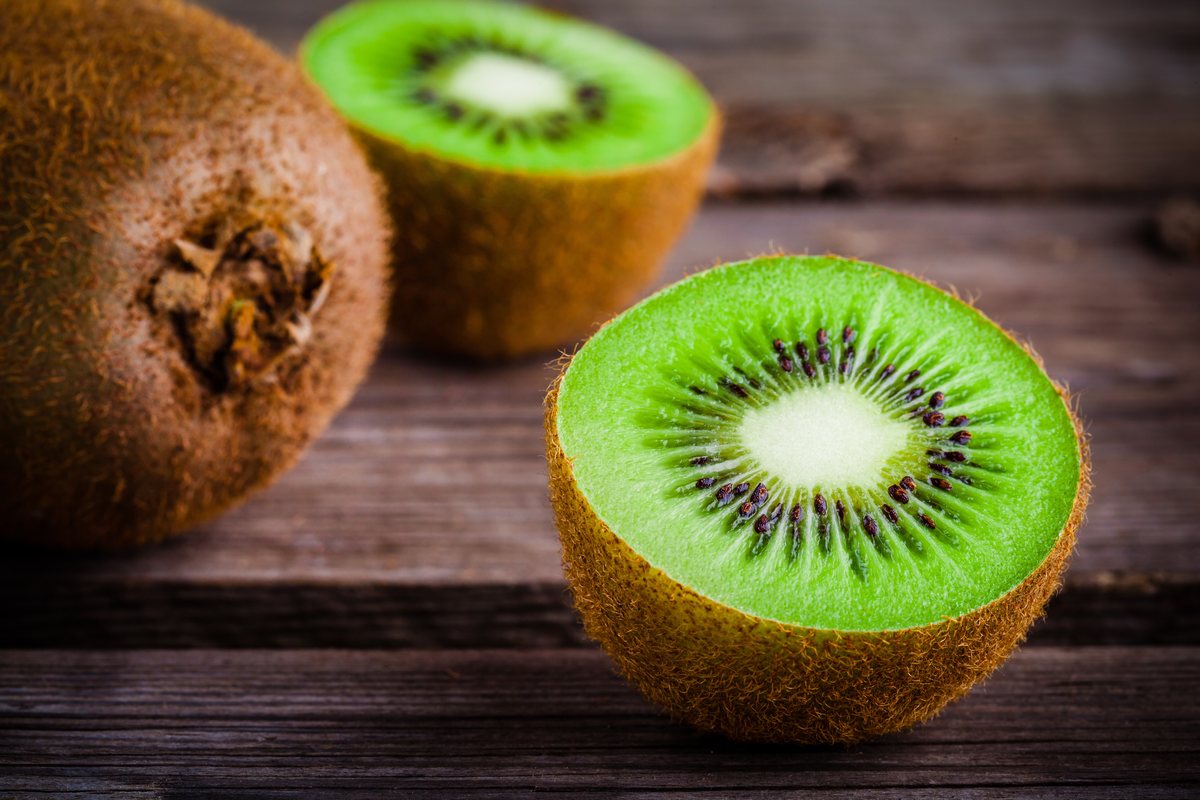
In 1904, teacher Isabel Fraser brought seeds from China to New Zealand - from which a global fruit emerged.
The kiwi grows wild as a climbing plant in the forests of the Yangtze Valley in China, where it Mi Hou Tao It's called "macaque peach". At the beginning of the 20th century, the New Zealand teacher Isabel Fraser brought seeds home from a mission school. The plant thrived in New Zealand, was improved through breeding, and initially sold as "Chinese gooseberry".
For export to the USA, this name proved disadvantageous in the 1950s; in 1959, the fruit was renamed "kiwifruit" after New Zealand's national bird. Today, China is once again the largest producer, followed by New Zealand, Italy, and Greece. Besides the green, fuzzy Hayward variety, there is the smooth golden kiwi and the small, hairless kiwiberry (mini kiwi), which is even winter-hardy in German gardens.
To useWhat the kiwi does for you
The kiwi is one of the everyday fruits richest in vitamin CA green kiwi (around 75 g) provides about 70 mg of vitamin D, a golden kiwi even more – more than an orange. It also contains fiber, vitamin K, vitamin E, folate, and potassium.
Their effects are best documented on the digestion. In several controlled studies, two green kiwis a day improved stool frequency in people with chronic constipation—in one US study, as effectively as psyllium husks or prunes, but with less flatulence. The European Food Safety Authority (EFSA) confirmed in 2021 that green kiwis contribute to normal bowel function. This is likely due to the water-binding fiber and the enzyme actinidin.
There are also small studies suggesting that eating two kiwis an hour before bed improves sleep. These are pilot studies with few participants – interesting, but not conclusive.
IngredientsThis is what's inside the kiwi
Next to Vitamin C Kiwis contain soluble and insoluble fiber (about 3 g per 100 g), which binds a lot of water, as well as vitamin K, vitamin E from the small black seeds, folate, potassium, carotenoids such as lutein, and polyphenols. The peel is edible and contains additional fiber and folate – this is more pleasant with golden kiwis than with the hairy green ones.
What's special is Actinidine, Actinidin, a protein-splitting enzyme similar to bromelain in pineapple and papain in papaya, helps break down proteins in the stomach, tenderizes meat in marinades, but also makes dairy products bitter and prevents gelatin from setting. Heat destroys the enzyme. Actinidin is also the most important kiwi allergen.
Enhanced combinationsWhat makes the kiwi stronger
The kiwi is a breakfast fruit, a meat tenderizer, and a dessert fruit - you just need to know its enzyme.
Two kiwis for breakfast, along with plenty of fluids - this is how the desired effect on digestion was achieved in studies.
Vitamin C improves iron absorption - kiwi as a dessert after a lentil dish.
Pureed kiwi should be cooked on top of beef or pork for 30 minutes – the actinidin makes it tender. Don't cook it longer, otherwise it will become mushy.
Kiwi salsa or smoothie: The acidity of the kiwi goes well with fresh herbs.
Eat well-washed with the peel on - more fiber, and it's faster.
Tropical fruit salad - cut only shortly before serving.
What contradicts itselfIt's best to avoid these combinations.
Actinidin breaks down milk proteins – after a while it becomes bitter. Mix fresh or blanch the kiwi briefly.
The enzyme breaks down the gelatin, so the pudding won't set. Use agar-agar or heat the kiwi beforehand.
Kiwi allergies are common and can be severe, especially in children. A tingling sensation in the mouth is a warning sign.
The acid and fine calcium oxalate crystals can irritate the mouth and lips.
Kiwis contain oxalate - eat them in moderation if you are prone to calcium oxalate stones.
Apples release ethylene, which causes kiwis to soften quickly - or you can use them for exactly that purpose.
In the kitchenWhere she belongs
- Spoon kiwiCut in half and scoop out – breakfast in ten seconds.
- Kiwi overnight oatsOatmeal, plant-based milk, chia seeds, with kiwi in the morning.
- Green smoothieKiwi, spinach, banana, water.
- Kiwi salsaKiwi, red onion, chili, coriander - go well with fish or tacos.
- PavlovaMeringue, cream, kiwi and passion fruit - the classic from New Zealand.
- meat marinadePureed kiwi with soy sauce and garlic for Korean bulgogi.
- fruit saladWith orange, mango, and pomegranate.
- Kiwi chutneyCooked down with ginger, onion and vinegar.
- Kiwi sorbetPuree, add a little sugar, and freeze.
- KiwiberriesEat the mini kiwis unpeeled, like grapes.
As a home remedyKiwi cure for sluggish digestion
Two kiwis in the morning
- Halve two ripe green kiwis (Hayward variety) in the morning and scoop out the flesh.
- Drink a large glass of water with it.
- Drink at least 1.5 liters of fluids throughout the day.
- Continue for four weeks and observe the effect.
Mild, chronic constipation. Studies have shown that the number of bowel movements per week increased, stools became softer, and abdominal discomfort decreased – with less bloating than with many other fiber sources.
Two green kiwis daily. Consult a doctor if you experience sudden constipation, blood in your stool, weight loss, or severe abdominal pain. Not suitable for those with a kiwi allergy.
Ayurveda & TCMWhat the old systems say
Ayurveda
The kiwi is not a fruit mentioned in classical Ayurvedic texts. Modern Ayurvedic practitioners classify it according to its taste as sour-sweet and cooling: good for Vata, in moderation for Pitta, but not recommended in large quantities for Kapha.
Traditional Chinese Medicine
In Traditional Chinese Medicine (TCM) it is called Mi Hou Tao It is considered sour-sweet and cold. It is said to cool heat, quench thirst, and promote urination – traditionally used for hot flashes, restlessness, and dry mouth, but not for coldness in the stomach and intestines.
Warning noticesWhen you should be careful
Please note
- Allergy: Kiwi is one of the more common fruit allergies; cross-reaction with latex and birch pollen is possible - stop eating immediately if swelling occurs in the mouth.
- Infants: Do not give kiwi as one of the first complementary foods if allergies run in the family.
- Oxalate: Use in moderation if you are prone to kidney stones.
- Mouth: Acid and oxalate crystals can cause a burning sensation on the tongue.
- Enzyme: Do not prepare raw food with dairy products or gelatin.
This page provides information and does not replace medical advice. If symptoms persist, please consult a doctor.
Related to the topicRead on and cook along!
Shop links lead to our product pages; it is indicated there if a partner is involved.
SourcesWhat is this based on?
- Chey SW, Chey WD, Jackson K, Eswaran S. Exploratory comparative effectiveness trial of green kiwifruit, psyllium, or prunes in US patients with chronic constipation. American Journal of Gastroenterology 2021; 116(6): 1304–1312.
- EFSA NDA Panel. Green kiwifruit (Actinidia deliciosa var. Hayward) and maintenance of normal defecation: evaluation of a health claim. EFSA Journal 2021; 19(6): 6641.
- Richardson DP, Ansell J, Drummond LN. The nutritional and health attributes of kiwifruit: a review. European Journal of Nutrition 2018; 57(8): 2659–2676.
- Lin HH et al. Effect of kiwifruit consumption on sleep quality in adults with sleep problems. Asia Pacific Journal of Clinical Nutrition 2011; 20(2): 169–174.
- USDA FoodData Central: Kiwifruit, green, raw.


