
Rhubarb (Rheum rhabarbarum)
OriginThe root from the East
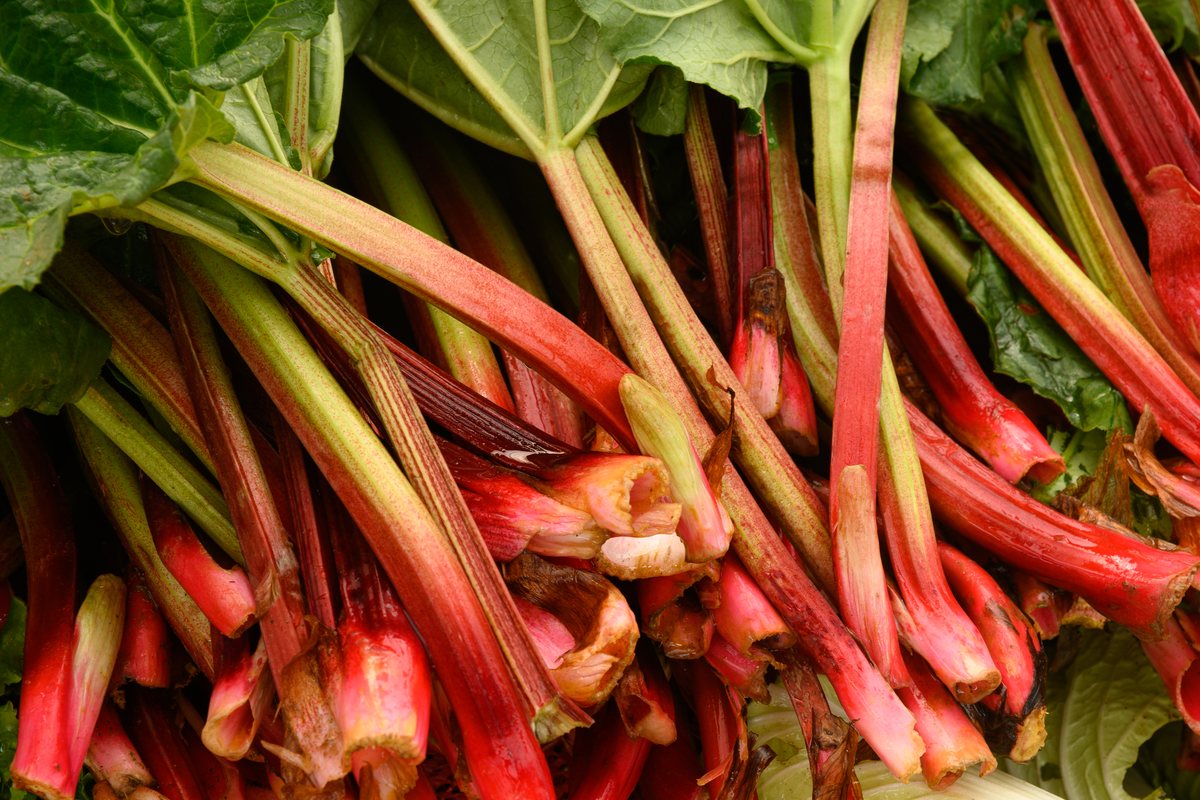
The name comes from Latin. rha barbarum - the „foreign root“ from beyond the Volga, which the Greeks called Rha.
Rhubarb originates from the mountainous regions of Central Asia. For centuries, Europe only knew the dried root of the Chinese medicinal rhubarb, which arrived via the Silk Road and was as expensive as opium. It was traded as a laxative.
It wasn't until the 18th century that the English began eating the stalks of garden rhubarb – when sugar, which neutralizes the acid, became cheap. It has been widespread in Germany since the 19th century. Like asparagus, it is harvested until St. John's Day on June 24th: after that, the oxalic acid content increases, and the plant needs its leaves to gather strength for the following year.
To useWhat rhubarb does for you
100g of rhubarb stalks contain only about 20 kcal and provide about 2g of protein. Dietary fiber, approximately 290 mg potassium, just under 30 µg Vitamin K and some vitamin C. Calcium is present in abundance, but largely bound to oxalic acid and therefore poorly absorbed. Red-stemmed varieties also contain anthocyanins.
The sour taste comes from malic acid and Oxalic acid. Rhubarb stalks contain approximately 0.2 to 0.8 g of oxalic acid per 100 g – more than most fruits, but less than spinach or chard. In normal quantities, this is not a problem for healthy individuals; however, those prone to calcium oxalate kidney stones should consume them in moderation.
Rhubarb compote stimulates digestion in some people due to its fiber, fruit acids, and liquid content. While the stalks do contain traces of anthranoids, they contain only a fraction of what is found in the root of medicinal rhubarb. Therefore, a laxative effect like that of the medicinal rhubarb is not to be expected.
IngredientsThis is what's in rhubarb
Rhubarb stalks contain water, malic acid, oxalic acid and citric acid, dietary fiber (pectin), potassium, calcium (predominantly bound as calcium oxalate), magnesium, vitamin K, vitamin C, polyphenols such as anthocyanins in red varieties, stilbenes such as rhaponticin and traces of anthranoids.
The leaves contain significantly higher levels of oxalic acid, as well as other irritants. They belong on the compost heap, not in the pot.
Enhanced combinationsWhat makes rhubarb better
Rhubarb needs sweetness, calcium - and partners that round off its acidity.
It binds oxalic acid in the intestine.
Less sugar needed.
It rounds off the acidity.
For compote and chutney.
As rhubarb porridge.
It lowers the acidity slightly.
What contradicts itselfIt's best to avoid these combinations.
High in oxalic acid, toxic.
It is more digestible when cooked.
Only a little, and with dairy products.
Oxalic acid levels rise.
Acid dissolves metal.
Acid softens tooth enamel - wait 30 minutes.
In the kitchenWhere he belongs
- Rhubarb compoteWith vanilla.
- Rhubarb cakeWith meringue or sprinkles.
- Rhubarb crumbleWith rolled oats.
- Rhubarb and strawberry jamEarly summer in a glass.
- Rhubarb spritzerFrom the syrup.
- Rhubarb chutneyWith ginger, go well with cheese.
- Red fruit jellyWith berries.
- Rhubarb porridgeWith yogurt.
- Baked rhubarbWith honey and orange.
- Rhubarb tiramisuMit Topfen statt Mascarpone.
As a home remedyRhubarb compote for sluggish digestion
Rhubarb compote
- Wash 500g of rhubarb stalks, peel off thick stalks and cut into 2cm pieces.
- Put 3 tablespoons of water, 2 to 3 tablespoons of honey or sugar and a little vanilla into a pot.
- Cover and simmer over low heat for 5 to 8 minutes, until the pieces are soft.
- Abkühlen lassen und mit Naturjoghurt oder Topfen essen.
Als leichte Nachspeise bei träger Verdauung. Ballaststoffe, Fruchtsäuren und Flüssigkeit können den Darm sanft anregen. Joghurt oder Topfen binden dabei einen Teil der Oxalsäure. Ein Abführmittel ersetzt das Kompott nicht.
One bowlful (about 150g) per day. If you have a history of kidney stones, only eat occasionally. If you experience constipation for more than two weeks, you should consult a doctor to determine the cause.
Ayurveda & TCMWhat the old systems say
Ayurveda
Garden rhubarb is not described in classical Ayurveda. The root of medicinal rhubarb (Revandchini) is used for its bitter and cooling properties in cases of constipation. According to modern classifications, the sour stalks would increase Pitta.
Traditional Chinese Medicine
In Traditional Chinese Medicine (TCM), Da Huang, the root of Rheum palmatum, is one of the most potent detoxifying agents: bitter and cold, it eliminates heat via the intestines. The stalks of garden rhubarb play no role in this practice.
Warning noticesWhen you should be careful
Please note
- Leaves: Do not eat them - they contain a lot of oxalic acid and can cause nausea, vomiting and kidney damage.
- Kidney stones: In cases of calcium oxalate stones or kidney disease, consume only small amounts and always with dairy products.
- Do not confuse: Medicinal rhubarb (Rheum palmatum, Rheum officinale) is an anthranoid-containing laxative - not for longer than 1 to 2 weeks, not during pregnancy, breastfeeding and in children under 12 years of age.
- Children: Only small portions were cooked because of the oxalic acid.
- Rheumatism and gout: Those who need to be careful about oxalic acid should only eat rhubarb rarely.
- Cookware: Do not cook or store in aluminium pots.
This page provides information and does not replace medical advice. If symptoms persist, please consult a doctor.
Related to the topicRead on and cook along!
Shop links lead to our product pages; it is indicated there if a partner is involved.
SourcesWhat is this based on?
- Committee on Herbal Medicinal Products (HMPC), EMA: Community herbal monograph on Rheum palmatum L. and Rheum officinale Baillon, radix. EMEA/HMPC/189624/2007.
- Noonan SC, Savage GP. Oxalate content of foods and its effect on humans. Asia Pacific Journal of Clinical Nutrition 1999; 8(1): 64–74.
- Mitchell T et al. Dietary oxalate and kidney stone formation. American Journal of Physiology - Renal Physiology 2019; 316(3): F409–F413.
- USDA FoodData Central: Rhubarb, raw.
- Consumer Advice Center Bavaria: Is the oxalic acid in rhubarb harmful?


