
Red cabbage (Brassica oleracea var. capitata f. rubra)
OriginRed cabbage or blue cabbage?
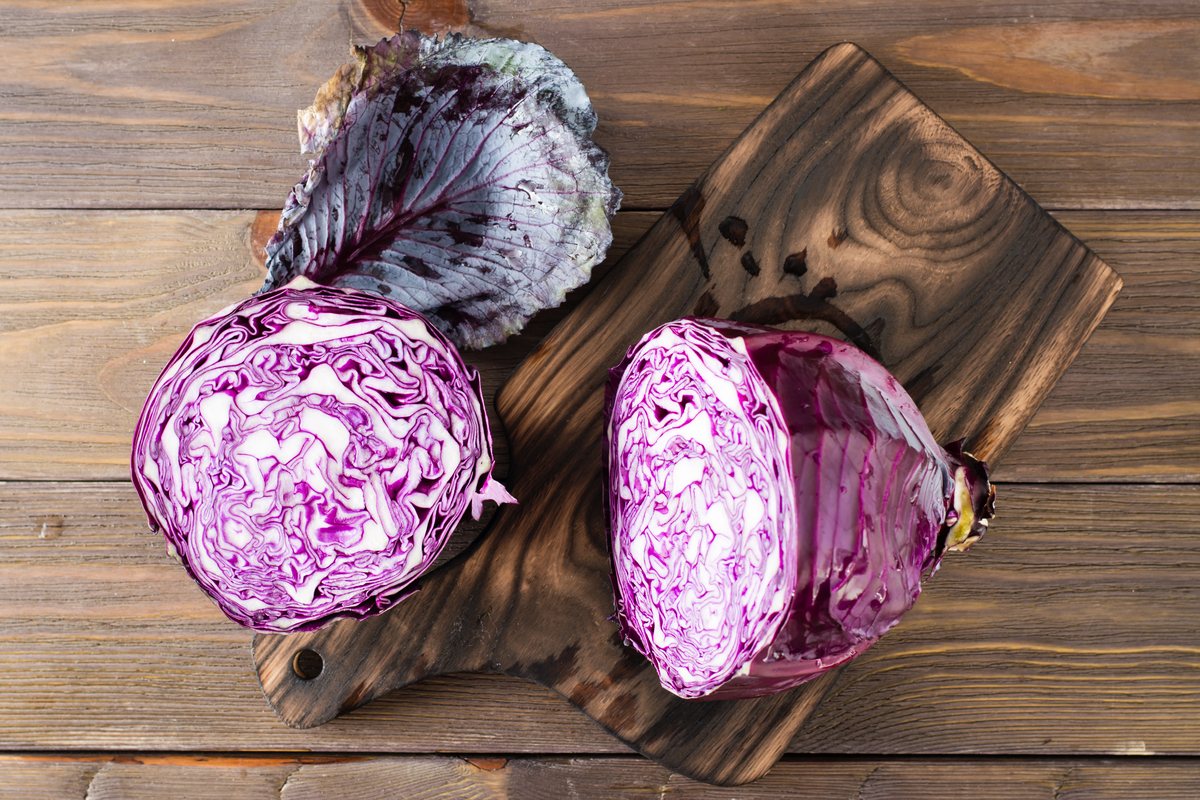
Whether you call it red cabbage or blue cabbage depends on how it is cooked - with acid it turns red, without it blue.
Red cabbage, like white cabbage, is a cultivated variety of wild cabbage with a high anthocyanin content. It has been known in Central Europe since the Middle Ages and was long valued as a medicinal and winter vegetable. In the south, where it was traditionally cooked without much acid, it is called blue cabbage; in the north, where vinegar and apples are added, it is called red cabbage.
The color change is a chemical phenomenon: anthocyanins alter their structure depending on the acidity. Red cabbage juice is therefore used as an indicator in schools – red in acidic conditions, violet in neutral conditions, and blue to green in alkaline conditions.
To useWhat red cabbage does for you
Red cabbage provides approximately 57 mg Vitamin C per 100 g - significantly more than white cabbage - plus vitamin K, vitamin B6, potassium, fiber and plenty Anthocyanins. With approximately 31 kcal per 100 g, it is light.
Like all cabbages, it contains Glucosinolate, which are converted into isothiocyanates when cut and chewed. The combination of anthocyanins and glucosinolates makes red cabbage one of the winter vegetables richest in polyphenols; observational studies link a high cabbage intake to a lower risk of some cancers.
Classic red cabbage with apples, high in sugar and cooked for a long time, retains less vitamin C than a briefly braised or raw red cabbage salad. The anthocyanin red color remains more stable with acidity.
IngredientsThis is what's in red cabbage
Red cabbage contains Vitamin C, Vitamin K, vitamin A (as beta-carotene), folate, potassium, fiber and Anthocyanins - Predominantly acylated cyanidin glycosides, which are comparatively heat- and light-stable. Also present are glucosinolates such as glucoraphanin and sinigrin.
The anthocyanins leach into the water during cooking - therefore, it is better to braise or steam red cabbage than to boil it in a lot of water.
Enhanced combinationsWhat makes red cabbage stronger
Red cabbage needs acidity, sweetness and spices - and not too much heat.
Acid keeps it bright red and stabilizes the anthocyanins.
The classic red cabbage seasoning.
Finely grated, salted, kneaded, with vinegar, oil and walnuts - maximum vitamin C.
Fat carries the spices and rounds out the flavor.
A handful of cranberries instead of lots of sugar.
For cabbage-related bloating.
What contradicts itselfIt's best to avoid these combinations.
Anthocyanins and vitamin C get into the water.
Ready-made red cabbage is often heavily sweetened.
Lye turns it blue-green - and destroys vitamins.
Cabbage causes bloating - increase the amount slowly, add caraway seeds.
Vitamin K evenly distributed.
Anthocyanins cause coloring - lemon juice helps.
In the kitchenWhere he belongs
- Apple red cabbageWith apples, onions, cloves, and bay leaves.
- Red cabbage saladRaw with walnuts and apple.
- Red cabbage and orange saladWith orange segments and pomegranate.
- Red cabbage with gooseThe feast.
- Red cabbage soupWith beetroot.
- red coleslawWith carrot and yogurt.
- Oven-baked red cabbageRoasted in wedges with balsamic vinegar.
- InsertedAs pickles for burgers and bowls.
- Red cabbage smoothieWith apple and berries.
- Red cabbage wrapsLeaves as a covering.
As a home remedyRaw red cabbage salad for winter
Red cabbage, apple and walnut salad
- Finely shred a quarter of a red cabbage, knead vigorously with a pinch of salt for 5 minutes.
- Cut an apple into thin strips, roughly chop a handful of walnuts.
- Mix 2 tablespoons of apple cider vinegar, 2 tablespoons of oil, one teaspoon of mustard and a little honey to make a dressing.
- Mix everything together and let it sit for 20 minutes.
A dose of vitamin C and polyphenols in winter, when fresh fruit is scarce: raw fruit retains the vitamin C, the acid stabilizes the anthocyanins, and the walnuts provide omega-3.
As a side dish or light meal. Keeps for two days in the refrigerator.
Ayurveda & TCMWhat the old systems say
Ayurveda
In Ayurveda, red cabbage, like other types of cabbage, is considered cooling, dry and bloating - good for Pitta and Kapha, but only suitable for Vata when cooked with cumin, ginger and ghee.
Traditional Chinese Medicine
In Traditional Chinese Medicine (TCM) red cabbage (Zi Gan Lan) sweet and neutral to slightly cool. It is said to strengthen the spleen and stomach and relieve pain; its dark color is now associated with blood-nourishing properties.
Warning noticesWhen you should be careful
Please note
- Flatulence: Increase the intensity slowly, add caraway seeds.
- Blood thinners: Maintain a consistent level of vitamin K.
- Finished products: often heavily sweetened.
- Thyroid: Only very large quantities of raw ingredients are relevant in cases of iodine deficiency.
- Allergy: rarely.
This page provides information and does not replace medical advice. If symptoms persist, please consult a doctor.
Related to the topicRead on and cook along!
Shop links lead to our product pages; it is indicated there if a partner is involved.
SourcesWhat is this based on?
- Wiczkowski W, Szawara-Nowak D, Topolska J. Red cabbage anthocyanins: profile, isolation, identification, and antioxidant activity. Food Research International 2013; 51(1): 303–309.
- Higdon JV et al. Cruciferous vegetables and human cancer risk: epidemiological evidence and mechanistic basis. Pharmacological Research 2007; 55(3): 224–236.
- Wallace TC, Giusti MM. Anthocyanins. Advances in Nutrition 2015; 6(5): 620–622.
- Aune D et al. Fruit and vegetable intake and the risk of cardiovascular disease, total cancer and all-cause mortality - a systematic review and dose-response meta-analysis of prospective studies. International Journal of Epidemiology 2017; 46(3): 1029–1056.
- USDA FoodData Central: Cabbage, red, raw.