
OriginThe key to heaven – and a case for nature conservation
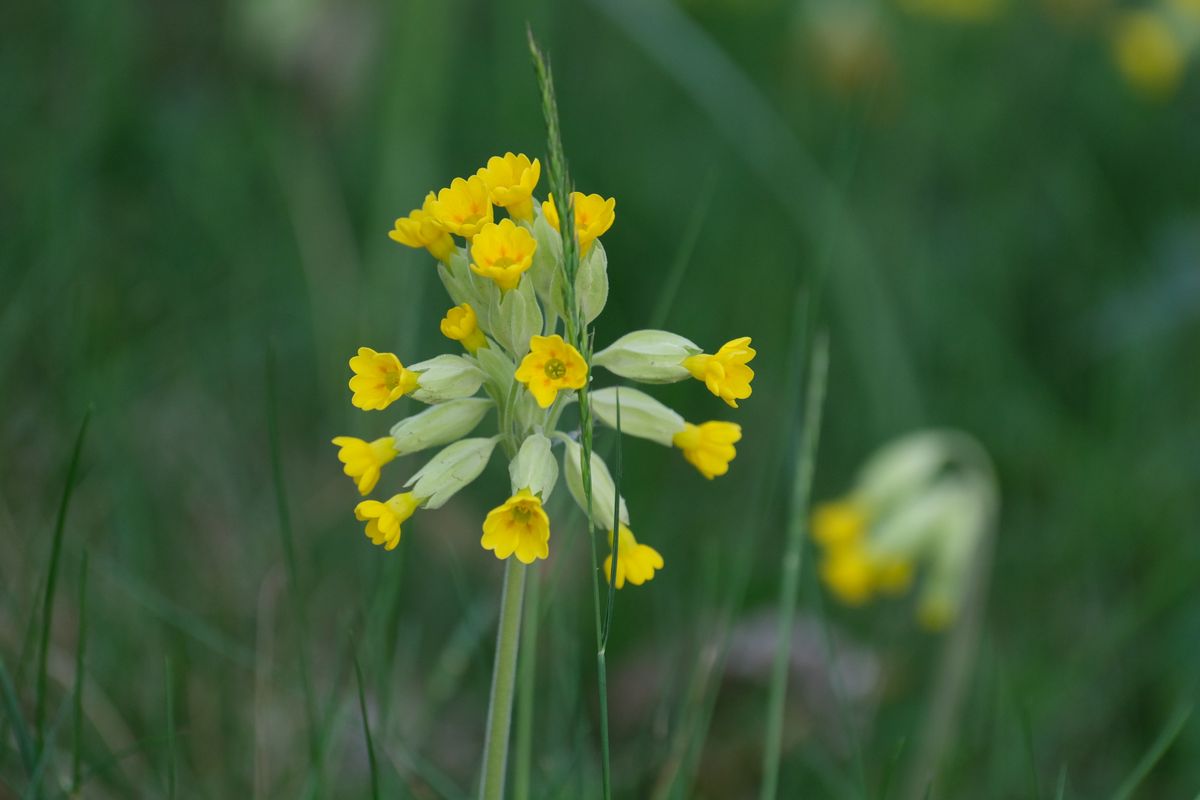
Hardly any plant is surrounded by so many legends and at the same time so specifically protected as the primrose.
The name derives from its shape: the nodding yellow blossoms hang from a stem like a bunch of keys. Christian legend attributes this to the key of St. Peter, which fell from his hand and caused the first primrose to grow where it touched the ground. Older Germanic traditions know it as the key of the goddess Freya, with which the earth is unlocked in spring. Both stories point to the same thing: the primrose is one of the first flowers in the meadow and marks the transition from winter to the new year.
Botanically, two species must be distinguished. The true primrose (cowslip) Primula veris The cowslip (also called meadow primrose) has a bulbous, light green calyx, egg-yolk yellow flowers with orange spots in the throat, and is fragrant. The oxlip (also called primrose) Primula elatior It has a closely fitting calyx, paler, odorless flowers, and tends to grow in damp woodland. Both are medicinally usable, but P. veris This is the stronger variety, and the one to which the monographs refer. The garden primroses from the garden center are something completely different and don't belong in tea.
The most important point first, because it might otherwise be overlooked: the cowslip is a specially protected species in Germany under the Federal Species Protection Ordinance. Its populations have declined sharply due to fertilization and the conversion of nutrient-poor meadows. Wild populations must not be dug up or picked – digging up the root would kill the plant anyway. Medicinal products come from cultivation, primarily from Southeast Europe and Turkey. Those who want to harvest their own can grow it in their own garden; it is perennial, undemanding, and can be divided after three to four years.
To useA true expectorant - with a verifiable mechanism
The primrose is one of the few cough remedies whose efficacy is not only claimed but plausibly described. The European Medicines Agency lists both the root and the flower as traditional use bei Husten in Verbindung mit Verkühlung, die Kommission E hat eine positive Monographie als Expektorans ausgestellt. Sie ist außerdem Bestandteil eines der meistverkauften pflanzlichen Verkühlungspräparate in Deutschland, dessen Fünf-Kräuter-Kombination in mehreren kontrollierten Studien bei akuter Rhinosinusitis untersucht wurde.
The mechanism involves the stomach. The triterpene saponins in the root mildly irritate the gastric mucosa, and this irritation reflexively triggers increased secretion in the bronchi via the vagus nerve. This thins the thick mucus, making it easier to cough up. This is called an expectorant reflex, and it explains two things at once: why primrose actually has an effect, and why some people experience stomach discomfort or nausea from it. Both the effect and the side effect have the same origin.
Additionally, saponins have a surfactant property – they lower surface tension, similar to soap, which directly promotes the loosening of thick secretions. This can be measured in laboratory tests. Whether this direct effect plays a role when drinking tea or whether the reflex pathway alone is responsible is not yet fully understood. For practical purposes, this is irrelevant: what matters is that the cough becomes more productive.
Eine ehrliche Einordnung gehört dazu. Die Studien zu Schlüsselblume als Einzelpflanze sind alt und methodisch schwach; die guten Untersuchungen betreffen die Kombinationspräparate, in denen sie nur eine von mehreren Komponenten ist. Eine Verkühlung dauert mit und ohne Schleimlöser etwa gleich lang. Was ein Schlüsselblumentee leisten kann, ist, dass das Abhusten weniger anstrengend wird und die Nächte ruhiger. Das ist ein reales, spürbares Ziel - und es ist kein Heilversprechen.
IngredientsSaponins, salicylates and a delicate fragrance
The root of the primrose contains five to ten percent triterpene saponins, formerly known collectively as primulic acid and now called primulasaponins. This is a high concentration—for comparison, licorice root contains a similar amount, while most other cough herbs contain significantly less. This concentration is the reason for both its effectiveness and its sensitivity to the stomach; one cannot exist without the other.
Of particular interest are the phenolic glycosides primverin and primulaverin, which are bound in the fresh root. During drying, enzymes break them down, producing, among other things, methyl salicylate – the substance responsible for the characteristic wintergreen or plaster odor. Fresh root has hardly any smell, dried root a distinct one. This smell is a useful test for freshness: drug products that smell of nothing at all are old or have been dried improperly.
The flowers contain significantly fewer saponins, but flavonoids and carotenoids, and a pleasant honey-like fragrance. Primula veris from P. elatior The difference lies in the flowers. In tea blends, they are therefore primarily a matter of appearance and taste; those seeking the expectorant effect need the root. Commercially available cough teas often contain both and do not always declare the proportions.
A word about allergies: The notorious "primrose allergy", a contact dermatitis caused by primin, originates from the primrose (Primula perfoliatum). Primula obconica from a houseplant. Primula veris It contains little to no primin. Therefore, if you get itchy hands when repotting primroses, you don't necessarily have to forgo primrose tea – but it's still a good idea to be cautious.
Enhanced combinationsThe classic partners in cough tea
Primrose is the driving force in a cough mixture. Good partners are those that counteract it – those that soothe the irritated throat, while the root loosens the mucus.
The standard combination: Thyme provides essential oil and antispasmodic properties, while primrose loosens mucus. Together, they cover a stubborn, troublesome cough much better than either one alone.
While the saponins irritate and loosen mucus, the plantain's mucilage coats the sore throat. This makes the mixture more bearable, especially if the cough has persisted for several days.
Fennel soothes stomach irritation thanks to its saponins and also has a mild expectorant effect. Anyone who experiences pressure when using primrose should try this combination before giving up on the plant altogether.
For evening tea: Linden blossoms provide mucilage and a diaphoretic component, while primrose helps loosen secretions. Drink warm, one hour before bedtime.
The five-herb combination of well-known sinusitis preparations targets precisely this issue: primrose, gentian, elderberry, sorrel, and vervain. This is the mixture with the strongest body of research.
Honey on tea cooled below 40 degrees is not an addition, but a measure in itself: For children's coughs, honey is one of the few proven effective remedies - from one year of age, not younger.
What contradicts itselfIt's best to avoid these combinations.
The effect is achieved through stomach irritation. If you have gastritis, reflux, or a stomach ulcer, this is not a good idea – in these cases, opt for mucilage-containing cough herbs such as marshmallow or ribwort plantain.
Primula veris It is specially protected. Picking or digging up wild populations is prohibited and harms an already declining species. Medicinal products come from cultivation, or you can grow them yourself in your own garden.
The colorful primroses from the garden center are cultivated varieties of other species and some contain primin. They do not belong in tea, nor do the flowers.
Using an expectorant on a cough without phlegm will make it worse, not better. For a barking, irritating cough without expectoration, mucolytic medications are the right choice.
Giving an expectorant and a cough suppressant at the same time is counterproductive: the loosened mucus needs to be coughed up. If a cough suppressant is necessary, then it should be given alone and in the evening.
There is insufficient data for children under four years old, and coughs at this age should always be investigated. For older children, ask at the pharmacy for age-appropriate preparations.
ApplicationWhat is possible with the blossoms – without endangering the population
- Flower syrupFrom the blossoms of your own garden plants: combine with sugar and lemon to make a light yellow, honey-like syrup for water and sparkling wine.
- Candied flowersCoated with egg white, rolled in fine sugar and dried - as cake decoration in spring.
- Spring saladScatter individual blossoms over the salad. The taste is mildly sweet, the effect primarily visual.
- herbal lemonadeSteep the blossoms together with woodruff and lemon in cold water - this results in a delicate, floral drink.
- Flower vinegarSteep blossoms in light wine vinegar for two weeks. It absorbs the fragrance better than oil.
- Root decoctionThe actual application: 1 to 2 g of dried root per cup, simmer gently for ten minutes, strain.
- Cough tea mixtureRoot with equal parts thyme and ribwort plantain as a storage mixture in a screw-top jar.
- Evening infusionFlowers with linden blossoms, warm one hour before bedtime - mild, more calming than relaxing.
- Honey starterPlace fresh blossoms in liquid honey, let it steep for two weeks, then strain through a sieve.
- Garden propagationDivide the rootstock after three to four years - this is how you can legally and permanently obtain your own material.
As a home remedyThe root is decoctionated – not infused.
Primrose root as a decoction
- Weigh out 1 to 2 grams of dried, finely chopped root from a store – about a level teaspoon. Leave wild plants undisturbed; the species is specially protected.
- Start with a cup of cold water and slowly bring to a boil. Saponins from the hard root are only released when boiled – an infusion alone is not enough.
- Simmer gently for ten minutes over low heat, covered. A visible foam will form on the surface; this is due to the saponins and is a good sign.
- Strain and drink lukewarm, two to three times a day. Always with or directly after a meal – on an empty stomach, the decoction is significantly more irritating.
- Those who find the soapy, scratchy taste difficult to tolerate can add fennel or anise to the decoction and stir in honey after it has cooled to drinking temperature.
- If you experience stomach pain or nausea, halve the amount or switch to a cough remedy containing mucilage. This is not a matter of getting used to it.
Für festsitzenden, zähen Husten im Rahmen einer Verkühlung, wenn der Schleim schwer abzuhusten ist. Nicht bei trockenem Reizhusten - dort macht ein Schleimlöser die Sache schlimmer.
Two to three cups daily for a maximum of two to three weeks. If the cough persists for longer than three weeks, if blood or fever develops, or if breathing becomes difficult, it should be checked by a doctor – without further delay.
Ayurveda & TCMWhat the old systems say
Ayurveda
The primrose is a Central European meadow plant and is not used in Ayurveda. Its role—as a saponin-based expectorant that loosens thick mucus—is taken over by other plants, such as... Vasa (Adhatoda vasica) and licorice, which is also rich in saponins and in the KaphaTreatment of the respiratory tract has a firm place. Transferring the primrose into Ayurvedic categories, as is sometimes read, are modern constructs.
Traditional Chinese Medicine
Traditional Chinese Medicine also uses this concept. Primula veris not represented. For what the primrose does – „transform mucus and soothe coughs“, in the systematics hua tan zhi ke - are their own drugs available there, for example? Jie Geng (Platycodon root), which is also rich in saponins and whose mode of action is described as remarkably similar. Two traditions have independently arrived at the same pharmacological solution here.
Warning noticesWhen you should be careful
Please note
- A particularly protected species: Primula veris It must not be picked or dug up in nature. Use only commercially available produce or produce from your own garden.
- Stomach sensitivity: The effect is based on stomach irritation. Primrose is unsuitable for gastritis, reflux, or stomach ulcers – marshmallow or ribwort plantain are better choices in these cases.
- Not suitable for dry, irritating coughs: An expectorant without mucus will only worsen the irritation. For a barking cough without phlegm, switch to mucilage-rich plants.
- Children under four years of age: Insufficient data available. Coughs at this age should be medically evaluated before any medication is administered.
- Pregnancy and breastfeeding: The EMA advises against its use due to a lack of data. This is not a known danger, but rather a gap in the data – and a reason to consider other cough remedies during this time.
- Warning signs: A cough lasting longer than three weeks, blood in the sputum, high fever, shortness of breath, or weight loss are not reasons to drink tea. See a doctor promptly.
This page provides information and does not replace medical advice. If symptoms persist, please consult a doctor.
Related to the topicRead on and cook along!
Shop links lead to our product pages; it is indicated there if a partner is involved.
SourcesWhat is this based on?
- European Medicines Agency, HMPC: Community herbal monograph on Primula veris L. et Primula elatior (L.) Hill, radix - traditional use.
- Commission E, Monograph „Primulae radix“ and „Primulae flos“, BAnz 1990.
- Federal Agency for Nature Conservation: Federal Species Protection Ordinance, Annex 1 - specially protected species, entry Primula veris.
- Jund R. et al.: Clinical efficacy of a dry extract of five herbal drugs in acute viral rhinosinusitis. Rhinology 2012.
- Blaschek W. (ed.): Wichtl - Herbal Drugs and Phytopharmaceuticals, Chapter Primulae radix.


