
Turnip (Brassica napus subsp. rapifera)
OriginFrom emergency food to winter vegetables
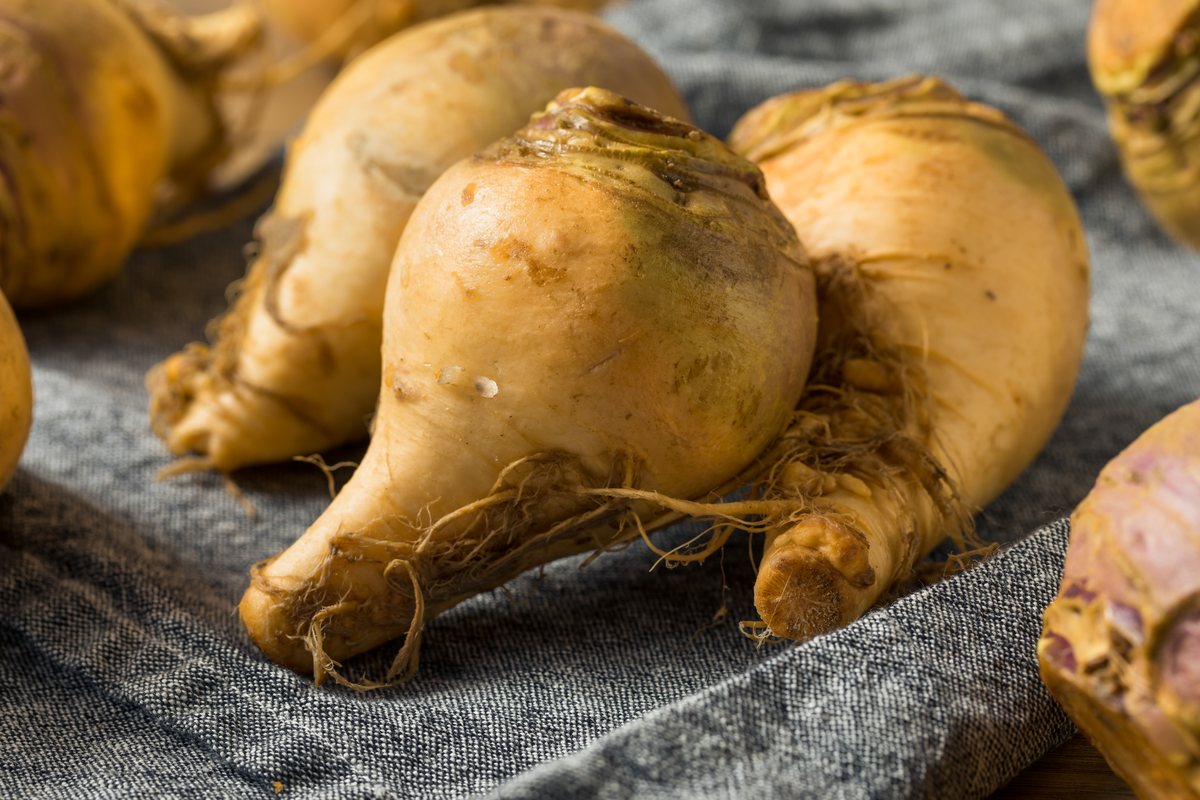
The swede is the offspring of two parents: it originated from a cross between cabbage and turnip rape.
Botanically, the swede belongs to the rapeseed family (Brassica napusThe variety with the thick storage root was likely selected in Northern Europe during the Late Middle Ages; from Scandinavia it came to Great Britain, where it is still called "swede". In Scotland, "neeps" are an ingredient in haggis, while in Northern Germany they are known as turnips, rutabaga, or butter turnips.
Ihren schlechten Ruf verdankt sie dem Ersten Weltkrieg. Nach der Seeblockade und einer katastrophalen Erdapfelernte 1916 mussten Steckrüben im „Steckrüben-“ oder „Kohlrübenwinter“ 1916/17 die Erdapfel ersetzen - als Suppe, Brot, Marmelade und sogar Kaffee-Ersatz. Satt machten sie kaum, die Tageszufuhr vieler Menschen fiel unter 1.000 Kilokalorien. Die Generation danach wollte keine Steckrübe mehr sehen. Heute kehrt sie als regionales Wintergemüse in Bioläden und Restaurantküchen zurück.
To useWhat the turnip can do for you
100g of raw swede provides only about 37 kcal, but around 25 mg of vitamin D. Vitamin C, approximately 300 mg potassium and about 2.3 g Dietary fiber. Even when cooked, a good portion of the vitamin C is retained, especially if the fruit is cooked in a small amount of water or eaten in a stew with the broth. In winter, when fresh fruit was scarce, it was therefore an important source of vitamin C.
Like all brassicas, the swede contains Glucosinolate (Mustard oil glycosides). When cut and chewed, these compounds are released into isothiocyanates and other breakdown products, which have been linked to protective effects on cells in laboratory and observational studies. However, a direct benefit of individual vegetables in humans has not been proven – it is more likely that the benefit lies in the regular consumption of cruciferous vegetables as a whole.
Weil sie kalorienarm ist und gut sättigt, eignet sich Steckrübe als leichtere Alternative zu Erdapfelpüree oder Pommes. Gelbfleischige Sorten bringen etwas Beta-Carotin mit, aber deutlich weniger als Möhren. Ein Wundermittel ist sie nicht - wohl aber ein ehrliches, heimisches Wintergemüse mit kurzen Wegen.
IngredientsThis is what's in the turnip
The swede consists of approximately 89 percent water and contains carbohydrates (primarily sugars), fiber, some protein, vitamin C, vitamin B6, folate, potassium, calcium, magnesium, and phosphorus. It also contains glucosinolates such as progoitrin, glucobrassicanapin, and glucobrassicin; yellow varieties also contain carotenoids.
The slightly cabbage-like taste comes from the mustard oils. These are located close to the skin – that's why the swede is peeled thickly; when cooked, it becomes milder and sweeter.
Enhanced combinationsWhat makes the swede stronger
The swede loves fat, spices, and company in the pot.
It rounds things off and helps with beta-carotene.
The classic North German mix.
Makes the puree smooth.
It brings freshness to vegetables.
Turn the stew into a meal.
For swede fries.
What contradicts itselfIt's best to avoid these combinations.
The outer layer tastes sharp and woody.
Otherwise it will overcook and become watery.
Vitamin C migrates into the cooking water.
Smaller ones are more delicate.
Progoitrin can interfere with iodine uptake.
Otherwise it will become soft and wrinkled.
In the kitchenWhere she belongs
- Turnip stewMit Erdäpfel, Möhren und Kümmel.
- mashed turnipsWith butter and nutmeg.
- Swede friesFrom the oven, with rosemary.
- ClapshotSchottisch mit Erdäpfel und Schnittlauch.
- Raw vegetable saladFinely grated with apple.
- SoupPureed with ginger.
- Oven-roasted vegetablesWith parsnip and beetroot.
- GratinWith cream or oat cream.
- RotmosMecklenburgian style with carrots.
- curryDiced with chickpeas.
As a home remedyWarming swede turnip mash
mashed turnips
- 500 g Steckrübe und 300 g mehligkochende Erdäpfel schälen und würfeln.
- Cook covered in a little salted water or broth for 15 to 20 minutes until tender.
- Do not discard the cooking water, but add it to the beets along with a piece of butter or a dash of rapeseed oil.
- Roughly pound everything, season with nutmeg, pepper and a little chives.
A light, easily digestible winter dish that keeps you warm and full. Eating the cooking water helps retain more vitamin C and potassium.
A large portion can be served as a side dish or main course. Those prone to bloating should start with smaller amounts and cook some caraway seeds with it.
Ayurveda & TCMWhat the old systems say
Ayurveda
The swede is not described in classical Ayurveda. According to modern classification, when cooked it is considered sweet, grounding and slightly cooling – balancing for Pitta; best eaten warm and with fat for Vata, and with hot spices for Kapha.
Traditional Chinese Medicine
In classical Traditional Chinese Medicine (TCM), the swede plays no role. In Western TCM nutritional theory, it is classified, like other root vegetables, as neutral to slightly cooling and sweet, and is said to strengthen the digestive system.
Warning noticesWhen you should be careful
Please note
- Thyroid: If you have an iodine deficiency or thyroid disease, do not eat raw cabbage and turnip vegetables in very large quantities; cooked, they are fine.
- Flatulence: Like other members of the cabbage family, it can cause bloating - cook it with caraway or fennel.
- Potassium: If you have kidney disease and potassium restriction, consult your doctor about the amount.
- Anticoagulants: Cruciferous vegetables contain vitamin K; if you have vitamin K antagonists, eat a consistent diet instead of fluctuating wildly.
- Storage: Generously cut away rotten or moldy parts, and dispose of heavily infested beets.
This page provides information and does not replace medical advice. If symptoms persist, please consult a doctor.
Related to the topicRead on and cook along!
Shop links lead to our product pages; it is indicated there if a partner is involved.
SourcesWhat is this based on?
- USDA FoodData Central: Rutabagas, raw.
- Scriba A. The „turnip winter“ of 1916/17. LeMO - Living Museum Online, German Historical Museum.
- Cartea ME, Velasco P. Glucosinolates in Brassica foods: bioavailability in food and significance for human health. Phytochemistry Reviews 2008 (online 2007): 213–229.
- Federal Centre for Nutrition (BZfE): Turnip makes a comeback. Meldung, Jänner 2025.


